Clear Sky Science · en
Electrohydrodynamic printed ultra-high performance liquid metal strain sensor
Stretchable Wires That Feel Every Move
Imagine a soft, elastic band that can feel the tiniest bend of your finger or the faint throb of your pulse, all without breaking or losing contact. This paper introduces a new way to print ultra-thin, liquid metal wires that act like nerves for future wearable gadgets, smart clothing, and soft robots—combining the conductivity of metal with the stretchiness of rubber.
Why Liquid Metal Is Special
Most electronics are built from rigid metals and hard chips, which do not mix well with bending elbows or stretching skin. Liquid metals, which are fluid at room temperature yet conduct electricity almost as well as solid metals, offer a way out of this mismatch. They can stretch, twist, and deform along with flexible materials, making them ideal building blocks for next-generation wearable sensors and human–machine interfaces. Until now, though, it has been difficult to draw liquid metal into extremely fine, precise lines without leaks, rough edges, or complicated molds, limiting how densely such devices can be packed and how sensitively they respond.
Printing Metal with Electricity
To tackle this challenge, the researchers use a technique called electrohydrodynamic printing, which harnesses an electric field to pull a tiny jet of special liquid metal ink out of a fine needle and onto a soft plastic surface. By tuning the voltage, ink flow, and motion of the underlying surface, they can draw continuous liquid metal microwires between 30 and 300 micrometers wide—thinner than a human hair—over lengths of several meters, all with a single nozzle. Because the wires are laid down directly where they are needed and later fully sealed between flexible plastic films, the risk of trapped bubbles or leaks, common in hollow-channel methods, is greatly reduced. 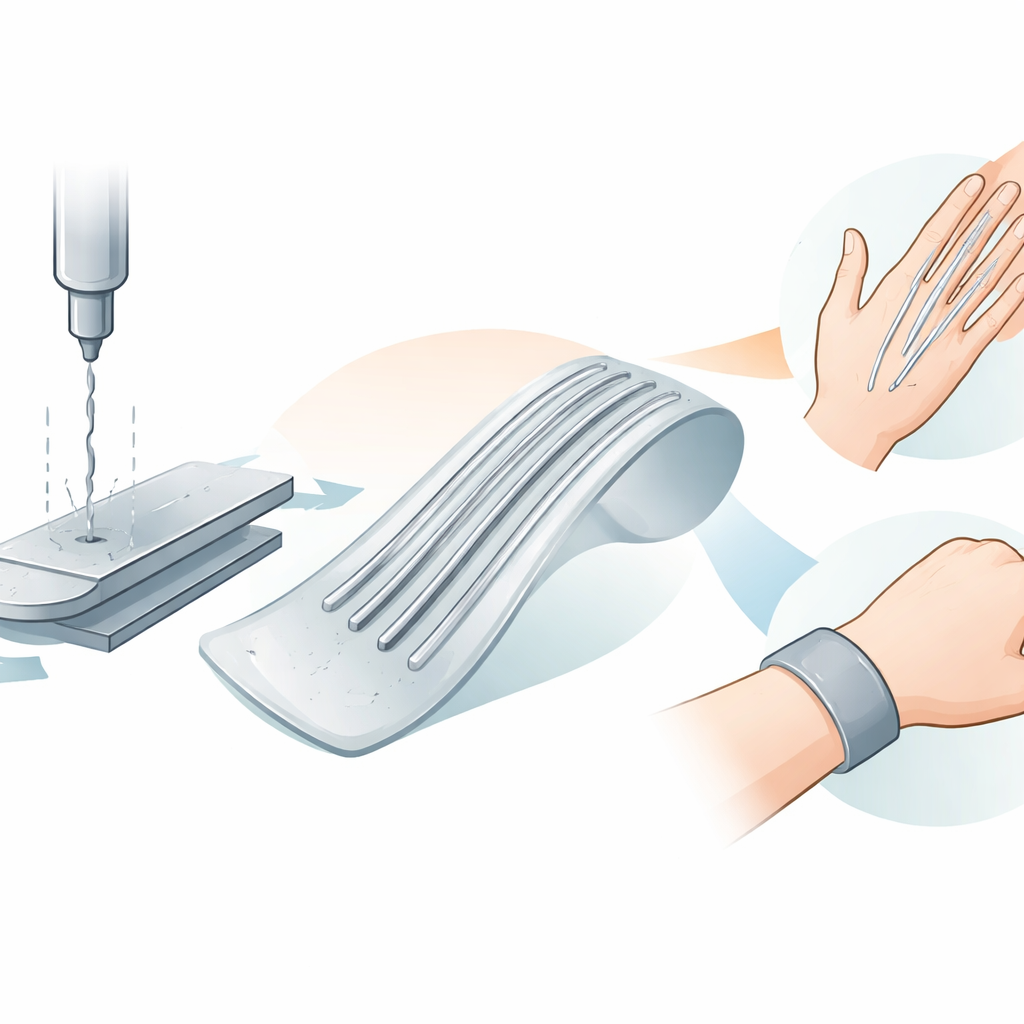
Hidden Metal Beads That Wake Up When Stretched
The key to this printable ink lies in its microscopic structure. Instead of a smooth pool of liquid metal, the team disperses tiny droplets of a gallium–indium alloy inside a supporting fluid, along with polymer and plastic particles that help hold everything in place. Each droplet is wrapped in a thin, solid skin made of metal oxide, which keeps the droplets from flowing together right away and makes the freshly printed wire almost non-conductive at first. When the flexible strip containing these droplets is stretched, however, the droplets deform and the rigid skins crack. The liquid metal inside then oozes out and links with its neighbors, forming continuous metallic pathways through the strip. Electron microscopes, computer simulations, and precise force measurements confirm this transition from isolated beads to connected, shiny threads of metal.
From Tiny Stretch to Tough Daily Use
Once activated, these liquid metal microwires behave as highly sensitive strain sensors. Because the wires are so thin, even a minute change in length—only 2 micrometers over a 2.5-centimeter span, corresponding to a strain of just 0.008%—produces a measurable shift in electrical resistance. As the strip is stretched further, up to three times its original length, the metal paths narrow and lengthen, and the resistance changes in a controlled, nearly linear fashion that follows basic electrical rules. Tests show that the wires can endure thousands of stretch–release cycles at large strains without breaking, leaking, or drifting in performance, and they remain stable for months. The soft plastic support can even be dissolved later so that the liquid metal can be recovered and reused, aligning with goals in recycling and resource efficiency. 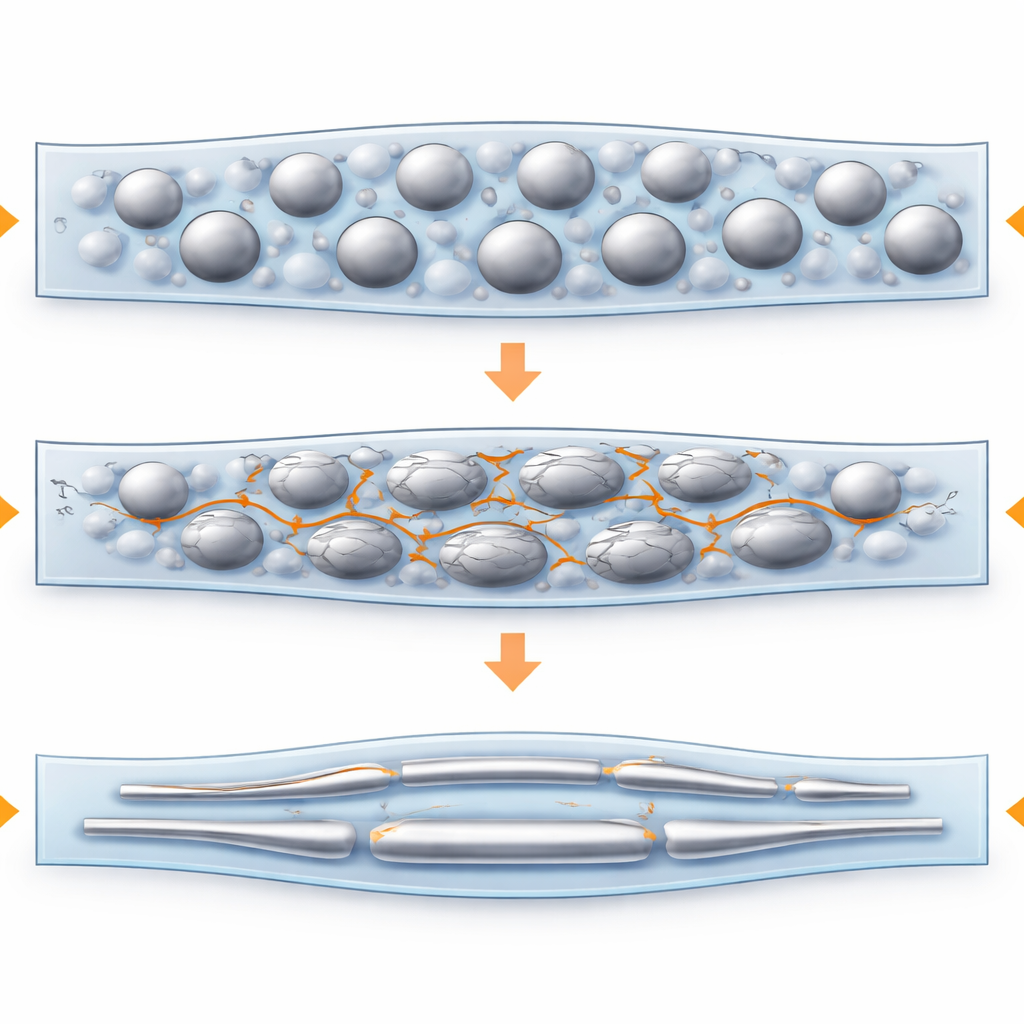
Hands That Speak and Skin That Listens
To show what these printed wires can do, the authors build simple devices that turn motion into signals. In one demonstration, five narrow sensors are fixed along the fingers of a hand. As each finger bends into different number gestures, the resistance of each wire changes in a distinct pattern that a small electronic board can read and send wirelessly. A robotic arm can then mirror the person’s hand shapes, suggesting future uses in remote control and virtual interaction. In another test, a single sensor gently strapped near the wrist tracks tiny expansions of the skin caused by the pulse. The changing electrical signal clearly reveals the different phases of a heartbeat and responds to faster, stronger pulses after exercise, showing that the sensor can capture both weak and dynamic strains on the body.
A Step Toward Smarter, Softer Electronics
In summary, this work presents a practical way to “draw” ultra-thin, long liquid metal wires with high precision and to turn them into extremely sensitive, durable, and recyclable stretch sensors. For a lay reader, the takeaway is that the researchers have brought us closer to electronics that move and feel like our own skin and muscles—devices that could one day help control robots as easily as moving a hand, or continuously monitor health signals without uncomfortable rigid hardware.
Citation: Chen, X., Feng, Y., Chen, K. et al. Electrohydrodynamic printed ultra-high performance liquid metal strain sensor. Microsyst Nanoeng 12, 145 (2026). https://doi.org/10.1038/s41378-026-01237-w
Keywords: liquid metal, flexible sensors, wearable electronics, strain sensing, soft robotics