Clear Sky Science · en
A cochlea bio-inspired tunable piezoelectric cantilever array MEMS microphone: comprehensive study
Listening Like the Inner Ear
Modern gadgets—from earbuds to smart speakers—depend on tiny microphones that turn sound into electrical signals. Yet our own inner ears still outperform most of these devices, especially when it comes to picking out faint sounds in noisy, ever‑changing environments. This paper describes a new chip-scale microphone inspired directly by the mechanics of the human cochlea, the spiral organ in our inner ear, promising future hearing aids and sensors that can "tune" themselves much like natural hearing does.
From Ear Spiral to Tiny Beams
In the mammalian ear, incoming sound sets off waves along the basilar membrane inside the cochlea. Different spots along this membrane respond most strongly to different pitches, creating a built‑in frequency map: high tones peak near the base, low tones near the tip. The authors recreate this idea using an array of four microscopic cantilevers—slender beams of silicon—on a chip. Each beam is a slightly different length, so each one resonates best at a different sound frequency within the important speech band around 1.8 to 2.3 kilohertz. When sound pressure bends a beam, a special piezoelectric layer on top produces an electrical voltage, much as inner hair cells in the ear convert motion into nerve signals. 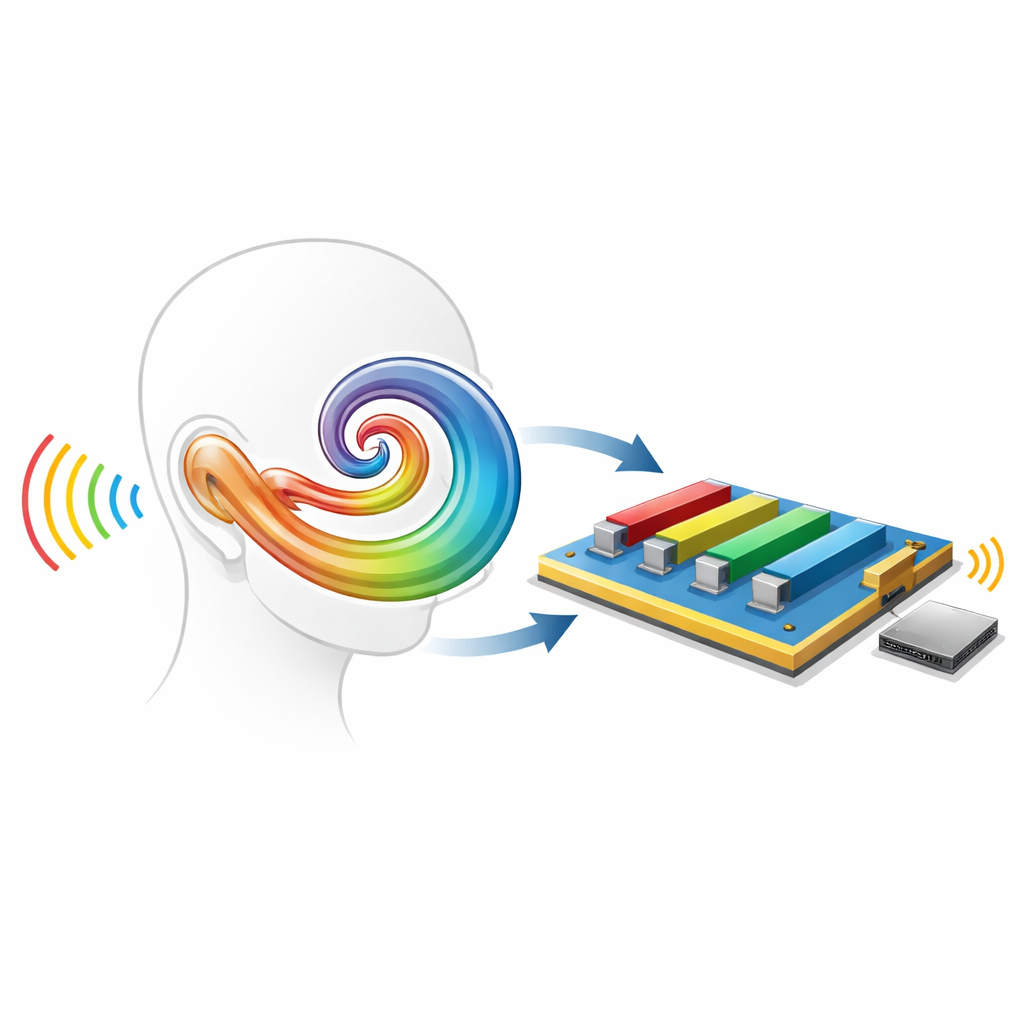
Borrowing the Ear’s Self-Adjusting Trick
Human hearing is not just a passive detector. Outer hair cells in the cochlea actively change their length in response to electrical signals, stiffening or loosening parts of the basilar membrane. This boosts sensitivity for very soft sounds and prevents overload for loud ones. The new microphone copies this self‑adjusting behavior using the same piezoelectric film that does the sensing. When an electric field is applied across selected electrodes on a beam, the film strains slightly, changing the beam’s effective stiffness. By driving this effect with an oscillating "pumping" signal, the researchers can increase or decrease how sharply the beam resonates—technically, its quality factor, or Q—without changing the physical structure.
Two Ways to Steer the Vibration
The device offers two distinct tuning routes. In the first, an electrical pumping signal is applied directly to the same beam that is listening to sound. This electrical energy, timed at specific relationships to the beam’s natural vibration frequencies, flows into or out of the motion of the beam. Depending on the pumping frequency and strength, the resonance peak can be narrowed and reduced (spreading sensitivity over a wider bandwidth) or, in other modes, sharpened under different conditions. In the second route, the design uses a subtle mechanical overhang so neighboring beams are weakly linked. Driving one beam electrically can then feed energy through this coupling into its neighbors, reshaping how energy is shared across the array and further adjusting how sharply each beam responds to sound. 
Measured Performance on a Chip
To test the concept, the team fabricated the microphone using standard semiconductor techniques: a silicon-on-insulator wafer, a thin aluminum nitride piezoelectric film, and patterned metal electrodes. In carefully controlled acoustic measurements, each beam showed its own resonant peak and a high sensitivity, converting small sound pressures into measurable voltages with low noise. Crucially, when the pumping signals were activated, the effective Q of a beam could be tuned over a wide range—from reducing it by more than half to nearly tripling it—while the resonant frequency itself stayed almost unchanged. This means the same tiny device can behave like a sharp tone filter when needed, or like a broader, more forgiving listener in other situations.
Why This Matters for Future Hearing
For everyday users, the main takeaway is simple: this microphone can adapt. In quiet settings it could act like our outer hair cells, sharpening select frequencies to pull weak sounds out of the background. In loud or unpredictable environments, it could deliberately broaden its response to avoid overload and capture more context. Because the device is built with chip‑friendly materials and techniques, it can, in principle, be integrated with on‑board electronics and smart algorithms to form a closed‑loop, ear‑like sensing system. While the current prototype focuses on a narrow speech‑related band, the same design principles could be extended across the full range of human hearing. The result could be a new generation of hearing aids, cochlear implants, and intelligent acoustic sensors that listen more like we do—tuning themselves in real time to the sounds that matter most.
Citation: Zheng, Z., Ke, Q., Luo, H. et al. A cochlea bio-inspired tunable piezoelectric cantilever array MEMS microphone: comprehensive study. Microsyst Nanoeng 12, 112 (2026). https://doi.org/10.1038/s41378-026-01232-1
Keywords: bio-inspired microphone, piezoelectric MEMS, cochlea-inspired sensor, hearing aids, tunable resonator