Clear Sky Science · en
Pre-snapback mode operation of CMUT for enhanced acoustic performance
Sharper sound pictures from safer ultrasound chips
Ultrasound scans are a mainstay of modern medicine, from checking a baby’s growth to guiding brain therapies. At the heart of each scanner is a tiny part that turns electricity into sound and back again. This study shows how a new way of driving a promising type of ultrasound chip can make images clearer and push sound deeper into the body, while still keeping the device stable and reliable for long-term use. 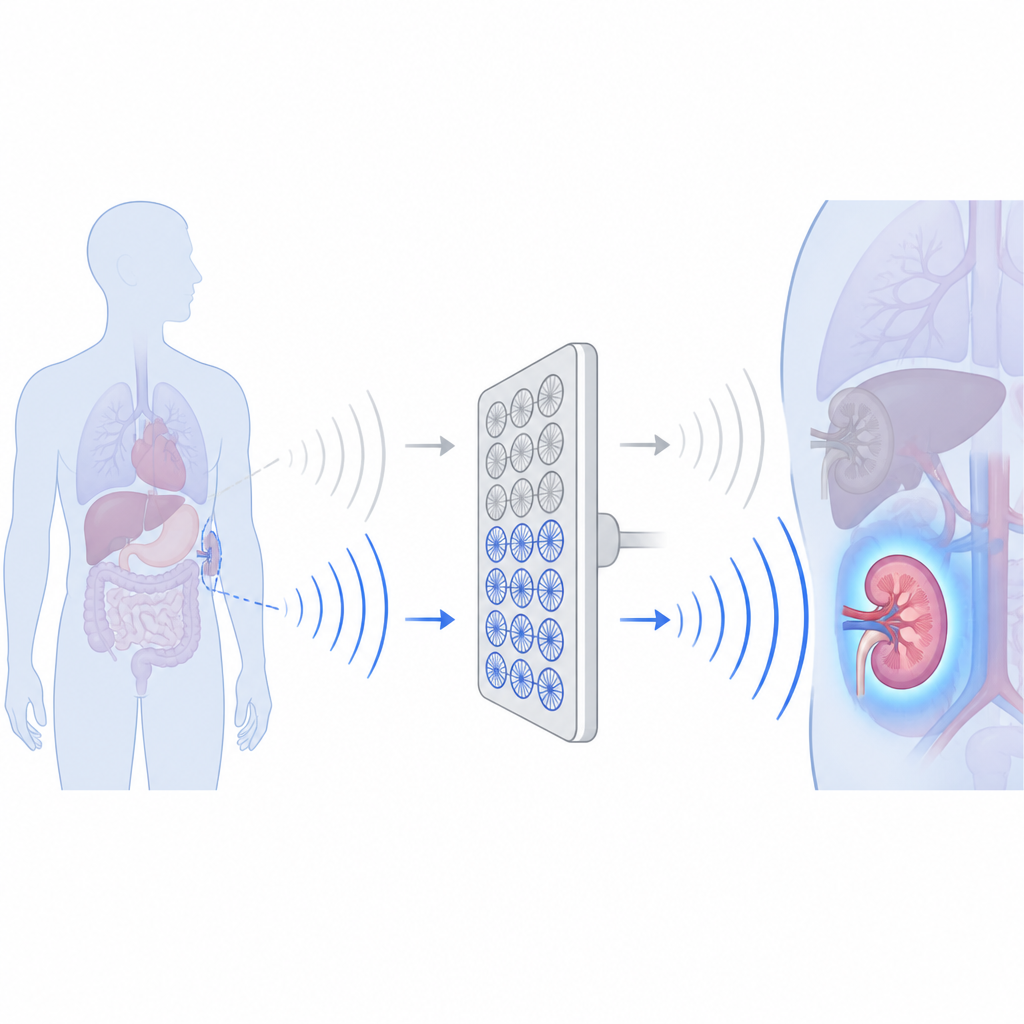
Why new ultrasound chips matter
Most hospital scanners today rely on crystals that squeeze and expand when a voltage is applied. These piezoelectric parts work well but can be hard to manufacture, often contain lead, and do not always pair easily with modern electronics. An alternative called a capacitive micromachined ultrasonic transducer, or CMUT, uses tiny vibrating membranes made with the same processes as computer chips. CMUTs offer broad frequency range, small size, and easy integration with circuitry, but their usual way of operating produces weaker sound than traditional crystal-based probes, which limits image sharpness and high-power treatments.
A sweet spot between weak and risky modes
In a CMUT, each membrane hovers above a cavity. A steady voltage pulls the membrane downward, and a small added signal makes it vibrate to send or receive sound. If the pull is too strong, the membrane suddenly snaps down onto the surface below, boosting sound output but raising the risk of electrical damage and long-term drift. The team focused on a little-used “pre-snapback” window, where the membrane has already touched down in the center but a ring-shaped outer area still moves freely. In this state the gap under the moving ring is smaller, which greatly strengthens the electrical force and sound output, yet the overall stress on the material and insulating layer stays much lower than in the fully collapsed, risky regime.
Designing the tiny drums for this special state
To exploit this sweet spot, the researchers built a detailed design playbook for each CMUT cell. Using equations and computer simulations, they studied how key dimensions such as membrane radius, thickness, cavity height, and insulation thickness change the voltage range over which the pre-snapback state exists and how efficiently electrical energy turns into sound. They found that smaller and thicker membranes, combined with a taller cavity and a thinner insulating film, widen the usable window and increase coupling. To explain why the pre-snapback state is so effective, they introduced a “donut-plate” model that treats only the free ring of the membrane as the vibrating part. This simple picture shows that the main boost in sound comes from the reduced gap under the moving ring, not from any exotic vibration pattern. 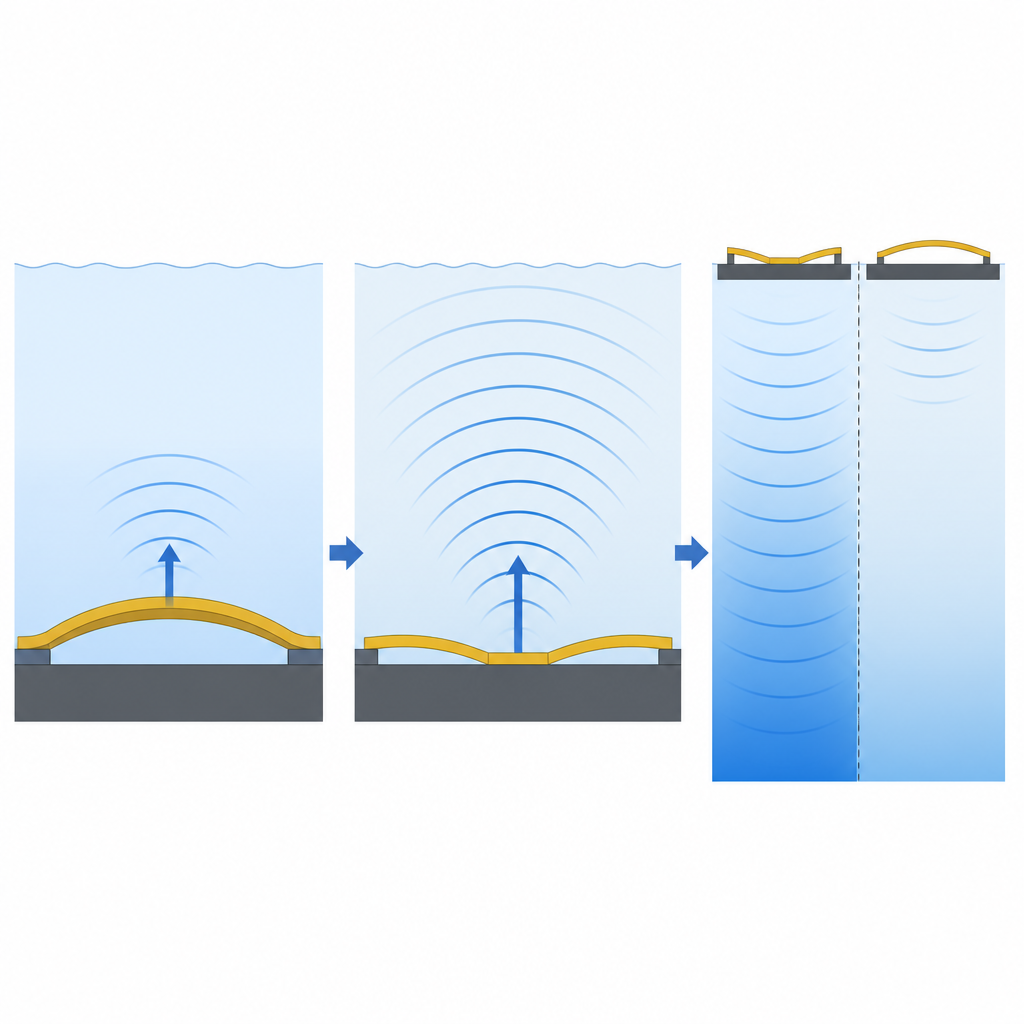
Building and testing real devices
The group then fabricated CMUT arrays using wafer bonding methods already compatible with chip factories and tuned the membrane thickness with a polymer coating. They measured how the devices’ resonance frequency and electrical properties shifted as the voltage was swept up and down, clearly identifying the transition into and out of the pre-snapback region. Laser measurements confirmed that in this mode the membrane center is clamped while the outer ring vibrates with larger motion than in conventional operation. Acoustic tests in water showed that, at the same bias conditions, the pre-snapback mode produced almost three times higher transmit sensitivity and nearly three times higher receive sensitivity. Importantly, long-term cycling and 24-hour endurance tests revealed only small changes in frequency and capacitance, indicating that this mode avoids the severe electrical charging and mechanical stress that plague deep collapse.
Clearer images and future possibilities
To connect these improvements to real-world use, the authors used a standard imaging system to perform B-mode scans of a wire phantom, comparing the normal and pre-snapback modes under identical drive conditions. The new mode delivered about eight times higher combined transmit–receive gain, giving stronger echoes and visibly deeper, higher-contrast images, including clearer signals from wires placed several centimeters away. While the devices were not yet optimized for the finest image resolution, the work shows that simply choosing a better operating state of a familiar CMUT structure can surpass commercial crystal-based probes. This approach could be scaled to high-frequency and flexible probes, opening the door to better diagnostics, therapy, and neuromodulation without sacrificing reliability.
Citation: Park, S., Oh, C., Lee, W. et al. Pre-snapback mode operation of CMUT for enhanced acoustic performance. Microsyst Nanoeng 12, 192 (2026). https://doi.org/10.1038/s41378-026-01228-x
Keywords: ultrasound imaging, CMUT, acoustic transducer, medical devices, neuromodulation