Clear Sky Science · en
Nano calligraphy via optical electro-aligning manipulation
Writing with the Smallest Possible Pen
Imagine using a single hair as a pen to draw intricate patterns, build tiny electronic circuits, or even gently steer living bacteria—without ever touching them. This paper describes a new way to do exactly that at the nanoscale. By combining light and electric fields in a clever way, the researchers can grab and steer ultra-thin wires and rod-shaped microbes as if they were strokes of ink, opening doors to future chips, sensors, and medical tools built one “nano-brushstroke” at a time.
Why Moving Tiny Wires Is So Hard
Thin, rod-like structures called nanowires are promising building blocks for next-generation technologies, from quantum light sources to ultrasensitive sensors and cellular probes. But there is a catch: to really use them, scientists must place each wire with nanometer-level precision while still being able to mass-produce complex patterns. Traditional optical tweezers—highly focused laser beams that can trap and move microscopic objects—struggle with these long, skinny shapes. Instead of holding them steady, the light tends to push the wires around and knock them out of the trap, especially when higher power is used, which can also cause heating and damage.
Guiding with Electric Fields, Grabbing with Light
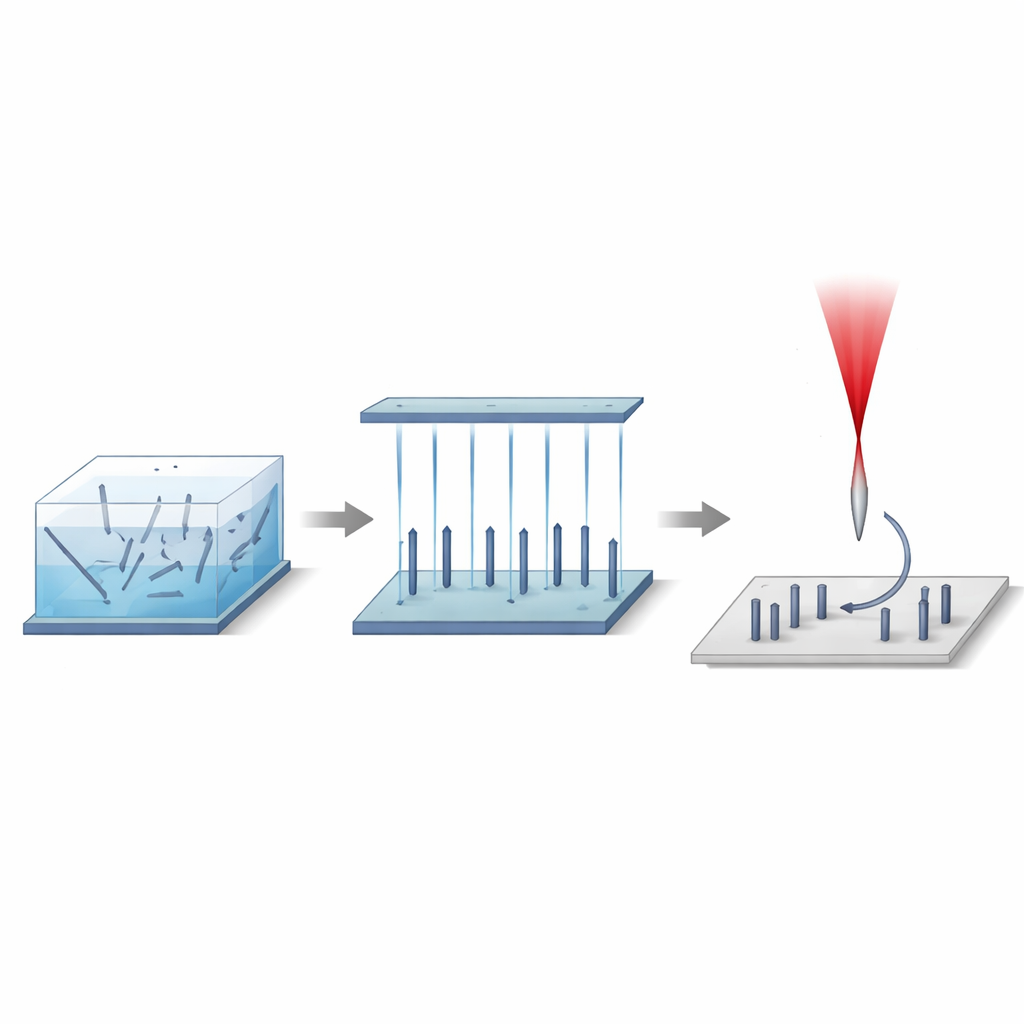
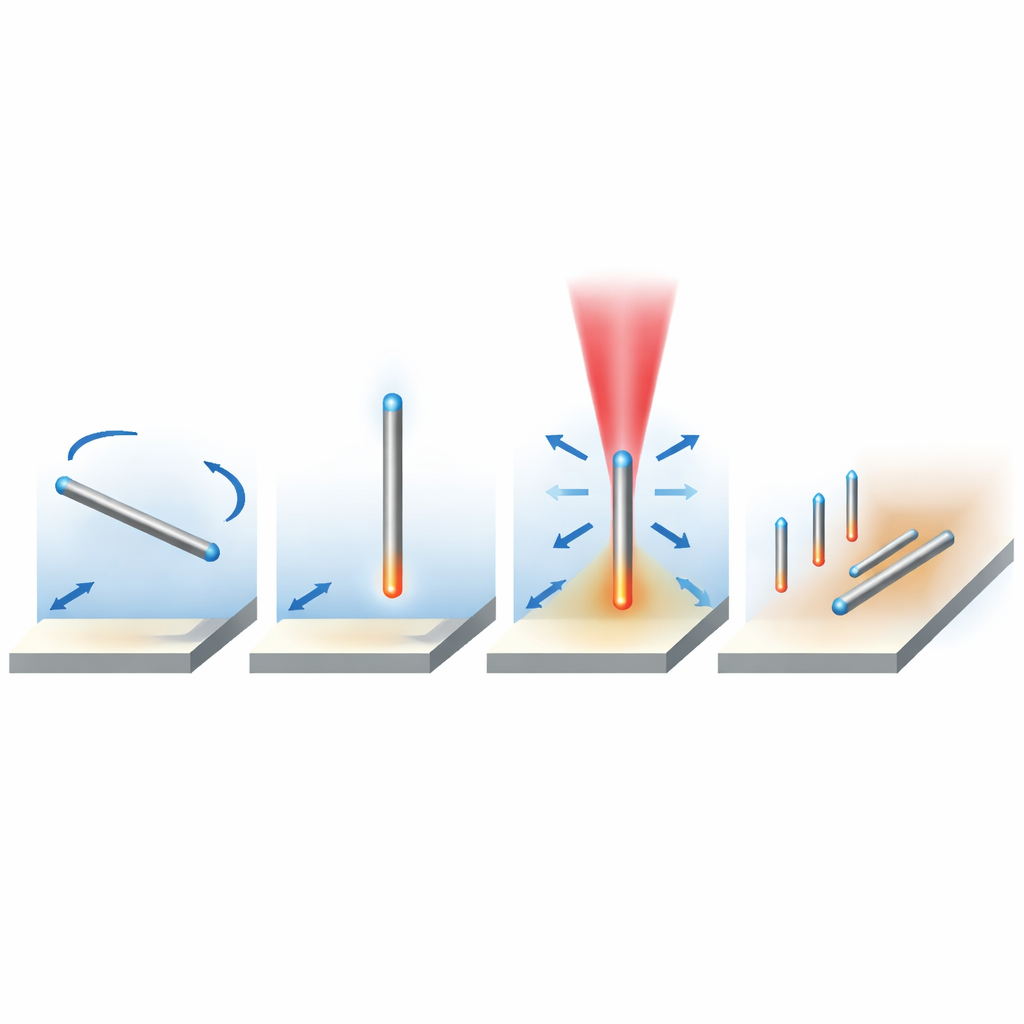
The authors introduce a strategy they call Optical Electro-aligning Manipulation, or OEM. They place nanowires in a thin liquid chamber sandwiched between transparent electrodes and then shine programmable laser traps through a microscope. When an alternating current is applied, the resulting electric field gently forces each wire to rotate until it lines up with the field, like tiny compass needles standing on end. In this upright position, a focused laser beam can trap the wire much more stably, because the wire now presents a smaller “target” area to the pushing force of the light while sitting squarely in the region where the trapping force is strongest. Numerical simulations and experiments together show how electric torque turns random, tumbling motion into orderly, controllable behavior.
Sharper Control with Less Power
By pre-aligning the nanowires electrically and then trapping them optically, the OEM approach gives a substantial performance boost. For several different types of nanowires—silver, titanium dioxide, gallium arsenide, and indium arsenide—the success rate of capturing a wire roughly doubles compared with conventional optical tweezers alone. At the same time, the laser power needed to hold a wire steady is cut in half, and the maximum speed at which a trapped wire can be moved before it escapes increases by nearly 40 percent. These improvements come from shifting the balance between two competing effects of light: the stabilizing “gradient” pull toward the beam center and the destabilizing “scattering” push along the beam’s path. OEM places each wire in the sweet spot where the stabilizing effect dominates.
Drawing and Building at the Nanoscale
To showcase what this new control can do, the team uses individual nanowires as movable pens that trace out complex paths. With one wire, they “write” letters and draw the outline of a dragon; with multiple wires held in parallel traps, they draw a school emblem and more elaborate shapes. From the microscope’s point of view, each vertically aligned wire appears as a small bright dot that glides across the field of view, leaving behind a precisely deposited line or curve. The same system can juggle up to seven nanowires at once, steering them along separate trajectories without the wires interfering with each other, demonstrating that the method is ready for more complex, programmable assembly tasks.
Gently Handling Living Microbes
The researchers also show that their method works not only for inorganic materials but for living systems. Rod-shaped bacteria, similar in size and shape to short nanowires, are first rotated and aligned by the electric field and then trapped and moved by the laser. Because the OEM approach reduces the required light intensity, it lessens the risk of heat and light damage that typically threaten delicate cells. This makes it a promising tool for arranging, transporting, or probing individual microorganisms in future biomedical experiments, all while keeping them alive and functional.
From Nano Calligraphy to Future Devices
In everyday terms, this work turns a long-standing limitation into a feature: instead of fighting the tendency of slender objects to flip and scatter in light, OEM uses an electric field to tame their motion first, then lets light do the fine positioning. The result is a kind of "nano calligraphy," where nanowires and bacteria become controllable brushstrokes for drawing complex, functional patterns without traditional lithography. This hybrid light-and-electric platform could become a powerful foundation for building nano-electro-mechanical devices, photonic networks, quantum circuits, and cellular probes from the bottom up, one precisely placed wire—or bacterium—at a time.
Citation: Liu, H., Fu, R., Guo, Z. et al. Nano calligraphy via optical electro-aligning manipulation. Microsyst Nanoeng 12, 125 (2026). https://doi.org/10.1038/s41378-026-01225-0
Keywords: nanowire manipulation, optical tweezers, electric field alignment, nano fabrication, biological cell handling