Clear Sky Science · en
Sub-6 GHz acoustic filters using laterally-excited bulk acoustic resonator with scattering vias in double-layer electrodes
Why your Wi‑Fi cares about tiny sound waves
Every time you stream a movie or join a video call, your phone and router rely on tiny chips that sort radio signals so they do not interfere with one another. As wireless networks move into crowded sub‑6 gigahertz (GHz) frequencies for Wi‑Fi 6 and future 6G systems, these signal-sorting chips, called filters, must squeeze more information into the same airwaves without overheating or distorting the signal. This paper reports a new type of miniature filter that uses carefully shaped sound waves in a crystal to handle high power while keeping signals clean, opening the door to faster and more reliable wireless links in compact devices. 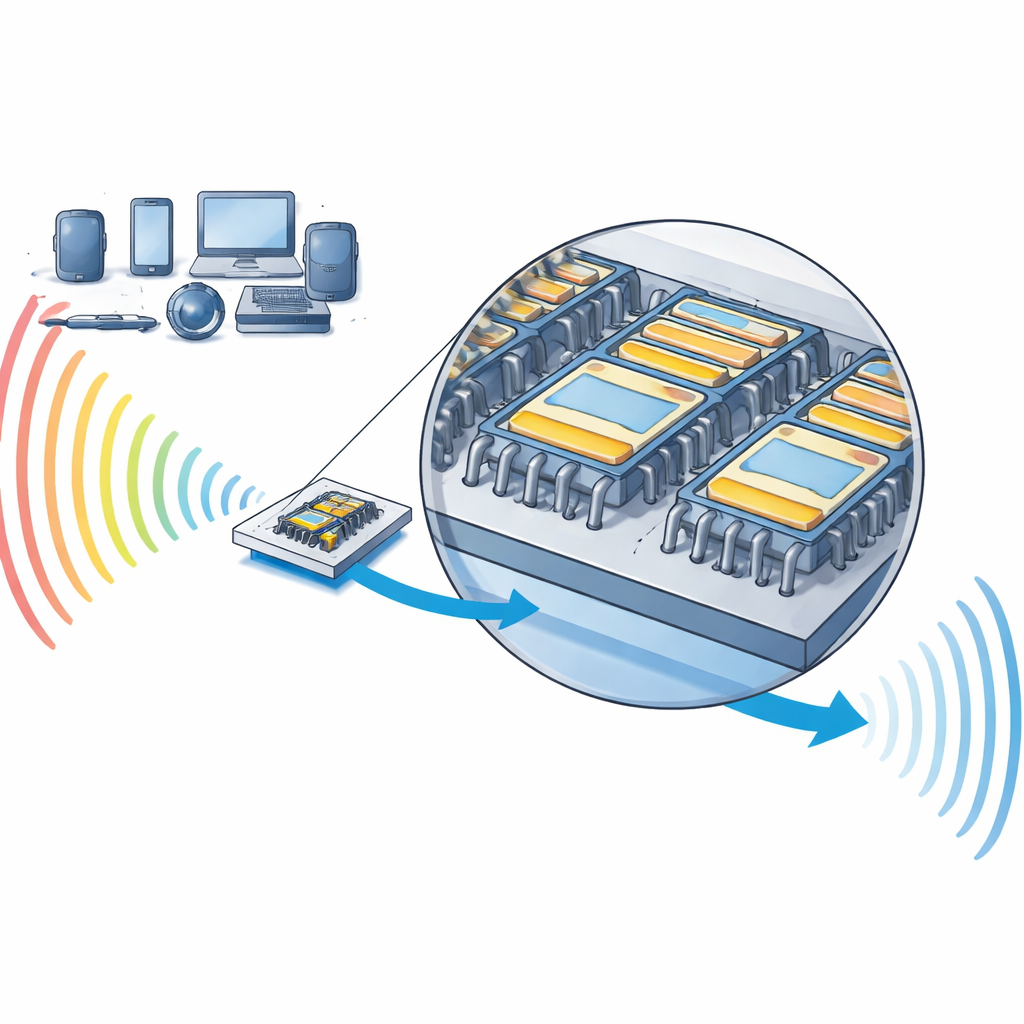
Turning radio waves into sound inside a crystal
Modern phones often rely on acoustic wave filters, which convert incoming radio waves into vibrations inside a solid material, let those vibrations pass only in a chosen frequency range, and then turn them back into electrical signals. The device studied here is a laterally excited bulk acoustic resonator made from a very thin film of lithium niobate, a crystal that responds strongly when an electric field is applied. Metal fingers on the surface act like tiny combs that launch high‑frequency shear waves sideways through the film. By designing these structures to resonate close to 6 GHz, the researchers aim squarely at the valuable 5 GHz band used by Wi‑Fi 6 and related wireless standards.
Fighting unwanted echoes and overheating
A major challenge for such resonators is that they do not vibrate in just one neat pattern. Extra “spurious” modes can appear, much like unwanted echoes in a concert hall, creating ripples and dips in the filter’s frequency response. At the same time, the metal electrodes can heat up and stress the thin crystal when high power is applied, limiting how much signal the device can safely handle. Earlier designs tried to tame these effects by tweaking film thickness or electrode shapes, but often ran into fabrication complexity or only partially solved the problem. The authors introduce a new structure called an SV‑BAR that attacks both issues at once.
Curved scatterers and double metals do the heavy lifting
The SV‑BAR adds rows of tiny, curved “scattering vias” inside the metal fingers and builds each electrode from two layers of metal: molybdenum for stiffness and gold for excellent electrical and thermal performance. The vias are filled with gold and carefully sized so that sound waves see a deliberate mismatch in acoustic properties at their boundaries. Instead of letting stray waves bounce back and forth and form strong side modes, these curved interfaces scatter and dissipate the unwanted energy before it can disturb the main resonance. Computer simulations show that the choice of metal is crucial: too strong or too weak a contrast with molybdenum actually worsens the problem, while gold gives the cleanest spectrum and also conducts heat efficiently, lowering hot spots and mechanical stress. 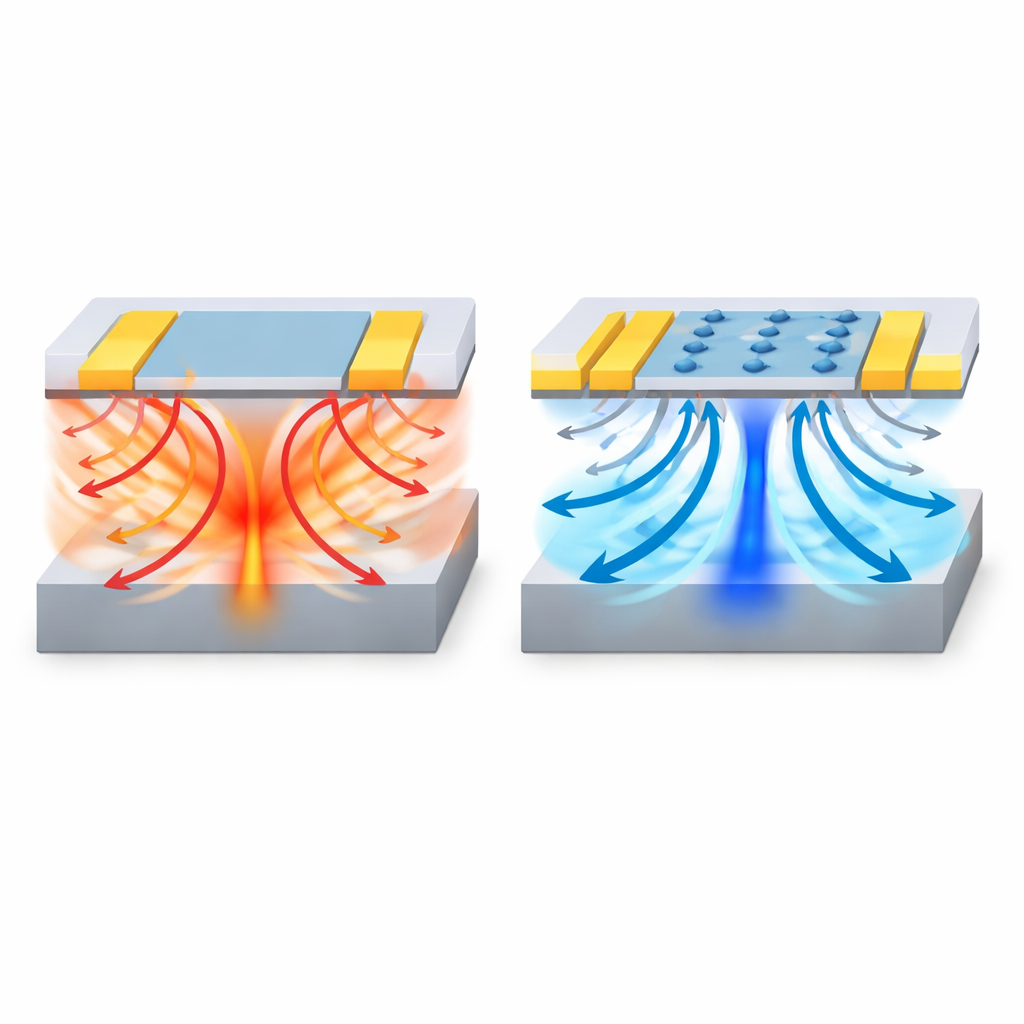
From single building blocks to a full filter
Using these improved resonators, the team designed a compact ladder‑style filter aimed at Wi‑Fi 6. They tuned key geometric parameters—such as the thickness of the lithium niobate film, the spacing and width of the metal fingers, and the number of electrode pairs—to balance several competing needs: matching to standard 50‑ohm circuits, maintaining a wide passband, and keeping in‑band ripples low. By slightly thinning some resonators with ion beam etching, they created the precise frequency offset needed between “series” and “parallel” building blocks. The finished filter occupies less than 2 square millimeters yet passes a band centered at about 5.86 GHz with nearly 10 percent fractional bandwidth, while strongly suppressing signals outside this window.
Handling real‑world power and changing temperatures
For practical wireless hardware, it is not enough for a filter to perform well at low test power: it must also survive the strong signals present in transmit chains. The researchers measured how the filter behaved as they steadily increased the input power and tracked when its response began to compress. Thanks to reduced electrical loss, improved heat spreading, and better mechanical stability, the new design can handle about 30.9 decibels‑milliwatt (roughly one watt of RF power) before its output drops by 1 decibel from the ideal value. They also examined how its passband shifts with temperature, finding that the lower edge of the band is more sensitive than the upper edge—an effect that actually helps delay thermal runaway under high power. In principle, any remaining drift could be corrected by adding materials with opposite temperature behavior.
What this means for future wireless gear
In plain terms, the authors have invented a smarter “sieve” for radio signals that is small, robust, and ready for the demanding 5–6 GHz range. By reshaping how sound waves travel inside a thin crystal and by choosing metals that both guide vibrations and spread heat, they demonstrate a filter that is wideband, compact, and capable of handling the higher powers expected in next‑generation phones, routers, and base stations. As wireless networks evolve toward 6G and beyond, such high‑performance acoustic filters will be key components quietly ensuring that our growing flood of data stays clear and reliable.
Citation: Wen, Z., Liu, W., Zeng, M. et al. Sub-6 GHz acoustic filters using laterally-excited bulk acoustic resonator with scattering vias in double-layer electrodes. Microsyst Nanoeng 12, 118 (2026). https://doi.org/10.1038/s41378-026-01204-5
Keywords: acoustic filters, lithium niobate resonator, Wi-Fi 6, sub-6 GHz RF, power handling