Clear Sky Science · en
Deep learning-driven performance prediction and design of high-DoF MEMS resonators
Smarter tiny machines
From smartphones to medical scanners, many modern devices rely on tiny vibrating parts carved into silicon chips. These parts, called resonators, act like microscopic tuning forks that sense motion, filter signals, or harvest energy. Designing them has traditionally been slow and painstaking. This research shows how deep learning, a branch of artificial intelligence, can dramatically speed up the way engineers design and fine tune these miniature machines.
Why these tiny vibrators matter
Resonators sit at the heart of systems that navigate airplanes, monitor earthquakes, power wireless sensors, and read out quantum states. Different jobs demand very different behaviors. Some applications need low vibration frequencies to pick up slow movements or weak signals, while others need very high frequencies for fast communications. The spacing between vibration tones also matters, because certain gaps help avoid interference between modes and allow stable, multi function operation. Meeting all these goals at once with traditional computer simulations can take days or even weeks for a single promising design.
Letting a neural network learn the physics
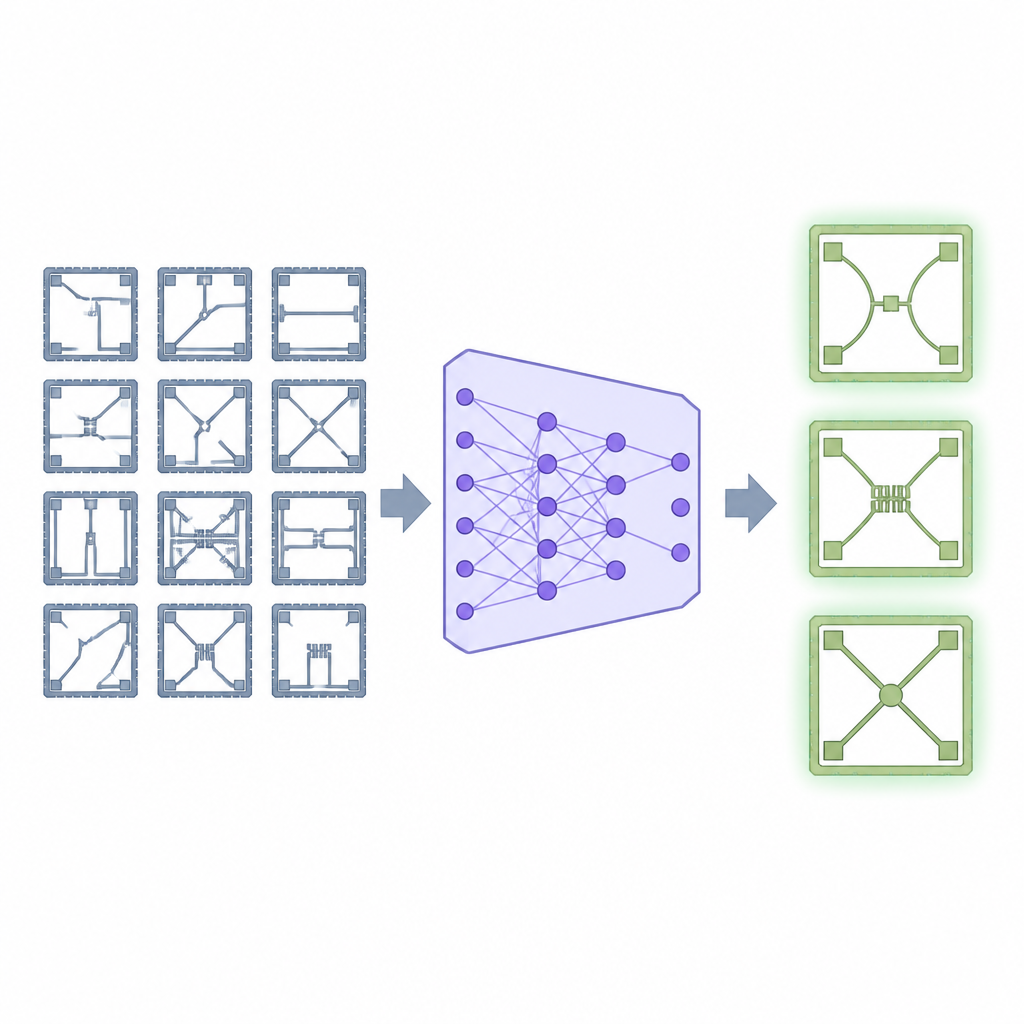
In this work, the authors build a deep learning tool called ResNES that predicts how a given resonator shape will vibrate. They first generate huge numbers of candidate structures made of a central mass connected to a frame by flexible beams. Each design is drawn on a square grid and turned into a simple black and white pattern that shows where silicon is present and where it is not. For every pattern, a standard physics simulator calculates the first two vibration frequencies that correspond to sideways motion of the mass. These image like patterns and their vibration results form the training material for ResNES, which learns to map structure to behavior directly.
Fast predictions with reliable accuracy
After training on ten thousand examples, ResNES predicts vibration frequencies for new designs in just a few milliseconds, nearly a thousand to three thousand times faster than the conventional simulator. For relatively simple patterns, its average error stays below three percent, and even for more intricate shapes the accuracy remains high. The team also examines how many examples the network needs to learn complex structures and finds that finer design grids demand larger datasets. To check that these digital results hold up in the lab, they fabricate several of the designed resonators on silicon wafers and measure their motion using a laser based instrument. The measured frequencies differ from the network’s predictions by less than five percent, small enough that manufacturing imperfections likely explain most of the gap.
Searching for better designs in minutes
Speed alone is not enough; designers also need to explore which shapes deliver the best performance. To do this, the researchers plug ResNES into a search strategy called Adaptive Elite Learning Particle Swarm Optimization. In simple terms, this algorithm treats each trial shape as a moving point in a shared landscape and nudges the population of points toward better performing regions. Because ResNES evaluates designs so quickly, the combined system can scan tens of thousands of options within minutes. Compared with methods that rely on slow simulations for every trial, the new approach cuts total design time by more than seventy percent, even after counting the effort spent collecting data and training the network.
Toward more capable tiny sensors
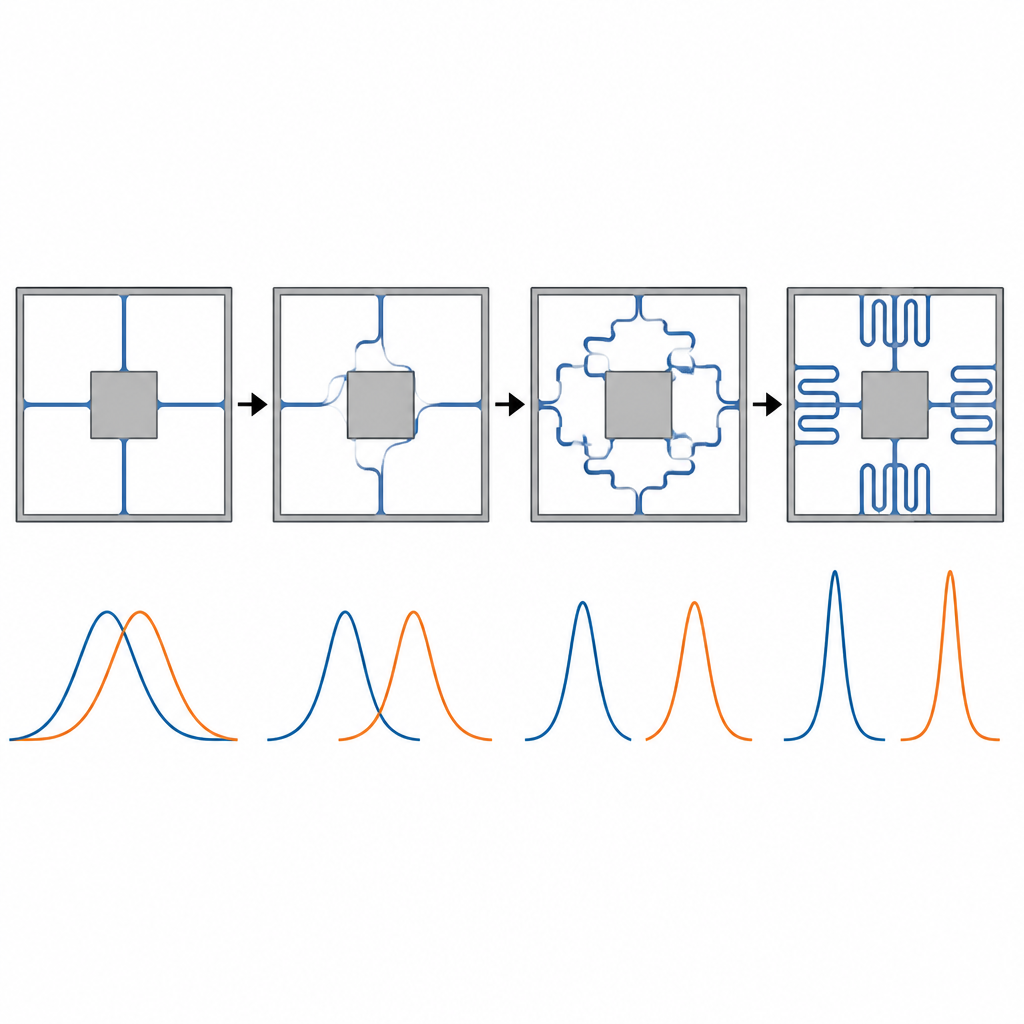
The study shows that once a neural network has learned the link between layout and vibration, it can reliably stand in for heavy duty simulations and guide advanced search algorithms. The resulting designs achieve lower operating frequencies and more favorable spacing between vibration tones than those found by traditional trial and error. Because the framework uses simple grid patterns, it can be expanded to include other behaviors, such as out of plane motion, stress levels, or even thermal effects. For non specialists, the takeaway is that intelligent design tools like this can help engineers create better, more energy efficient micro devices faster, ultimately benefiting technologies from navigation systems to medical sensors.
Citation: Jia, Z., Wu, C., Li, M. et al. Deep learning-driven performance prediction and design of high-DoF MEMS resonators. Microsyst Nanoeng 12, 194 (2026). https://doi.org/10.1038/s41378-026-01198-0
Keywords: MEMS resonator design, deep learning, structural optimization, microdevices, frequency tuning