Clear Sky Science · en
Laser-fabricated reconfigurable PT-symmetric sensors for wireless health monitoring of CFRP structures
Keeping Hidden Cracks from Becoming Disasters
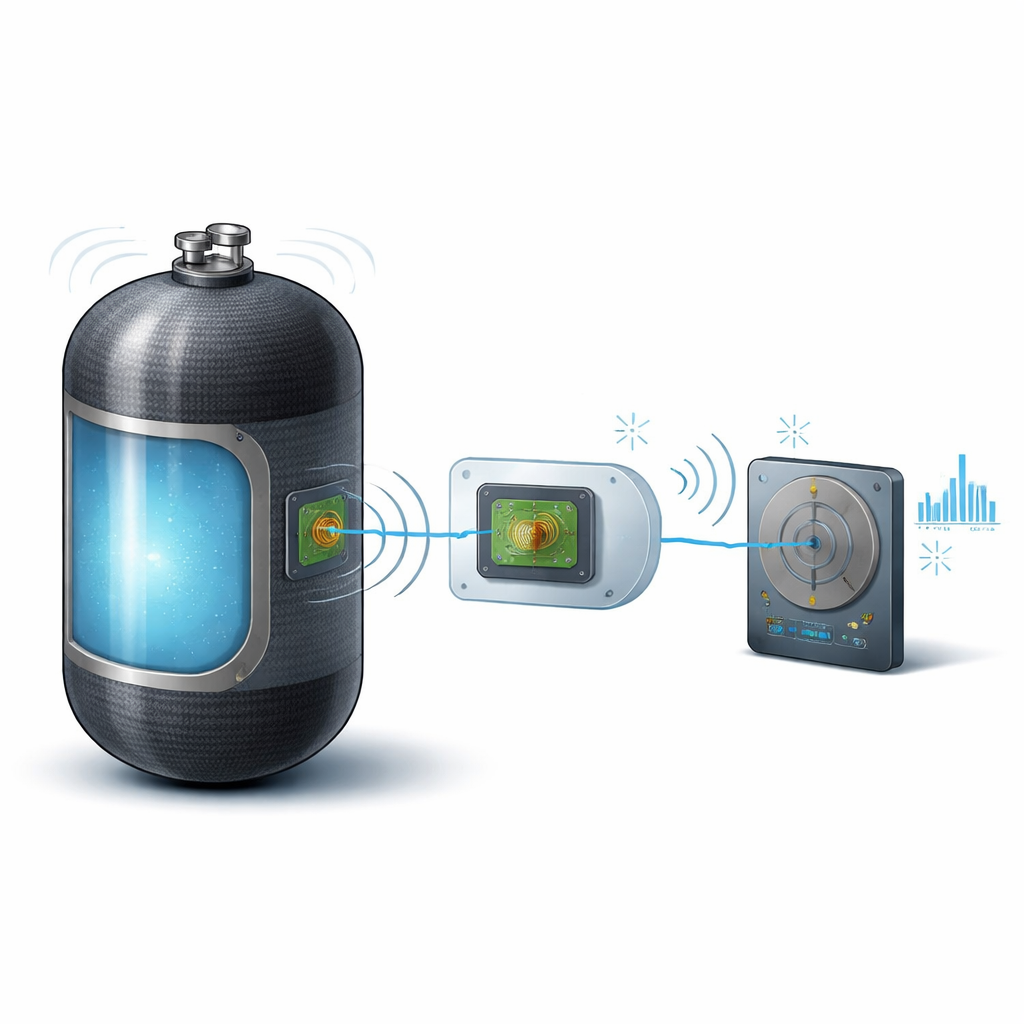
Modern airplanes, trains, and hydrogen-powered vehicles rely on carbon-fiber-reinforced plastics—light, tough materials that quietly bear enormous loads. But tiny, invisible cracks inside these composites can grow over time and lead to leaks or even sudden failure, especially in high-pressure hydrogen tanks. This paper introduces a new kind of wireless “nervous system” for such structures: a thin sensor built directly into the carbon-fiber wall that can remotely track minute strains and pressure changes before they turn into trouble.
Why Watching Composite Structures Is So Hard
Carbon-fiber composites are made of stacked layers with fibers running in different directions. This gives them strength but also makes damage hard to spot. Early problems—such as tiny splits between layers or microscopic cracks in the resin—barely change the outside shape, yet they weaken the structure and can precede gas leaks in hydrogen tanks. Conventional monitoring tools, like wired strain gauges, fiber optics, or ultrasonic probes, require cables, direct contact, or manual scanning. They are difficult to install on curved or buried components and awkward to maintain inside sealed tanks. The result is a gap between the need for continuous monitoring and the practicality of doing it in real-world systems.
Turning the Tank Wall into Its Own Sensor
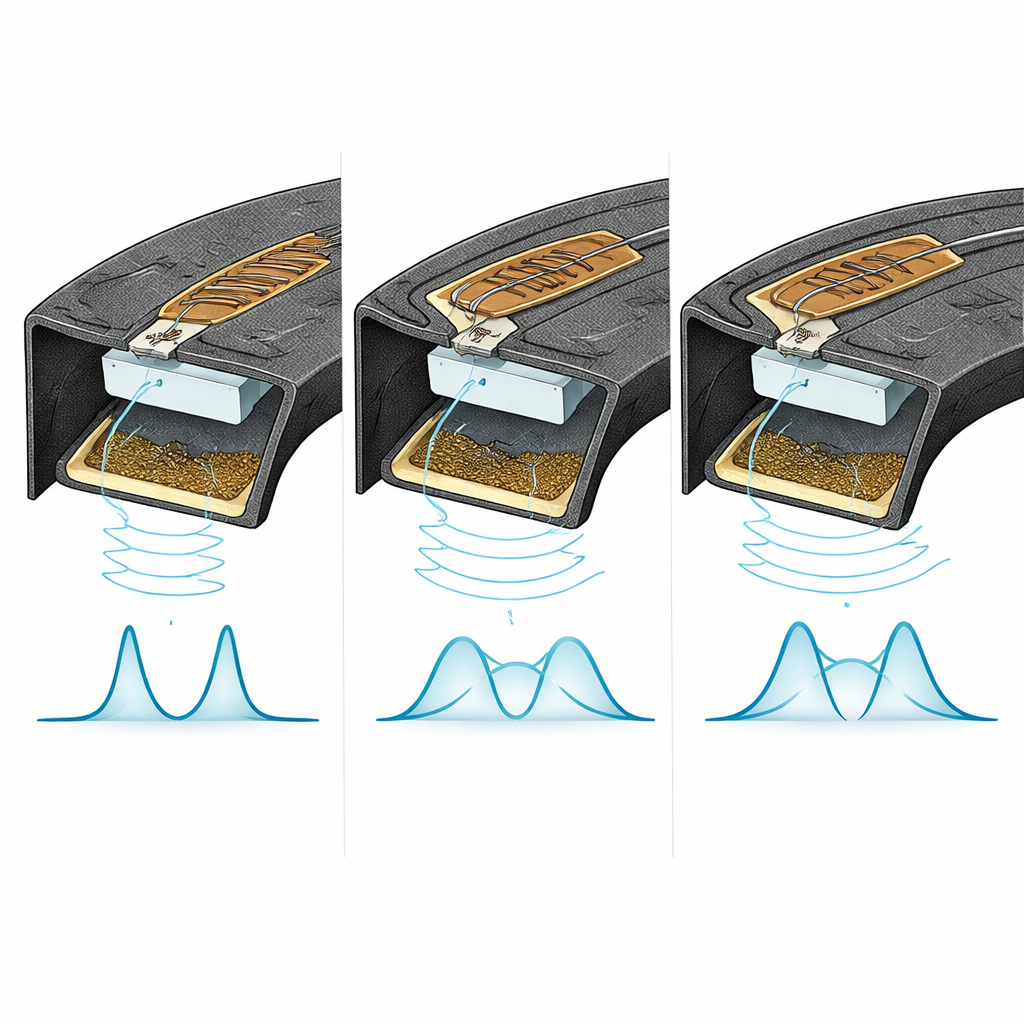
The authors tackle this challenge by transforming part of the carbon-fiber wall into an electronic component. Using a finely controlled laser, they first carve a shallow cavity into the composite and then convert the exposed carbon surface from insulating to conductive. This conductive patch becomes the bottom plate of a tiny capacitor. A flexible film with high electrical responsiveness is laid over the cavity, and a copper top electrode is added, all connected to a small spiral coil. Together, these elements form a resonant electrical circuit whose natural frequency shifts whenever the distance between the capacitor plates changes. Because tank pressure and wall strain subtly alter that distance, the structure’s mechanical state is encoded as an easily measured frequency change.
Smart Wireless Readout with a Paired Circuit
To read this built-in sensor without wires, the team uses a nearby reader coil that couples magnetically to the embedded resonant circuit. The key innovation is how they design this reader–sensor pair using principles of parity–time symmetry, a concept from physics that balances energy gain and loss between two coupled systems. By carefully choosing the resistance and capacitance on the reader side, they create operating states where the two circuits exchange energy very efficiently and their shared response splits into two closely spaced resonant peaks. Small shifts in the sensor’s capacitance—caused by tiny strains—then produce exaggerated, easy-to-detect changes in these peaks. Importantly, the researchers can reconfigure the reader’s components to move between different operating states, each optimized for a particular strain range or readout distance.
From Computer Models to Working Hardware
Simulations show how coil spacing, resistance, and capacitance shape the strength of the wireless link and the pattern of split resonances. Experiments confirm these predictions. On flat composite plates, the laser-fabricated capacitor responds strongly and repeatably to bending: its capacitance rises as the plate strains, and the wireless resonant frequencies shift in a nearly linear way. By switching the reader’s initial state, the team can “zoom in” on different strain windows, boosting sensitivity where it matters most. At a stand-off distance of 15 millimeters, they achieve a frequency sensitivity of about 23 megahertz per percent strain—high enough to register very small deformations—and demonstrate stable, real-time tracking over many loading cycles.
Watching a Hydrogen Tank Breathe
The researchers then attach the sensor patch to a carbon-fiber hydrogen storage cylinder and position the reader coil just outside the wall. As external force increases, mimicking internal pressure, the tank wall strains slightly. The paired resonances shift in frequency and amplitude in a characteristic pattern: one peak moves more in frequency, the other more in strength. Together, these two “voices” provide a robust fingerprint of the tank’s state, even though the absolute deformations are very small. The system maintains clear signals up to several megapascals of applied pressure and remains stable over repeated loading–unloading cycles, suggesting it can handle the demands of long-term monitoring.
What This Could Mean for Safer Infrastructure
In everyday terms, the work turns the wall of a hydrogen tank—or any similar carbon-fiber structure—into its own built-in, wirelessly readable gauge. Because the sensor is passive and powered by the reader’s probing field, there are no batteries or cables to fail. The ability to re-tune the reader to emphasize specific strain ranges or extend the read distance makes the approach adaptable to different designs and risk levels. While questions remain about long-term durability, integration in full-scale tanks, and operation in harsh environments, this combination of laser-shaped materials and smart circuit design offers a promising path toward “self-aware” composite structures in hydrogen storage, aerospace, transportation, and beyond.
Citation: Yue, W., Guo, Y., Zhang, Y. et al. Laser-fabricated reconfigurable PT-symmetric sensors for wireless health monitoring of CFRP structures. Microsyst Nanoeng 12, 116 (2026). https://doi.org/10.1038/s41378-026-01196-2
Keywords: wireless structural health monitoring, carbon fiber composites, hydrogen storage tanks, passive resonant sensors, laser-fabricated electrodes