Clear Sky Science · en
Theoretical modelling and optimization design of PMUT arrays for enhanced acoustic performance
Sharper Sound Beams on a Tiny Chip
Ultrasound isn’t just for prenatal scans—it is a versatile tool for peering inside the body, checking for cracks in aircraft parts, and sensing motion underwater. This paper explores how to design tiny ultrasound chips, called piezoelectric micromachined ultrasonic transducer (PMUT) arrays, so they can send and receive sound more powerfully and precisely, while still being small and energy efficient.
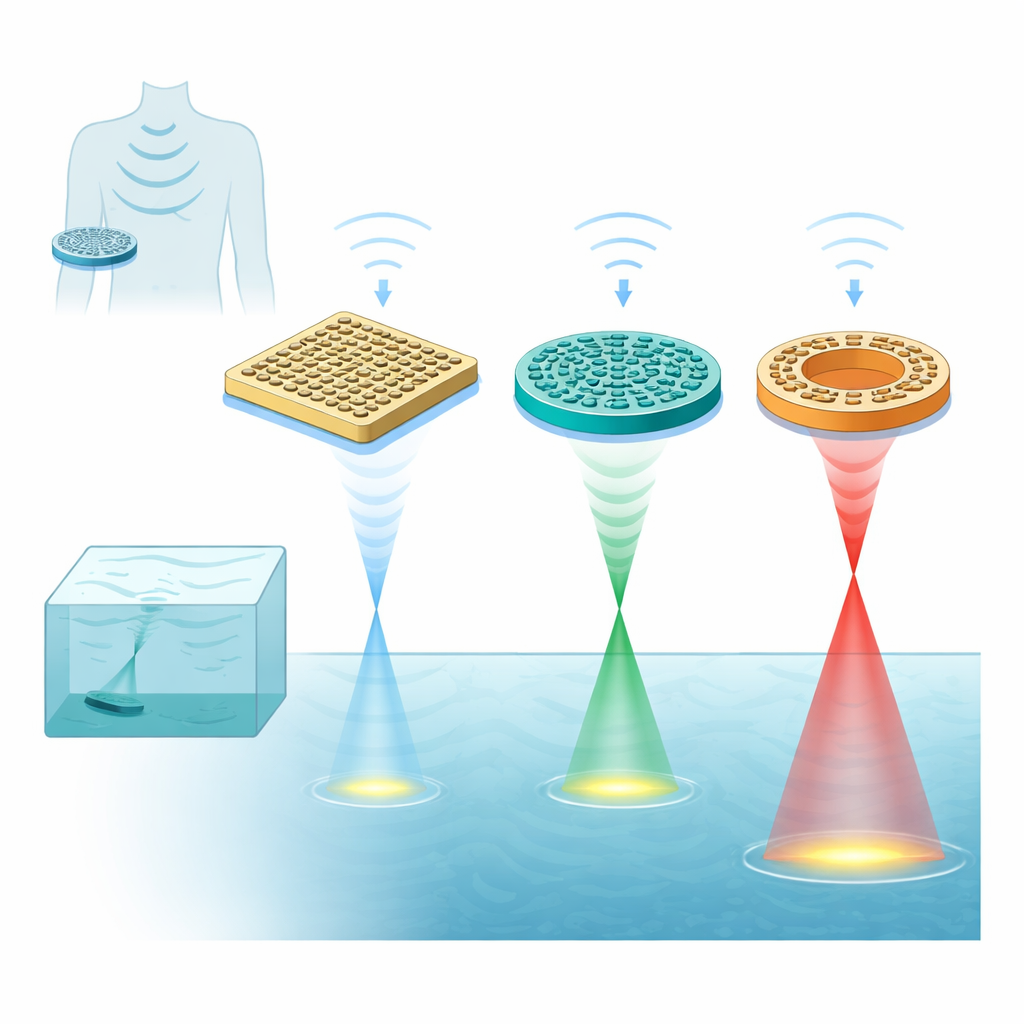
From Bulky Probes to Mini Ultrasound Chips
Traditional ultrasound probes rely on relatively large ceramic blocks to generate sound waves. PMUTs shrink this function down to microscopic vibrating membranes built on silicon, similar to computer chips. Each PMUT cell is a thin drum that flexes when a voltage is applied, launching sound into a surrounding fluid or tissue. Because these cells are much smaller than the wavelength of sound they produce, they can be grouped into dense arrays that behave like programmable sound sources. By controlling how thousands of these miniature drums vibrate together, engineers can steer and focus ultrasound beams, potentially enabling portable medical imagers, wearable health monitors, and compact underwater sensors.
A New Way to Predict How Arrays Behave
Designing such arrays is challenging because the cells are packed closely together. When one cell vibrates, it not only radiates sound outward, it also shakes its neighbors through the surrounding fluid, a phenomenon known as crosstalk. Existing mathematical models often ignore this interaction or use overly simple descriptions of how electrical signals, mechanical motion, and sound are linked. The authors introduce a more complete equivalent circuit model that couples the electrical drive, the bending of the membrane, and the sound field, while also accounting for the mutual influence between every pair of cells. This approach replaces extremely time-consuming full 3D computer simulations with a fast analytical framework that still matches detailed simulations within a few percent.
Tuning Density, Size, and Shape of the Array
With this model in hand, the team studies how three main design knobs—how tightly the cells are packed (filling ratio), how large the overall array is, and how the cells are arranged in shape—affect performance. Increasing the filling ratio from about one-fifth to over half of the chip area boosts total transmitted power and dramatically broadens the useful frequency range, which is good for high-resolution imaging. However, closer spacing also strengthens crosstalk, which blurs the focus and reduces how sharply energy concentrates at a given point. Making the array physically larger has a different effect: with cell spacing held fixed, a bigger aperture pumps out more sound power and raises the peak pressure at the focus, while narrowing the beam and extending the focal distance—much like switching from a small to a large flashlight reflector.
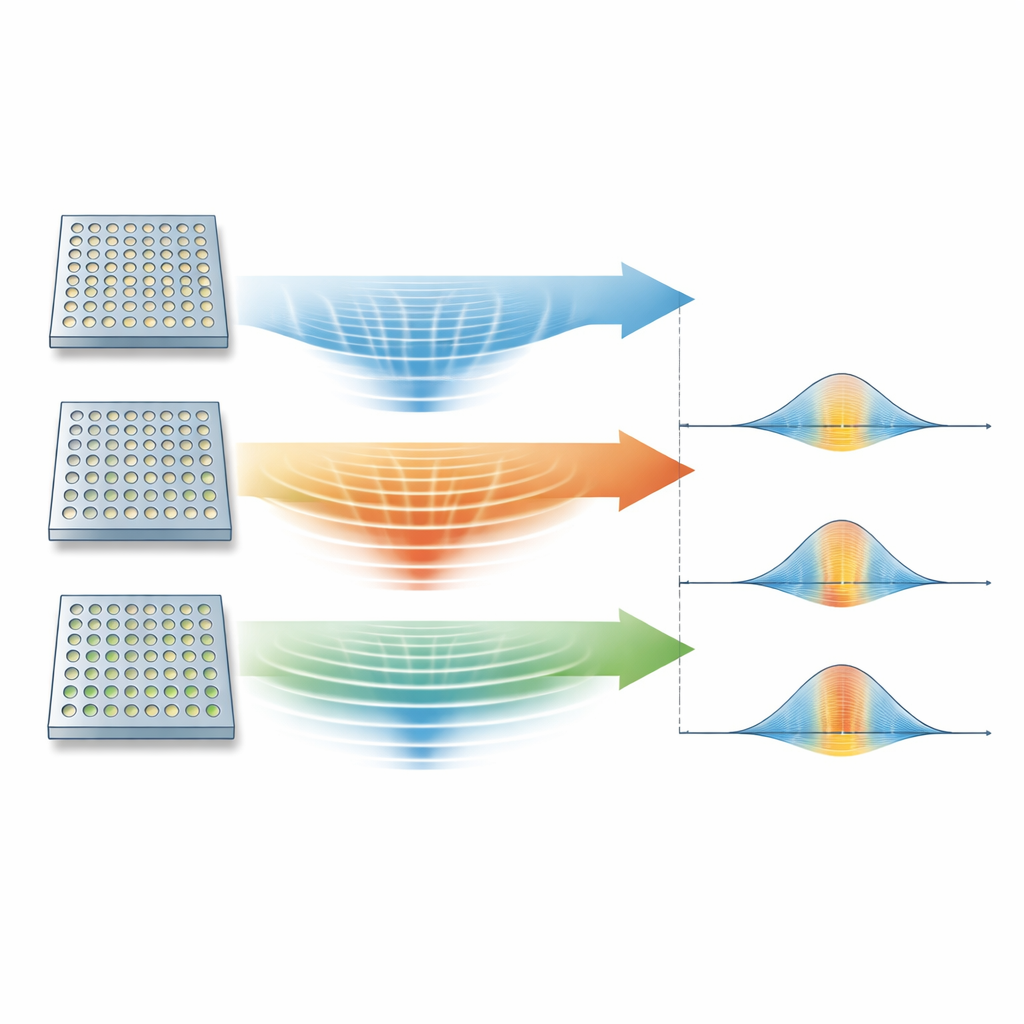
Why the Layout Pattern Matters
Beyond density and size, the geometric pattern of cells strongly shapes the sound field. The authors compare square grids, staggered and hexagonal tilings, spiral-like patterns, and ring-shaped (annular) layouts, all with similar footprint. Square arrays are easy to design but suffer stronger crosstalk at the corners and yield lower focal pressure. Circular and spiral-like patterns, which are more symmetric around the beam axis, bring the emitted waves into better alignment, giving higher pressure at the focus and cleaner side regions. Annular arrays behave differently: they emit sound from a ring, forming a narrow central beam accompanied by bright ring-shaped side zones. This structure is less efficient at concentrating energy close to the chip, but it excels at maintaining strong focus over longer distances.
From Theory to Real Devices
To test their predictions, the researchers fabricate several PMUT chips with different array shapes and measure their electrical and acoustic behavior in liquids. The observed resonance frequencies, bandwidths, focal pressures, and focal distances closely follow the model, typically within a few percent. Pulse–echo experiments, in which the chip both sends a short pulse and listens for its reflection from a moving target, further confirm the distinct directional behavior of each design. Finally, the model is used to explore very large arrays—up to 100 by 100 elements—where brute-force simulations would be impractical. These studies show that power scales roughly with element count, and that carefully chosen layouts can deliver high sound pressure hundreds of millimeters away while keeping computation times manageable.
What This Means for Future Ultrasound Tools
For non-specialists, the central message is that the way we arrange and pack microscopic ultrasound drums on a chip strongly affects how sharply and how far we can focus sound. The new model gives designers a fast, accurate way to predict these trade-offs and tailor PMUT arrays for specific uses, whether that is high-resolution medical imaging, long-range underwater sensing, or wide-area listening. By turning complex chip physics into an efficient design tool, this work helps pave the way for the next generation of compact, smart ultrasound devices that could be built into wearables, minimally invasive probes, and small robots.
Citation: Li, Z., Lu, D., Li, Z. et al. Theoretical modelling and optimization design of PMUT arrays for enhanced acoustic performance. Microsyst Nanoeng 12, 133 (2026). https://doi.org/10.1038/s41378-026-01159-7
Keywords: micromachined ultrasound, PMUT arrays, acoustic beamforming, ultrasound imaging, sensor design