Clear Sky Science · en
Piezoelectric stepped-plate resonators vibrating at lateral modes for direct viscosity determination in liquids
Why Measuring Goo Matters
From engine oil and industrial solvents to blood plasma and drug formulations, how “thick” or “runny” a liquid is—its viscosity—can make the difference between a machine running smoothly and a medical test giving the right answer. Today’s precision viscometers are often bulky, expensive, and hard to shrink into portable devices. This paper introduces a tiny chip-scale sensor that can directly measure liquid viscosity with high accuracy, paving the way for compact, low-cost monitoring tools in factories, hospitals, and labs.
A Tiny Ruler for Liquids
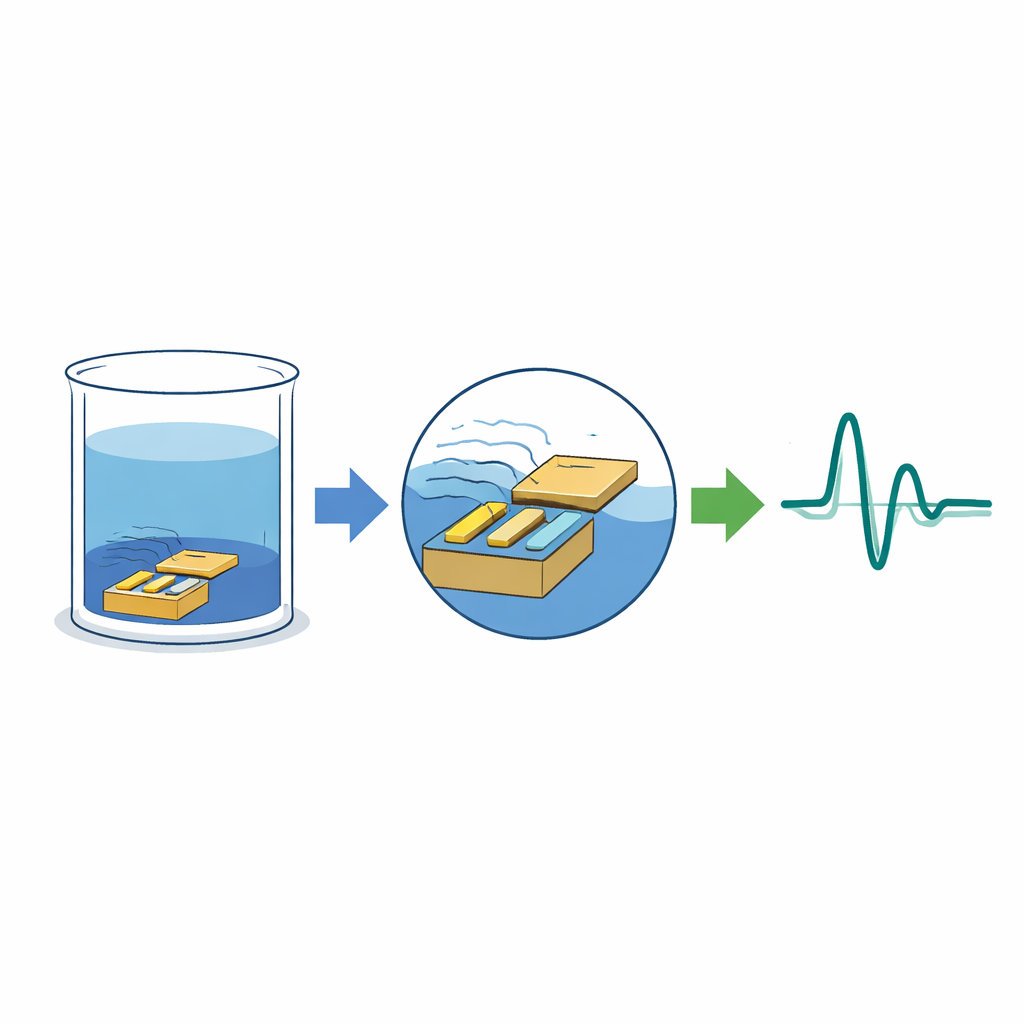
The heart of the work is a microscopic mechanical structure called a resonator, built on a silicon chip and driven by a piezoelectric material, aluminum nitride. The device looks like a small cantilevered plate with a narrow stem and a wider, tapered tip that dips into the liquid. When an alternating voltage is applied, the plate vibrates side-to-side in the plane of the chip rather than flapping up and down. This “lateral” motion produces less drag in liquid than conventional out-of-plane vibrations, allowing the device to ring more cleanly and making it better suited for precise measurements.
Shaping the Vibration
The researchers used detailed computer simulations to fine-tune the resonator’s geometry. By adjusting the width and length of the stem and the tapered plate, they could control both the vibration frequency and how strongly the liquid’s resistance—the viscosity—slowed the motion. A key design insight was that the wide “step” between the narrow stem and the larger plate lets them separate two jobs: the stem mainly sets how stiff the structure is, while the plate’s shape governs how it interacts with the surrounding liquid. This separation makes it possible to boost the quality factor—a measure of how sharply the device rings—while also making its response to viscosity more linear and easier to interpret.
Turning Ripples into Numbers
To use the device as a sensor, the team relies entirely on electrical signals. The same aluminum nitride layer that drives the vibration also senses it, generating a tiny voltage as the structure bends. By sweeping through frequencies, they track the resonant peak and extract two key parameters: the resonant frequency and the quality factor. In a series of organic liquids spanning more than a tenfold range in viscosity, they found a remarkably straight-line relationship between viscosity and the quality factor, and a predictable dependence of both quality factor and frequency on the square root of viscosity. This behavior allowed them to derive a simple formula that calculates viscosity directly from the two resonance parameters—without needing a separate measurement of the liquid’s density, which is usually required.

From Simulation to Real-World Performance
Fabricated using standard microelectronics processes, the chip is only a few millimeters across yet can be fully immersed in liquid. The authors verified their design by comparing experimental measurements with simulations and by testing multiple liquids, including common hydrocarbons and silicone oils. Across the full range, the sensor achieved a mean relative error of just 2.65% and a worst-case stability deviation of 3.43%, performance on par with commercial benchtop viscometers. Importantly, these results were obtained while operating at moderate frequencies suitable for robust electronics and with no optical readout or bulky mechanical parts, making the approach attractive for portable and embedded systems.
What This Means for Everyday Uses
In simple terms, the authors have built a tiny “tuning fork” on a chip whose tone and sharpness change in a very orderly way as a liquid gets thicker or thinner. Because the device is designed so cleverly, those changes can be converted straight into viscosity numbers without the usual extra steps and corrections. This combination of miniaturization, electrical simplicity, and high accuracy suggests that future diagnostic cartridges, industrial pipelines, and environmental sensors could all carry their own built-in viscosity meters, quietly monitoring the flow of critical liquids in real time.
Citation: Huang, L., Lu, D., Han, X. et al. Piezoelectric stepped-plate resonators vibrating at lateral modes for direct viscosity determination in liquids. Microsyst Nanoeng 12, 122 (2026). https://doi.org/10.1038/s41378-025-01135-7
Keywords: liquid viscosity sensor, MEMS resonator, piezoelectric microcantilever, in-plane vibration, lab-on-a-chip