Clear Sky Science · en
Sound-focusing package for MEMS vector hydrophone
Listening Better Beneath the Waves
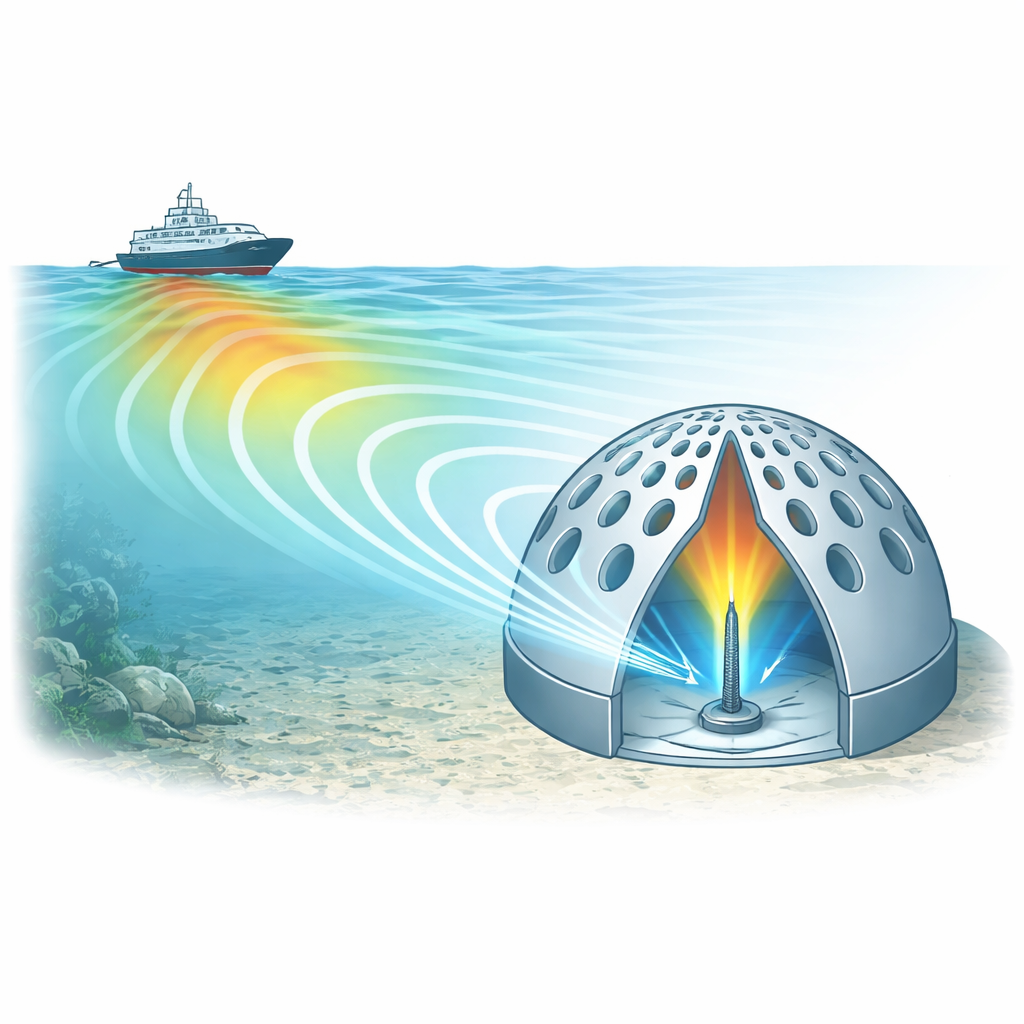
Modern oceans are filled with sound—from ship engines to marine life—and scientists rely on underwater microphones to make sense of this noisy world. This paper describes a new way to package a special type of underwater sensor so that it can hear faint sounds more clearly and tell where they come from with greater precision. By reshaping the tiny openings that let sound reach the sensor, the researchers turn a simple protective cover into an acoustic “lens” that concentrates underwater sound instead of weakening it.
Why Directional Underwater Hearing Matters
Conventional underwater microphones, called scalar hydrophones, mainly measure how loud a sound is, not where it comes from. Vector hydrophones go a step further: they are designed to sense both loudness and direction, much like a biological inner ear or the lateral line of a fish. That makes them valuable for tracking ships, monitoring marine animals, and building compact underwater navigation systems. But to survive harsh ocean conditions, these delicate sensors must be sealed inside protective packages. Existing covers, such as steel mesh caps, keep water out but also scatter and weaken incoming sound, robbing the sensor of the very signals it is meant to capture.
Turning a Protective Cap into a Sound Lens
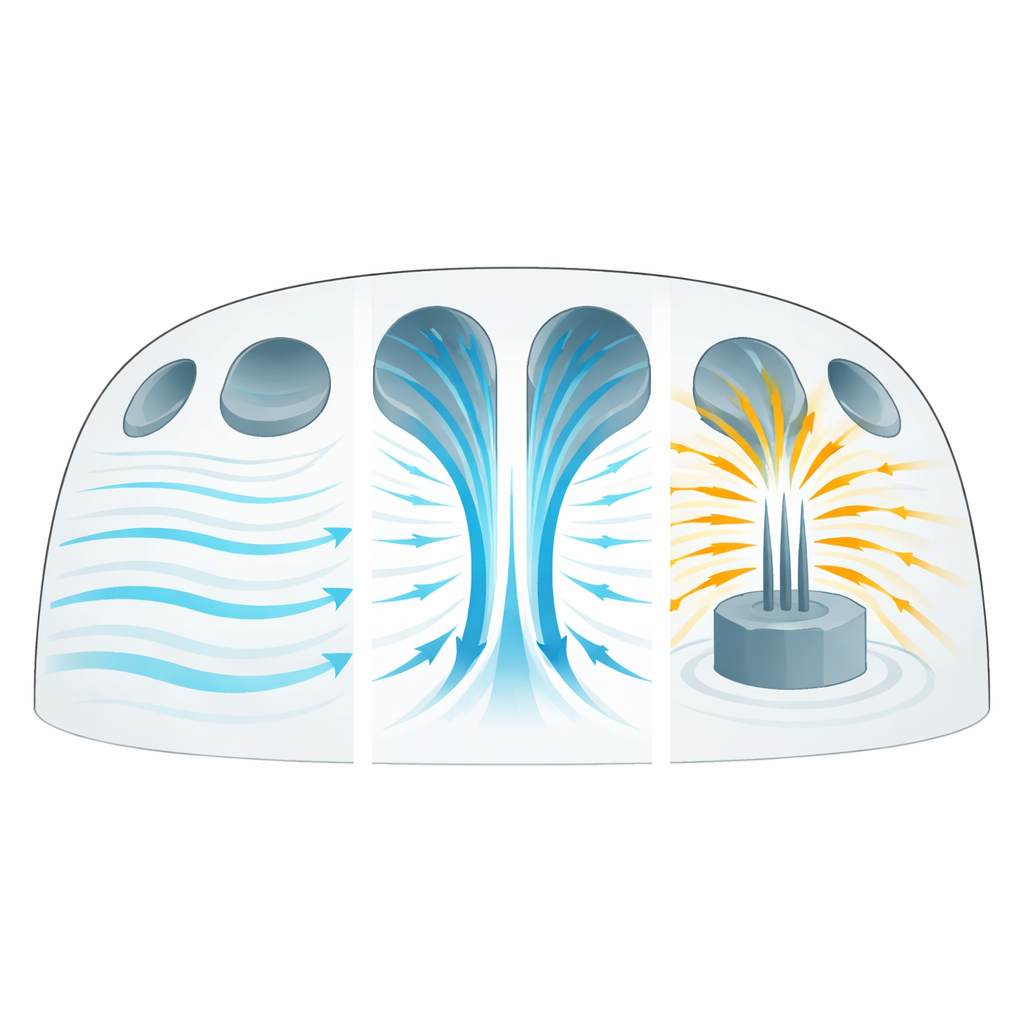
The authors propose a new sound-focusing package that does more than simply shield the device. At its heart is a rigid nylon cap shaped like a small dome, perforated with many tapered holes that are wide on the outside and narrow on the inside. Beneath this dome sits a microfabricated “bionic cilium”—a tiny upright rod on flexible beams that bends when sound pushes on the surrounding water. Instead of letting sound leak through a simple grid of straight holes, the tapered channels squeeze and redirect the incoming wavefronts so that acoustic energy converges around the cilium. In effect, the geometry of the cap amplifies the motion of the water particles right where the sensor is most sensitive.
From Theory and Simulation to Real Hardware
To understand and optimize this focusing effect, the team combined acoustic theory with computer simulations. They showed that when sound passes through a channel whose cross-section shrinks, the speed and acceleration of the fluid particles at the narrow end increase, boosting the pressure differences that bend the cilium. Simulations in COMSOL examined how the inlet and outlet sizes, length of the tapered holes, and overall number of holes affect this gain. The best performance came from relatively long channels with strongly reduced exit openings and a high overall perforation rate in the dome. The researchers also compared different cap materials—steel, aluminum, and nylon—and found that nylon’s low stiffness and density shift any structural resonances to higher frequencies, safely above the 20–500 Hz band where ship noise and many important ocean signals lie.
Proving the Design in Water
After settling on a nylon cap design, the team built miniature hydrophones using established microfabrication techniques and 3D-printed the cilia directly on each chip. They then tested the same sensor in three configurations: completely bare, covered by a traditional steel mesh cap, and enclosed by the new nylon sound-focusing cap. In a controlled standing-wave water tank, they measured how strongly each version responded to sound at different frequencies, and how sharply each one could distinguish direction. The nylon cap not only avoided reducing the signal; it actually boosted sensitivity by about 6–8 decibels compared with the other options and maintained a clean, predictable rise with frequency. Its directional “nulls”—angles where unwanted signals are sharply suppressed—were also deeper, meaning it could more clearly discriminate sounds coming from different directions.
What This Means for Underwater Sensing
In simple terms, the researchers have turned the protective housing of a tiny underwater ear into a built-in acoustic magnifying glass. By carefully shaping and arranging tapered openings in a nylon dome, they concentrate low-frequency underwater sound onto a micro-scale sensor without introducing harmful vibrations of the housing itself. The result is a compact vector hydrophone that hears more weak signals and points to their origin more accurately, all while remaining robust enough for real-world marine use. This approach to “smart packaging” could help future underwater listening systems become smaller, more sensitive, and better suited to the increasingly noisy oceans they are meant to monitor.
Citation: Cheng, Z., Zhang, G., Bai, Z. et al. Sound-focusing package for MEMS vector hydrophone. Microsyst Nanoeng 12, 111 (2026). https://doi.org/10.1038/s41378-025-01112-0
Keywords: underwater acoustics, vector hydrophone, sound focusing, tapered apertures, marine sensing