Clear Sky Science · en
Surpassing kilometer-scale terahertz wireless communication beyond 300 GHz enabled by hybrid photonic–electronic synergy
Faster Links Through Thin Air
Streaming ultra‑high‑definition video, connecting remote villages, or restoring communications after disasters all demand data links that are both extremely fast and easy to deploy. Optical fiber can deliver huge capacity but is costly and slow to install across rivers, mountains, or busy cities. This paper explores a different path: using very high‑frequency "terahertz" radio waves to send fiber‑like data rates wirelessly over kilometers, potentially reshaping how we build future communication networks.

Why These Invisible Waves Matter
Today’s mobile networks already crowd lower‑frequency airwaves. To keep up with exploding data traffic, researchers are turning to terahertz bands above 300 gigahertz, where vast, mostly unused spectrum promises tens or even hundreds of gigabits per second. These links are ideal for connecting base stations, buildings, or temporary sites when laying fiber is impractical. However, there is a catch: at such high frequencies the signal fades rapidly in air, and existing transmitters struggle to generate enough power, especially when the signal is produced using optical techniques that integrate nicely with fiber networks.
The Big Idea: Marrying Light and Electronics
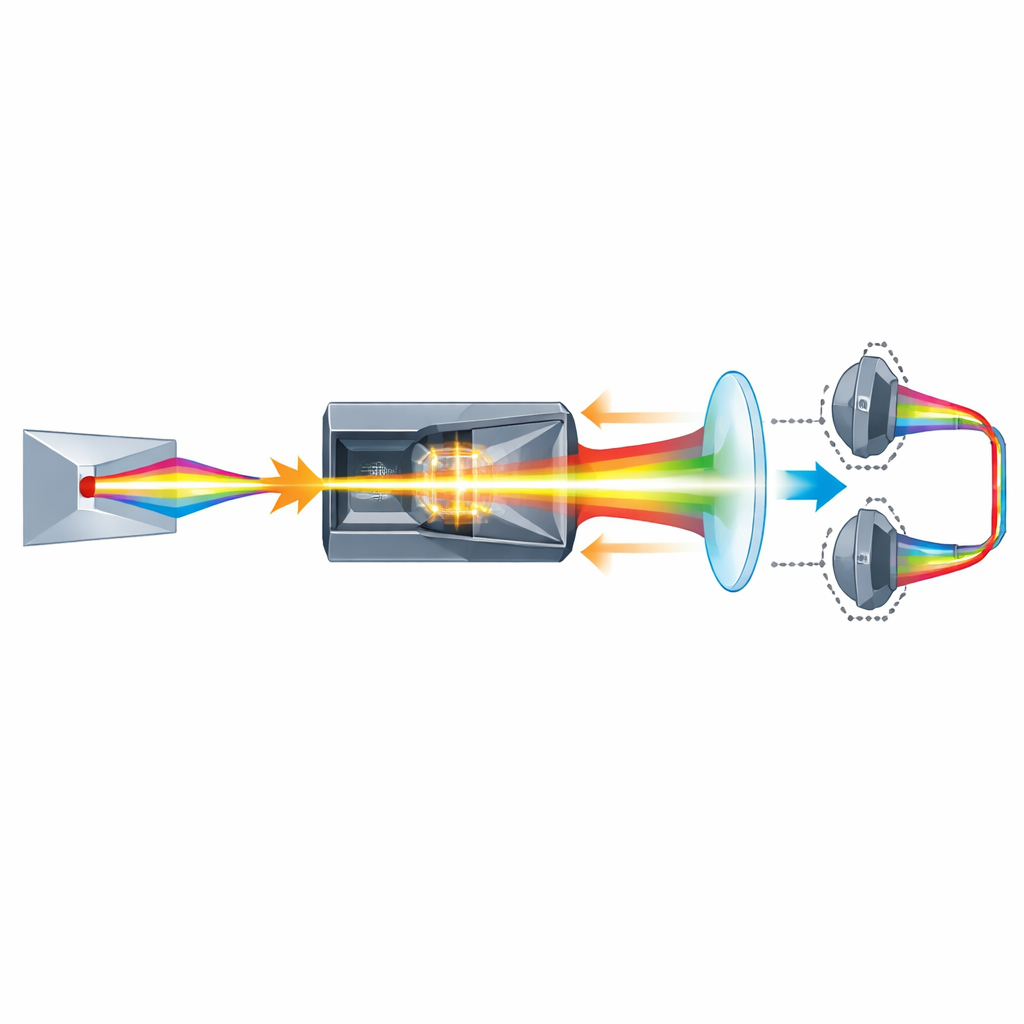
The authors propose a hybrid solution that combines the strengths of photonics and vacuum electronics. On the transmitter side, two precisely tuned lasers beat together in a special photodiode to generate a high‑frequency terahertz signal that naturally matches modern fiber systems and supports ultra‑high data rates. This faint signal is then fed into a custom‑built device called a traveling wave tube amplifier, which uses an electron beam interacting with a carefully shaped metal waveguide to boost the power from microwatts to several watts. On the receiver side, a large plastic lens concentrates the weak signal after kilometers of travel onto two separate electronic receivers whose outputs are intelligently combined to improve sensitivity.
Building a Powerful Terahertz Engine
At the heart of this work is a new amplifier operating around 335 gigahertz. Traditional solid‑state amplifiers at these frequencies offer only tens of milliwatts of output power and limited gain, capping the feasible distance. The team redesigned the internal waveguide structure of a traveling wave tube so that the electric field couples more strongly to the electron beam while keeping losses low, even at terahertz frequencies. Their device achieves nearly 4 watts of continuous output power and more than 50 decibels of gain—roughly a ten‑thousand‑fold increase in signal strength—while maintaining good efficiency for this challenging band. These performance figures currently set a new benchmark for amplifiers above 300 gigahertz.
Sending High‑Speed Data Across a City
To test the full system, the researchers set up a point‑to‑point terahertz link between two high‑rise buildings in Nanjing, China, spanning 2.2 kilometers and crossing several urban rivers. Inside one building, an optical transmitter generated a 335 gigahertz carrier, encoded it with a 16‑level data pattern, and boosted it with the new amplifier before feeding a high‑gain rooftop antenna. At the distant building, a large lens captured the faint beam and directed it to two closely spaced receivers. Their electrical outputs were recorded and processed using advanced digital algorithms that combined both streams, effectively taking advantage of differences in fading and noise along the two slightly separate paths to clean up the signal.
Getting More Out of the Same Air
The dual‑receiver approach provided a clear benefit. Compared with using just one receiver, combining the pair increased the signal‑to‑noise ratio by nearly 3 decibels—equivalent to almost doubling the usable signal power—allowing the system to sustain higher data rates and tolerate weaker incoming signals. With this hybrid photonic–electronic architecture, the team achieved a net information rate of 27.84 gigabits per second over 2.2 kilometers at 335 gigahertz. This sets a new record for the product of data rate and distance in this frequency range and shows that kilometer‑scale, fiber‑class wireless connections are feasible even beyond 300 gigahertz.
What This Means for Future Networks
For non‑specialists, the key takeaway is that the authors have demonstrated a practical way to push very‑high‑frequency wireless signals much farther than previously thought, without giving up the ultra‑fast speeds promised by terahertz bands. By pairing optical signal generation with a powerful electron‑beam amplifier and smart dual‑receiver processing, they overcome the severe loss normally suffered by these waves in air. While improvements in bandwidth and compactness are still needed, this work points toward future networks where long, high‑capacity links can be set up quickly through free space, complementing fiber and helping to carry the immense data loads expected in coming generations of communication systems.
Citation: Cai, Y., Zhang, L., Zhang, J. et al. Surpassing kilometer-scale terahertz wireless communication beyond 300 GHz enabled by hybrid photonic–electronic synergy. Light Sci Appl 15, 228 (2026). https://doi.org/10.1038/s41377-026-02321-6
Keywords: terahertz wireless, 6G backhaul, traveling wave tube amplifier, photonics-assisted communications, long-range high-speed links