Clear Sky Science · en
All-in-one optically interactive soft robots with embedded liquid crystal holography
Soft robots that talk with light
Imagine a soft, squishy robot that not only moves when you shine light on it, but also "tells" you what it wants to do through hidden light patterns. This study introduces just such a system: soft robots that store, encrypt, and send instructions using light, while also carrying out complex motions. The work points toward future machines that behave more like living creatures, with their own built‑in "nervous system" made of smart materials instead of wires and chips. 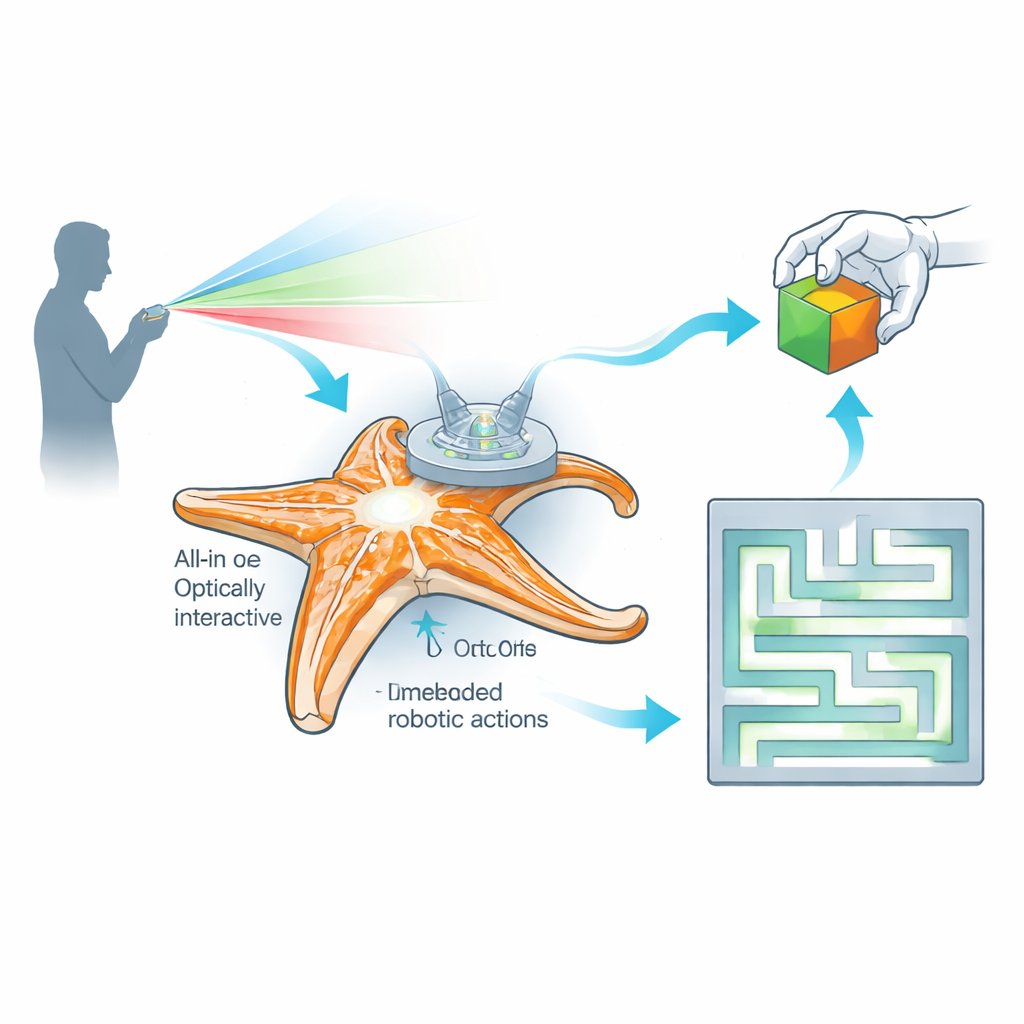
Why soft robots need built-in brains
Most soft robots today rely on bulky external electronics or direct human judgment for deciding what tasks to perform and how to perform them. They may be flexible and safe to touch, but they lack an internal center that can store and manage information the way a brain does for an animal. That means they cannot independently guide an operator through a task or securely hold mission plans inside their own bodies. The authors set out to create a soft robot where information and motion are tightly linked, so that commands, feedback, and actions are all handled within a single all‑soft framework.
Two special materials working as one
The key is a carefully designed pairing of two thin films: a liquid crystal network, which responds strongly to light, and silk fibroin, a protein drawn from silkworm cocoons that reacts to moisture. Stacked into a bilayer, these films bend in opposite directions under light or humidity, allowing the robot to curl, coil, twist, and even adopt three‑dimensional shapes. By choosing film thickness, cutting direction, and how segments are assembled, the researchers program a wide range of motions, from simple bending strips to spiral springs and complex multi‑segment structures. This combination overcomes the limits of each material alone, yielding soft parts with many degrees of freedom and long‑term stability under repeated use.
Holograms hidden inside soft matter
Beyond movement, the same liquid crystal material is patterned at the microscopic level to store holograms—light‑based images that appear when the film is illuminated in the right way. Using a digital micromirror system, the team writes intricate patterns into the orientation of the liquid crystal molecules, converting them into solid films that project crisp holographic images when lit. At the same time, the silk layer is doped with special nanoparticles that glow in different colors when excited by invisible near‑infrared light. By mixing blue, green, yellow, and red upconversion particles into silk, the researchers create flexible films that shine in distinct colors without losing mechanical performance. Together, the holographic liquid crystal and the glowing silk form an all‑optical information unit that can encode, hide, and reveal commands in several layers. 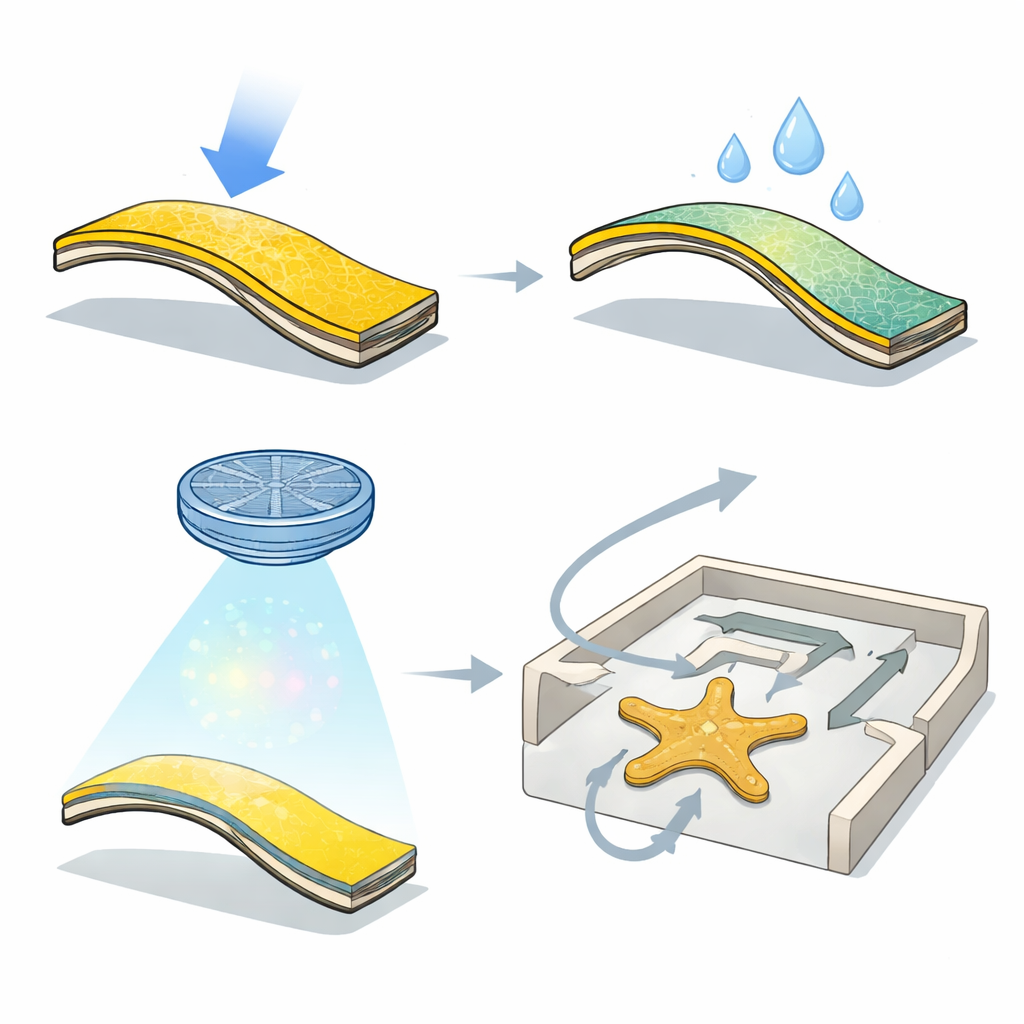
Soft machines that follow hidden light instructions
To show how this works in practice, the team builds two showcase robots. The first is a four‑armed gripper whose base carries a holographic film. When illuminated with a special light pattern, the base projects an image that visually describes the mission—for example, grab the blue block and place it in the matching box. The operator decodes this projection and then uses a separate light beam to heat the bilayer arms, making them bloom open and close to grip, lift, move, and release the object on demand. In a second example, a tiny four‑legged walker is combined with a flower‑like shell holding colored silk petals and a central hologram disk. Water vapor first opens the flower, exposing the hidden holograms. Circularly polarized light then reveals four different holographic patterns, each paired with a specific petal color that appears under infrared excitation. Only one particular color sequence matches the correct path through a maze. Once decoded, the operator drives the walker by selectively shining light on its legs, causing it to crawl in different directions and escape the maze along the prescribed route.
What this means for future smart tools
In simple terms, this work shows how to give soft robots both a body and a memory made entirely of responsive materials. Light acts as the universal language: it writes and hides instructions, lets the robot display them back to the user, and powers the movements that carry out the task. Because the building blocks—liquid crystal polymers and silk—are compatible with biological systems, the authors envision future medical micro‑robots that could be guided and authenticated optically inside the body, even where conventional electronics struggle. While real applications will require deeper light penetration and further material refinements, this study maps out a new direction for soft machines that think and act through light‑based "conversations" built directly into their flexible structures.
Citation: Zhang, ZC., Wei, Y., Wang, ZY. et al. All-in-one optically interactive soft robots with embedded liquid crystal holography. Light Sci Appl 15, 219 (2026). https://doi.org/10.1038/s41377-026-02287-5
Keywords: soft robotics, holography, liquid crystals, silk biomaterials, light-controlled actuation
See more on the researcher's website: https://light.nju.edu.cn/index