Clear Sky Science · en
Active steering of cathodoluminescence through a generalized Smith–Purcell effect
Turning Fast Electrons into Tiny Adjustable Spotlights
Imagine being able to shine a beam of light from a chip and steer it to any angle you like, not by moving mirrors, but by reprogramming the material itself. This paper explores how fast-moving electrons flying over carefully designed nanostructures can generate beams of light whose direction can be actively controlled. The work points toward ultra-small, tunable light sources and sensors that could plug directly into electron microscopes and future photonic chips.
The Classic Effect Behind the Idea
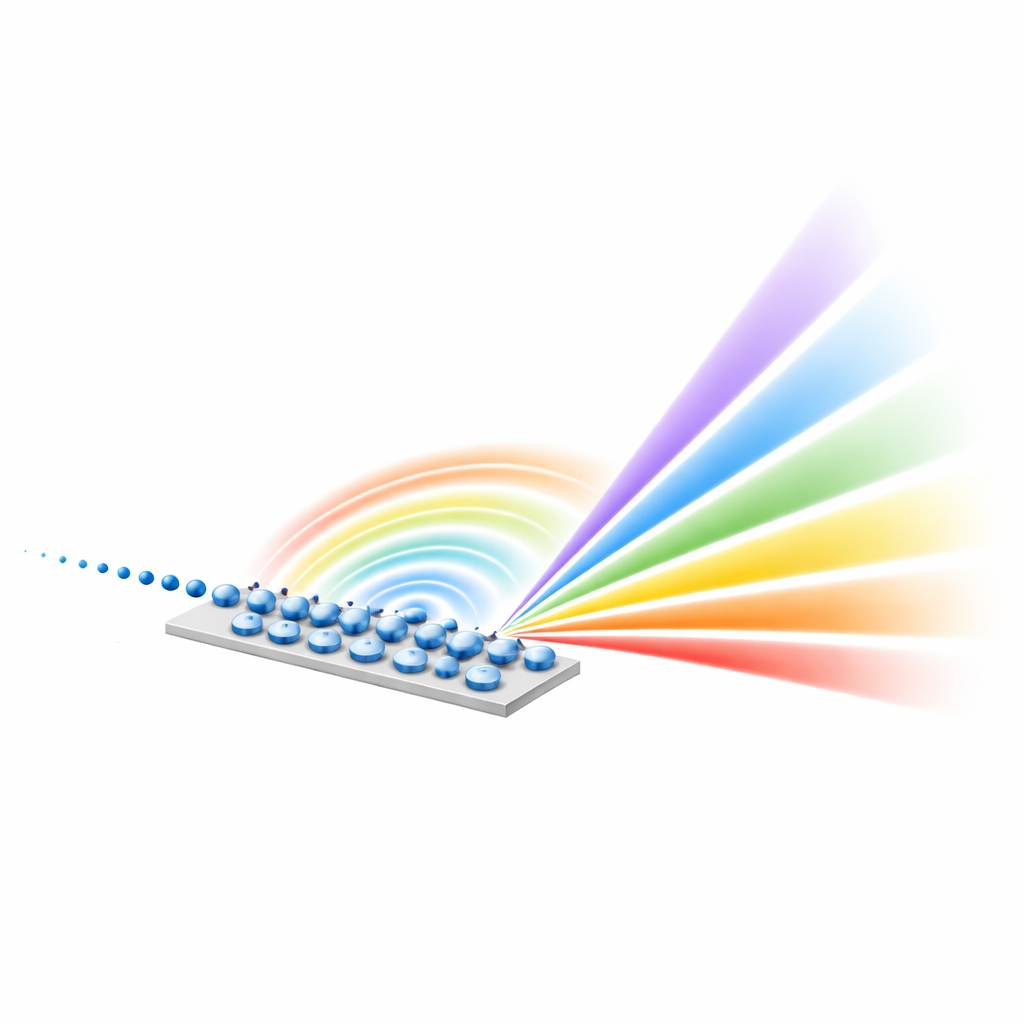
When a fast electron glides past a regularly patterned surface, its electric field shakes the surface in a repeating way, causing it to emit light. This phenomenon, known as Smith–Purcell radiation, produces light at specific angles and colors set by the spacing of the pattern, the electron speed, and the light’s wavelength. In the traditional picture, the surface is an infinite, perfectly regular grating, and every element responds in the same way. Under these simple conditions, only a few emission angles are allowed, and the pattern cannot be changed once the grating is fabricated.
Generalizing How the Light Gets Out
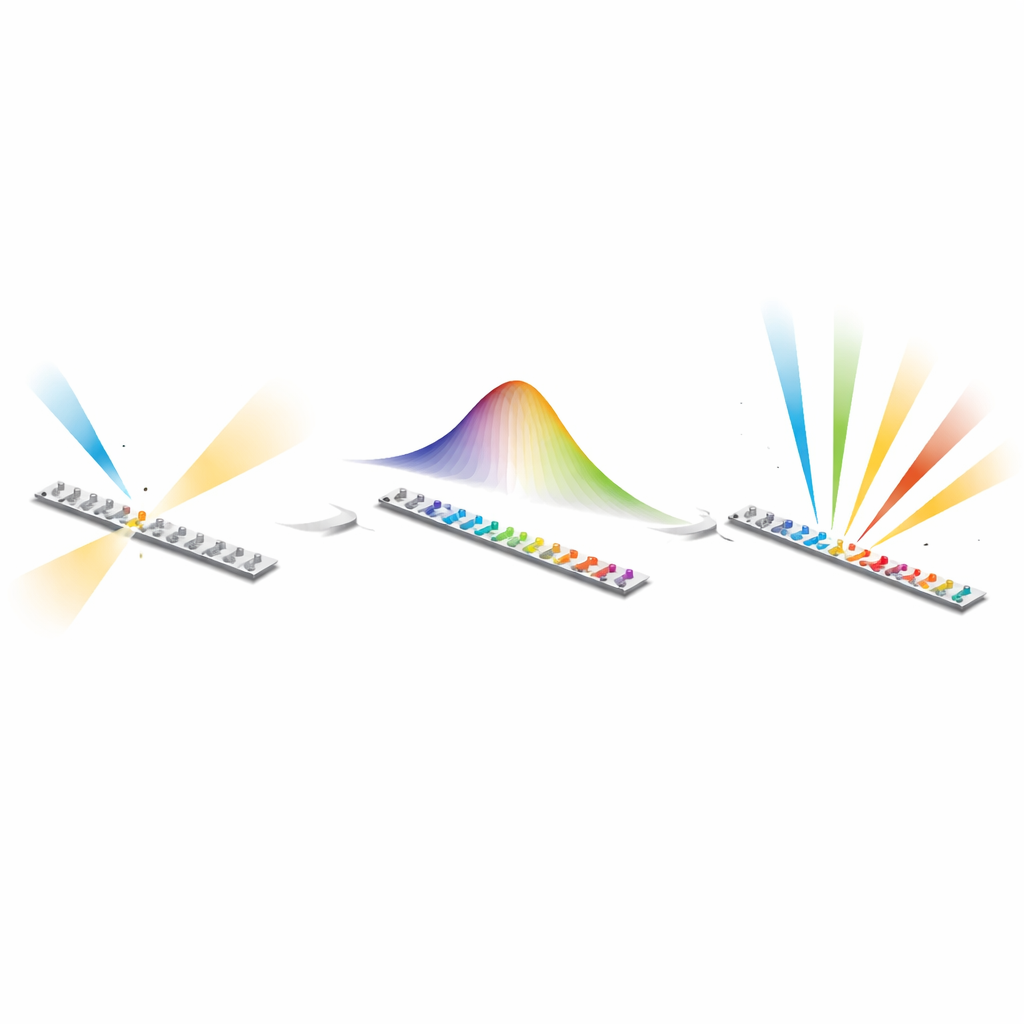
The authors extend this classic effect to something much more flexible. They study finite arrays of tiny scatterers—like nanoscale rods, disks, or ribbons—arranged in a line. Crucially, each element is allowed to respond differently to the passing electron. Instead of every nano-object having the same strength and phase of oscillation, they treat the array as a set of dipoles whose amplitudes can be patterned along the line. By decomposing this pattern into simple “harmonics,” they derive a generalized Smith–Purcell condition that predicts many more possible emission channels. Each harmonic in the dipole pattern corresponds to a distinct allowed emission angle, so changing the pattern selects which angles light comes out.
How to Steer the Beam Without Moving Parts
With this generalized framework, the team shows that carefully choosing the variation of dipole strength along the array makes the light beam steerable. For example, imposing a smooth sinusoidal modulation across 51 elements produces a single sharp lobe of radiation at a chosen angle, while other directions are suppressed by destructive interference. By changing the modulation’s “frequency” across the array, the emission peak can be shifted stepwise from near-normal emission to more oblique angles, covering a wide span of directions. Increasing the number of elements narrows the light beam and adds more finely spaced steering positions, much like increasing the number of slits in a diffraction grating sharpens and multiplies its peaks.
Materials That Can Be Reprogrammed on Demand
To turn this concept into a practical device, the authors explore real materials whose optical response can be tuned after fabrication. They propose arrays of vanadium dioxide (VO₂) nanodisks, a material that switches between insulating and metallic states when heated by a laser pulse. By shaping the pump beam so each disk receives a different energy dose, the local phase of VO₂ and thus its polarizability can be patterned along the array, imprinting the desired dipole profile and steering the emitted light. They also examine arrays of graphene nanoribbons, whose carrier density—and hence optical strength—can be adjusted electrically. By assigning a different gate voltage to each ribbon, they create strong, programmable modulations that yield nearly ideal steering into selected angles.
From Theory to Future Electron-Driven Photonic Devices
In essence, this study shows that by engineering how each tiny element in a metasurface responds to a passing electron, one can reroute the resulting light in a controlled way, without moving any hardware. The conclusion is that Smith–Purcell radiation is not just a fixed property of a grating, but a reconfigurable resource if the underlying nanostructures are tunable. This opens paths to compact, programmable free-electron light sources, angle-selective spectroscopy tools, and potentially even electron-driven holography and quantum light generation, all built on the same principle of shaping emission through tailored nano-arrays.
Citation: Dias, E.J.C., Rodríguez Echarri, A., Rasmussen, T.P. et al. Active steering of cathodoluminescence through a generalized Smith–Purcell effect. Light Sci Appl 15, 218 (2026). https://doi.org/10.1038/s41377-026-02280-y
Keywords: Smith–Purcell radiation, cathodoluminescence, metasurfaces, graphene nanoribbons, active beam steering