Clear Sky Science · en
Minimalist optical system for achromatic imaging within extended field of view based on monolithic integrated meta-axicon cluster
Sharper Color Photos from Thinner Lenses
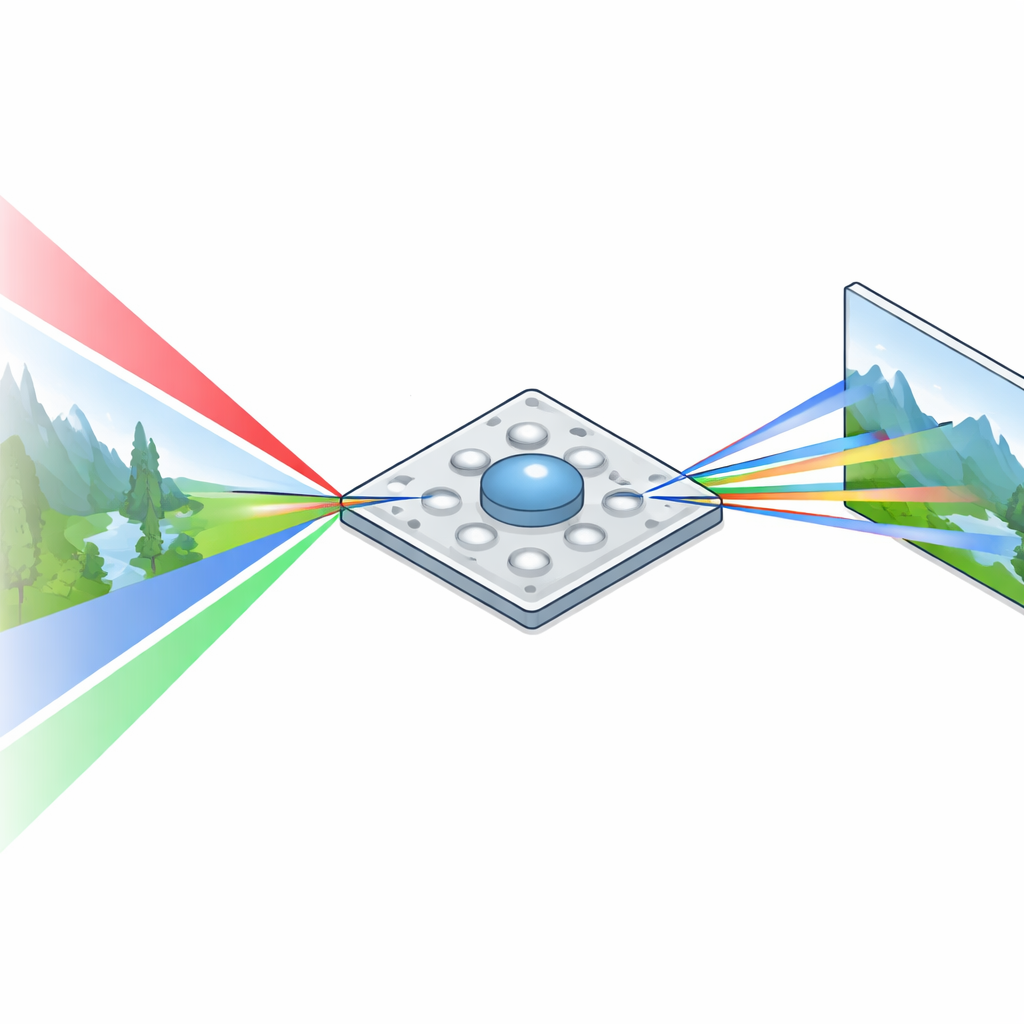
Modern cameras, from smartphones to space telescopes, struggle to stay small and light while still capturing sharp, color-accurate pictures over a wide field of view. This research shows a new way to build an ultra-thin “meta‑camera” that avoids the usual color blur of simple lenses, yet keeps the design compact and minimalist. Instead of fighting the natural behavior of light with ever more complex glass stacks, the authors harness that behavior—and clean it up later with smart computation.
Why Regular Flat Lenses Hit a Wall
Flat “metalenses” steer light using forests of microscopic pillars etched onto a surface. They promise thinner, lighter optics than traditional glass. But when these metalenses are made large enough for real cameras, different colors of light no longer focus to the same spot. Engineers have tried to fix this by carefully tuning how each tiny pillar slows different colors, but fabrication limits mean there is a hard trade-off: you can have a big lens, or a wide color range, or a high numerical aperture—but not all three at once. As a result, most truly color-corrected metalenses today are still too small for many practical imaging systems.
Turning Rings of Light into an Advantage
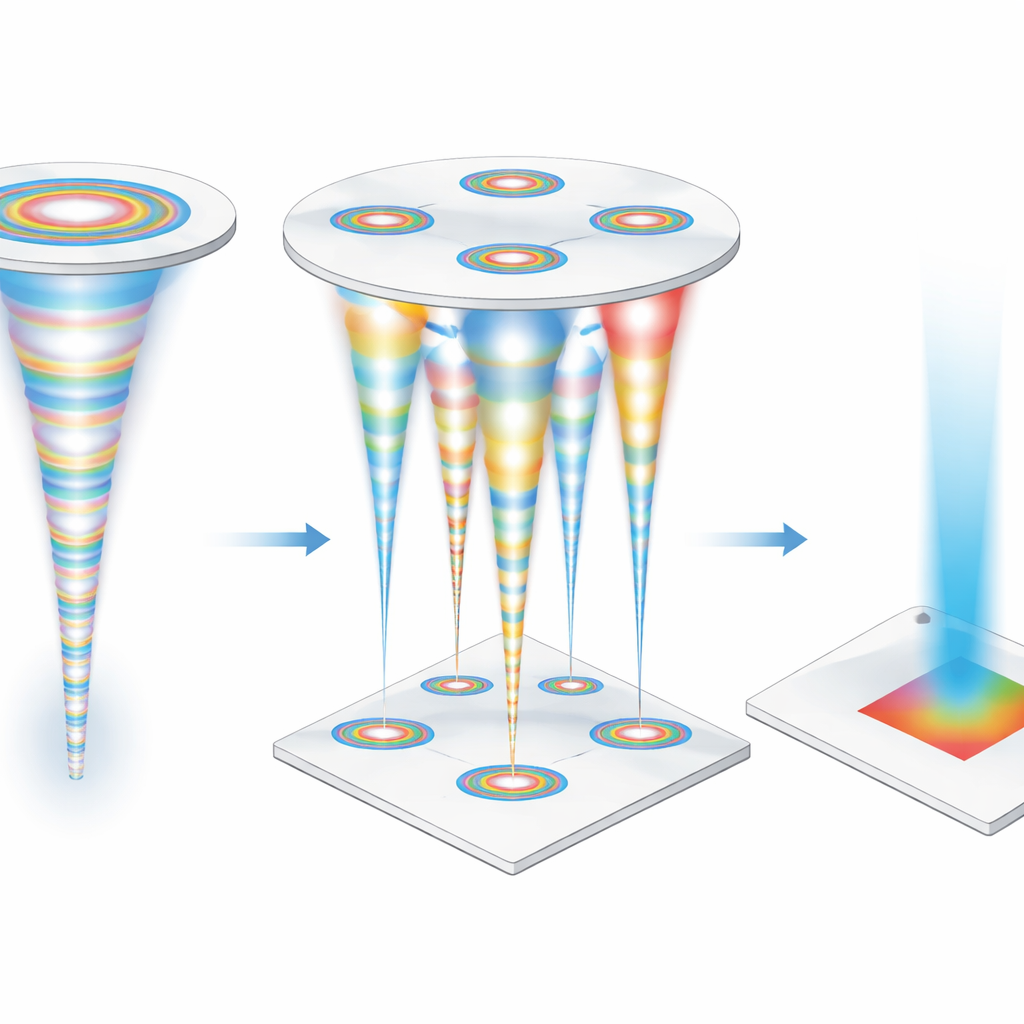
The authors take a different path. Instead of forcing light to form a tight point, they use “axicons”—cone-shaped phase profiles that turn light into Bessel beams: a bright central spot surrounded by rings. Crucially, the pattern of rings from these beams barely changes shape across the visible spectrum, even though the light naturally spreads along the axis. This means that, while the raw image looks blurred and ringy, the blur itself is almost the same for red, green, and blue light. That repeatable blur pattern, known as the point spread function, is exactly what a computer algorithm needs to reconstruct a sharp image after the fact.
Covering a Wide Field without Color Smear
A single axicon works well only for light coming straight in; tilt the light and the ring pattern distorts, especially at different colors. To overcome this, the team designs special “off-axis meta‑axicons” that catch light arriving from angled directions and convert it into nearly ideal Bessel beams—with very little lateral color shift. They do this by carefully shaping the phase pattern so that light from many points within a given field angle travels along paths that remain equal in length, and by adding a tiny corrective tilt to balance color shifts across the spectrum. Eight of these off-axis elements are placed around a larger central axicon on one monolithic chip, each responsible for a wedge of the scene. Together they cover a stitched field of view of about 10 degrees while keeping the blur pattern consistent enough for accurate restoration.
Letting the Computer Finish the Job
Because the blur from the axicon-based system is well behaved across colors and field angles, the recorded image can be treated as a known convolution of the true scene with a stable blur kernel. The authors develop a “non-blind” deconvolution method that assumes this known kernel and uses a total-variation regularization step to remove noise while preserving edges. In practice, the camera first records a soft, halo-like image dominated by Bessel rings. The algorithm then inverts the effect of both the principal diffracted beam and the small amount of directly transmitted light, recovering a crisp color image. Despite using just a single metasurface and a detector, the restored pictures reach angular resolutions at least 80 percent as good as an ideal conventional lens of the same size across the whole field.
What This Means for Future Tiny Cameras
For non-specialists, the key message is that future cameras may not need bulky glass stacks to deliver sharp, color-true images. By embracing a controlled, predictable blur produced by a patterned flat surface and cleaning it up numerically, this work shows that a single, compact metasurface can act as the heart of a wide-angle, achromatic imaging system. The result is a promising recipe for thinner, lighter cameras in phones, drones, wearable devices, and even astronomy, where every gram and millimeter counts.
Citation: Wang, J., Wang, C., Wang, B. et al. Minimalist optical system for achromatic imaging within extended field of view based on monolithic integrated meta-axicon cluster. Light Sci Appl 15, 202 (2026). https://doi.org/10.1038/s41377-026-02272-y
Keywords: metasurface imaging, achromatic optics, flat lenses, computational photography, Bessel beams