Clear Sky Science · en
Speckle-based curvature optical metrology
Seeing Tiny Bends in Critical Mirrors
From powerful X-ray microscopes to space telescopes, many of today’s most advanced instruments rely on mirrors that must be shaped and polished with almost unbelievable precision. But checking whether a mirror is “just right” becomes very hard when its surface is strongly curved or has a complex, freeform shape. This paper introduces a new way to read out those tiny bends using shimmering laser speckle patterns, opening the door to faster, more flexible quality control for next‑generation optics.
Why Measuring Mirror Shape Is So Hard
High‑end X-ray mirrors are no ordinary bathroom mirrors. To focus X-rays cleanly, their surfaces must be smooth and accurately shaped to within a few billionths of a meter over lengths of many centimeters. Traditional tools such as interferometers and long‑trace profilers can reach that accuracy, but they struggle with mirrors that are very strongly curved, non‑spherical, or simply very large. Interferometers often need custom reference optics and complex stitching of many small measurements, and may fail entirely when the mirror bends too steeply. Profilers scan line by line and can take hours, while newer speckle‑based methods have been limited by small cameras and narrow fields of view. As modern X‑ray sources and industrial systems demand more intricate optics, engineers need metrology that is both precise and practical on the factory floor.
A New Way: Reading Shape from Speckle
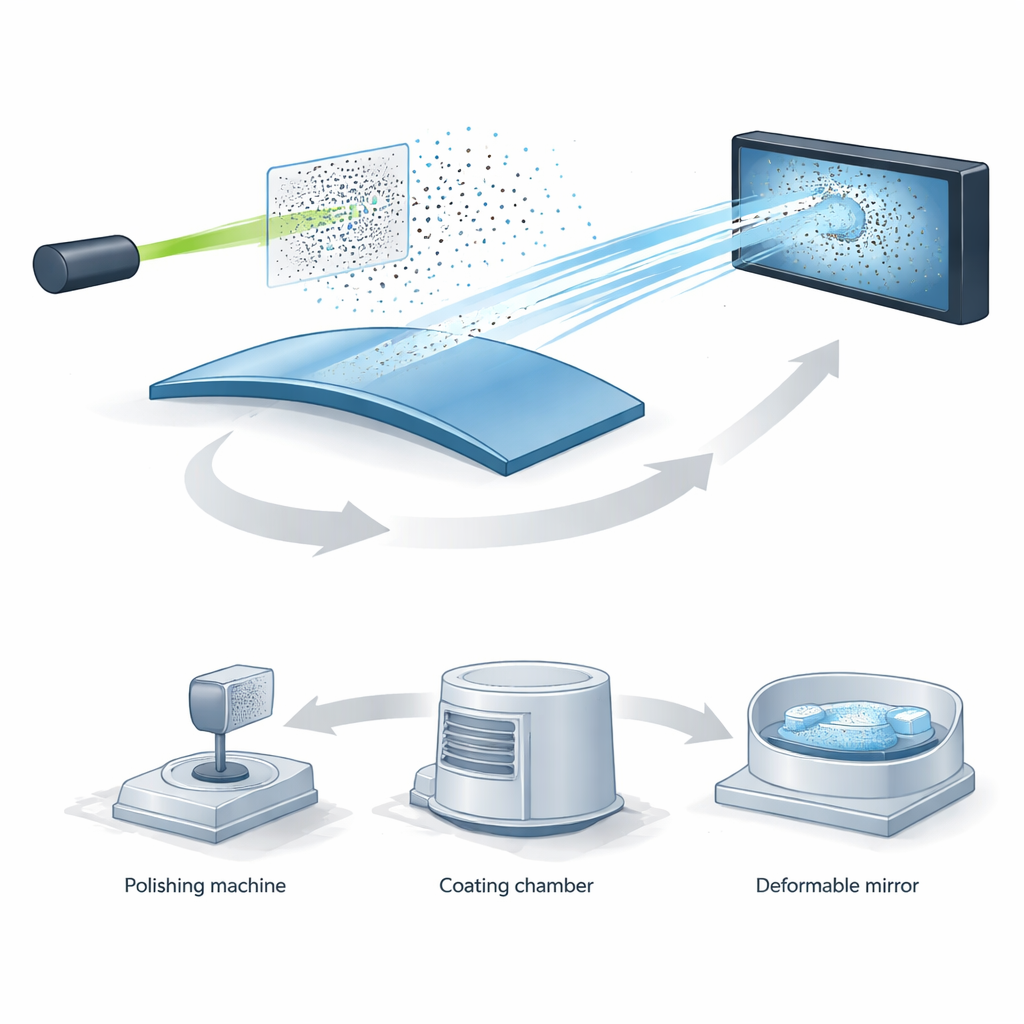
The authors present Speckle-based Curvature Optical Metrology (SCOM), a compact instrument that infers how a mirror bends by watching how a laser speckle pattern shifts when reflected. A low‑power laser is broadened by a diffuser into a field of fine bright and dark spots, which illuminates the mirror surface. A beam splitter directs the reflected speckle pattern onto a large‑area camera. When the mirror is moved slightly between measurements, tiny changes in surface curvature cause subtle speckle shifts on the detector. By comparing stacks of images with advanced digital correlation algorithms, the system reconstructs how much the pattern has moved at each point. That motion is mathematically linked to the mirror’s curvature, and from curvature the method builds up maps of surface slope and height. Careful tuning of the aperture, camera distance, and scanning strategy balances field of view, resolution, and sensitivity.
From Polishing Machines to Coating Chambers
SCOM is designed to work directly on manufacturing tools, so mirrors do not need to be removed for inspection. The first implementation was retrofitted onto an ion beam figuring machine, which gently sculpts optical surfaces by controlled erosion. By measuring before and after the beam runs, SCOM can operate in an “absolute” mode, which reports the full surface shape, or in a “differential” mode that focuses on changes due to a single polishing step. Tests on etched patterns showed that both modes track material removal rates closely, and that SCOM’s results agree well with a high‑end commercial interferometer while offering faster turnaround. In a demanding trial on a steeply curved elliptical X‑ray mirror—extremely challenging for standard optics tests—SCOM delivered detailed curvature maps in about an hour, compared with six and a half hours for interferometry, yet matched the target shape and reference data.
Probing Strong Curves, Flexible Mirrors, and Film Stress
To probe the limits of the technique, the team built a dedicated SCOM station on a precision gantry and measured spherical mirrors ranging from gently curved (10‑meter radius) to very strongly curved (100‑millimeter radius). For the milder mirror, SCOM’s curvature and height maps closely matched interferometer measurements, with differences on the order of a few nanometers. The steeper mirror could not be measured interferometrically at all, but SCOM still recovered its shape and revealed polishing defects. The instrument was then used to characterize a deformable mirror whose surface is reshaped by electrical actuators: by applying patterned voltages and recording how the curvature map flipped and varied, the authors showed that SCOM can sensitively track complex freeform deformations. In a third application, SCOM was mounted on a multilayer coating chamber to monitor how thin film deposition bends a substrate. Its curvature readings agreed well with those from a commercial multi‑beam sensor, but with finer spatial detail, enabling accurate estimates of internal film stress.
Stitching the Big Picture Together
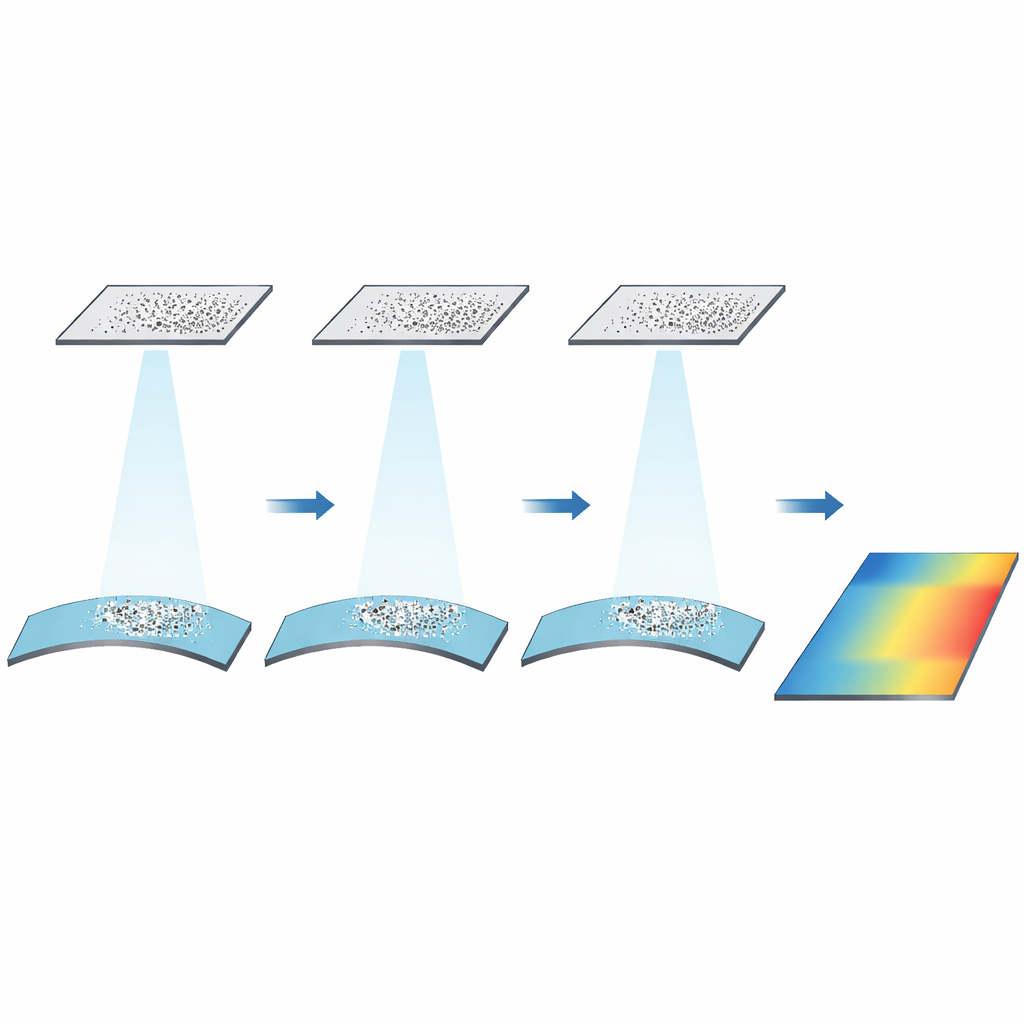
Because the camera covers only part of a large mirror at once, the system translates the optic in small steps and records overlapping curvature tiles. These are then stitched into a seamless two‑dimensional map, preserving both gentle global bends and fine ripples in curvature. Line profiles from stitched SCOM data compare favorably with interferometer and earlier speckle‑based measurements, especially at the mid‑scale surface features that most affect X‑ray beam quality. The authors also benchmark SCOM against a range of established tools, showing that while classic interferometers still win on ultimate accuracy for simple shapes, SCOM offers a unique mix of portability, 2D coverage, and tolerance of strong curvature, all with moderate resolution and repeatability suitable for real‑world production.
What This Means for Future Optics
By turning noisy‑looking speckle patterns into precise maps of how a mirror bends, this work extends optical metrology to surfaces that are difficult or impossible to measure with conventional instruments. SCOM is compact enough to ride directly on polishing, coating, and alignment setups, providing near‑real‑time feedback that can shorten development cycles and improve mirror performance. As demands grow for intricate X‑ray, space, and industrial optics, such speckle‑based curvature mapping could help manufacturers confidently shape and verify mirrors whose complexity once placed them beyond reach.
Citation: Wang, H., Shurvinton, R., Pradhan, P. et al. Speckle-based curvature optical metrology. Light Sci Appl 15, 192 (2026). https://doi.org/10.1038/s41377-026-02257-x
Keywords: X-ray mirrors, optical metrology, laser speckle, curved optics, surface curvature