Clear Sky Science · en
Electrically switchable continuous phase liquid crystal Fresnel zone plate
Why this matters for future eyewear
Today’s augmented and virtual reality headsets struggle with a basic problem: their optics are bulky, power-hungry, and hard to adapt to different users’ eyes. This paper explores a new kind of ultra-thin, electrically adjustable lens that can focus light efficiently while remaining flat and lightweight. Such lenses could help shrink headsets, improve image brightness, and allow electronic focusing without any moving parts, making long-term wear more comfortable and practical.
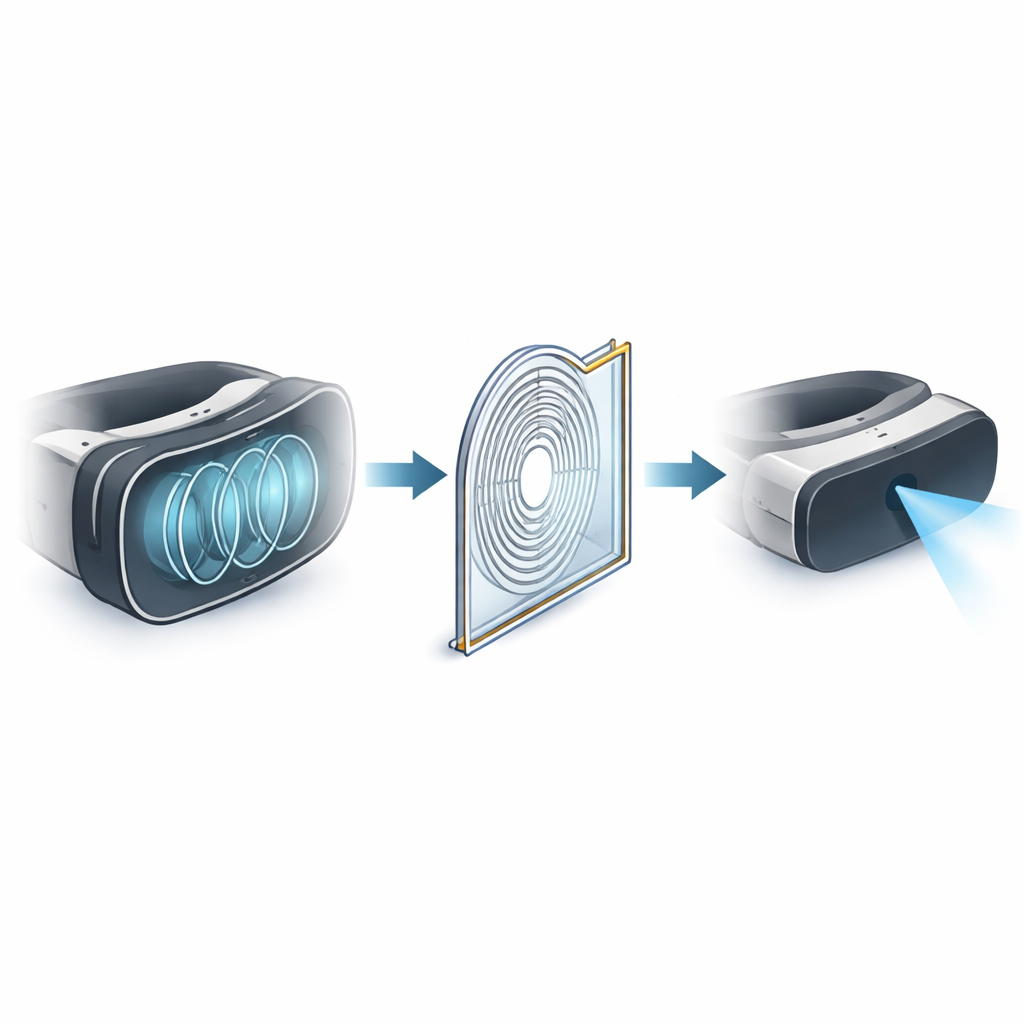
A flat lens made from soft orderly liquids
The heart of the work is a special class of materials called liquid crystals, which behave like a fluid but keep their molecules pointing in preferred directions. That directional order changes how light travels through them and can be controlled by an applied voltage. The researchers combine these liquids with a light-sensitive “building block” that can be solidified by a tightly focused laser. By selectively solidifying tiny regions, they sculpt a three-dimensional pattern inside the liquid crystal layer that acts as a thin lens called a Fresnel zone plate. Unlike traditional zone plates that use abrupt on–off patterns, this device has a smoothly varying phase profile, meaning the light’s wavefront is bent in a more continuous, lens-like way.
Writing a lens inside a liquid layer
To build this flat lens, the team sandwiches a mixture of liquid crystal, reactive molecules, and a light-activated starter between two glass plates with transparent electrodes. Using a technique called two-photon polymerization, they focus an ultrafast infrared laser into the liquid layer. Only at the tiny focal spot is the light intense enough to lock the nearby molecules into a rigid polymer network. By scanning this spot in three dimensions while the liquid crystal is held in a well-defined state by an applied voltage, they “freeze in” a carefully calculated pattern of refractive index that emulates a continuous Fresnel lens. The result is a micrometer-thick, hundreds-of-micrometers-wide structure that can bend light like a lens yet remains flat and compatible with standard display stacks.
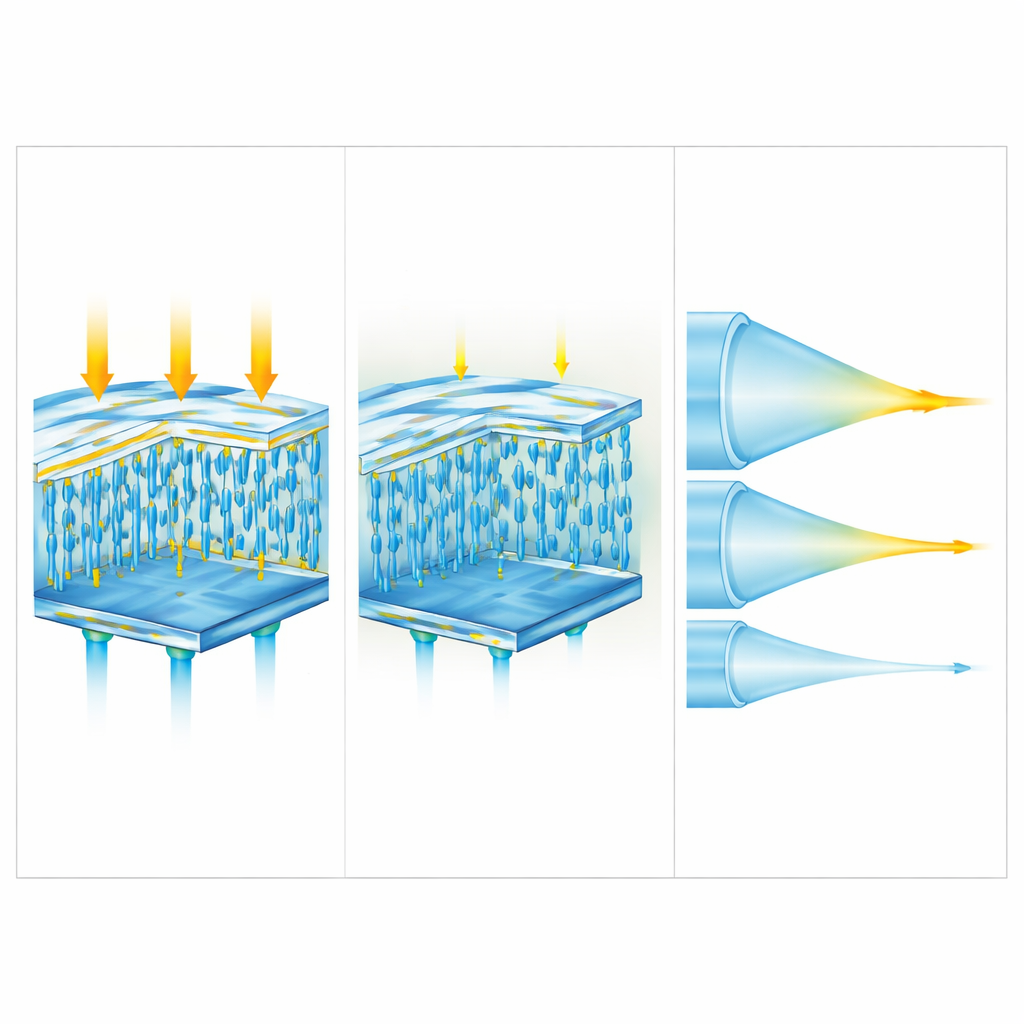
Sharper focus with less wasted light
The authors first demonstrate a device whose phase pattern wraps smoothly over a range equivalent to one full 2π cycle of the light’s wavefront. Microscopy and holographic measurements show that the fabricated pattern closely matches the design: concentric rings of varying phase that gently steer the passing light toward a single focal point. When tested with a laser, this continuous-profile lens produces a bright, well-defined spot at the designed focal length when no voltage is applied, and the focusing effect disappears when a higher voltage realigns the liquid crystal. Compared with a conventional “binary” Fresnel plate of the same size and focal length, the smooth version nearly doubles the intensity in the main focus, because much less light is scattered into unwanted side spots.
A tiny lens that jumps between two focal distances
The second device pushes the concept further by allowing the same flat lens to switch between two different focal distances. Here, the phase pattern is designed to span roughly twice the wavefront range (about 4π), so that at low voltage the lens produces a short focal length. As the voltage is increased, the liquid crystal partially unwinds, effectively compressing the phase range to behave like a 2π design with approximately twice the focal length. Experiments confirm this dual behavior: at zero volts the lens focuses at about 24 millimeters, at an intermediate voltage it refocuses at about 48 millimeters, and at higher voltage the focusing largely vanishes. Imaging tests with a standard resolution target show that the lens can form recognizable images at both distances, with the longer focal length naturally giving slightly lower resolution due to its smaller numerical aperture.
Stability, limits, and future possibilities
The team also checks how robust the device is under repeated use. Over a full day of cycling between focusing and non-focusing voltages, the brightness at the focused spot remains effectively constant, indicating that the internal polymer structure and liquid crystal alignment are stable. The main limitation in the current prototype is switching speed, which is slowed by the relatively thick liquid crystal layer and the way it was written; the authors outline clear routes to faster response, including thinner cells and improved laser-writing optics. Looking ahead, this approach could be scaled up or replicated using imprint techniques, and extended to lenses that step through multiple focal distances. In plain terms, the work shows how to carve a precise, adjustable lens directly into a soft, voltage-controlled material—opening a promising path toward thinner, brighter, and more adaptable optics for headsets, cameras, and other photonic systems.
Citation: Xu, Z., Nourshargh, C., Wang, T. et al. Electrically switchable continuous phase liquid crystal Fresnel zone plate. Light Sci Appl 15, 203 (2026). https://doi.org/10.1038/s41377-026-02251-3
Keywords: liquid crystal lenses, Fresnel zone plate, AR/VR displays, flat optics, electrically tunable focus