Clear Sky Science · en
45 km ROTDR with 0.5 m/0.11 °C via complex-domain square-wave width-chirp pulse compression
Taking the Temperature of the World with Glass Wires
From glaciers and power cables to oil pipelines and tunnels, knowing exactly where things are heating up can prevent disasters and save money. A single optical fiber, as thin as a human hair, can already act like thousands of tiny thermometers spread over many kilometers. This paper presents a new way to use such fibers to measure temperature along 45 kilometers with half‑meter detail and very high accuracy, overcoming limits that scientists long thought were unavoidable.
Why Long-Distance Temperature Mapping Is Hard
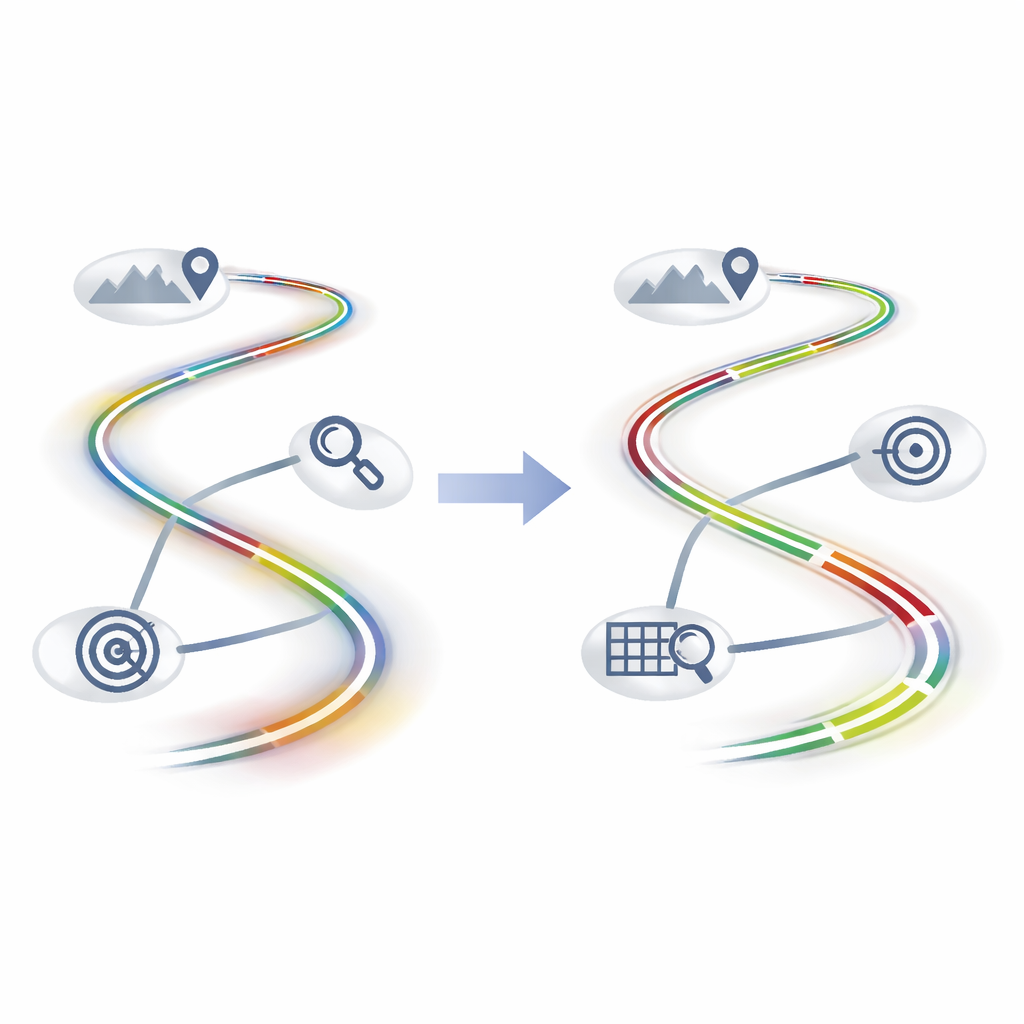
In standard fiber-based temperature systems, short light pulses are sent down the glass and a faint glow called Raman backscatter returns from every point along the fiber. By timing how long the light takes to return, the system works out where the signal came from and how hot that spot is. But there is a catch: to see small features, you need very short pulses, which carry little energy and produce weak signals. To look far, you need long, energetic pulses, which blur together signals from many meters of fiber. Engineers have been stuck in this three-way tug-of-war between how far they can see, how fine the detail is, and how accurate the temperatures are.
Earlier Workarounds and Their Limits
Researchers have tried clever tricks to dodge this trade-off. Some methods use advanced math or machine learning to sharpen blurry data after the fact, but these struggle when the raw signals are noisy, especially over long distances. Other approaches swap in special fibers, complicated coding patterns, or exotic light sources with random waveforms. These can improve either range or resolution, but usually not both at once, and they often add cost and complexity. A few systems can watch tens of kilometers or resolve features under a meter, yet seldom achieve long reach, fine detail, and precise temperature readings all together.
A New Way to Pack and Squeeze Light Pulses
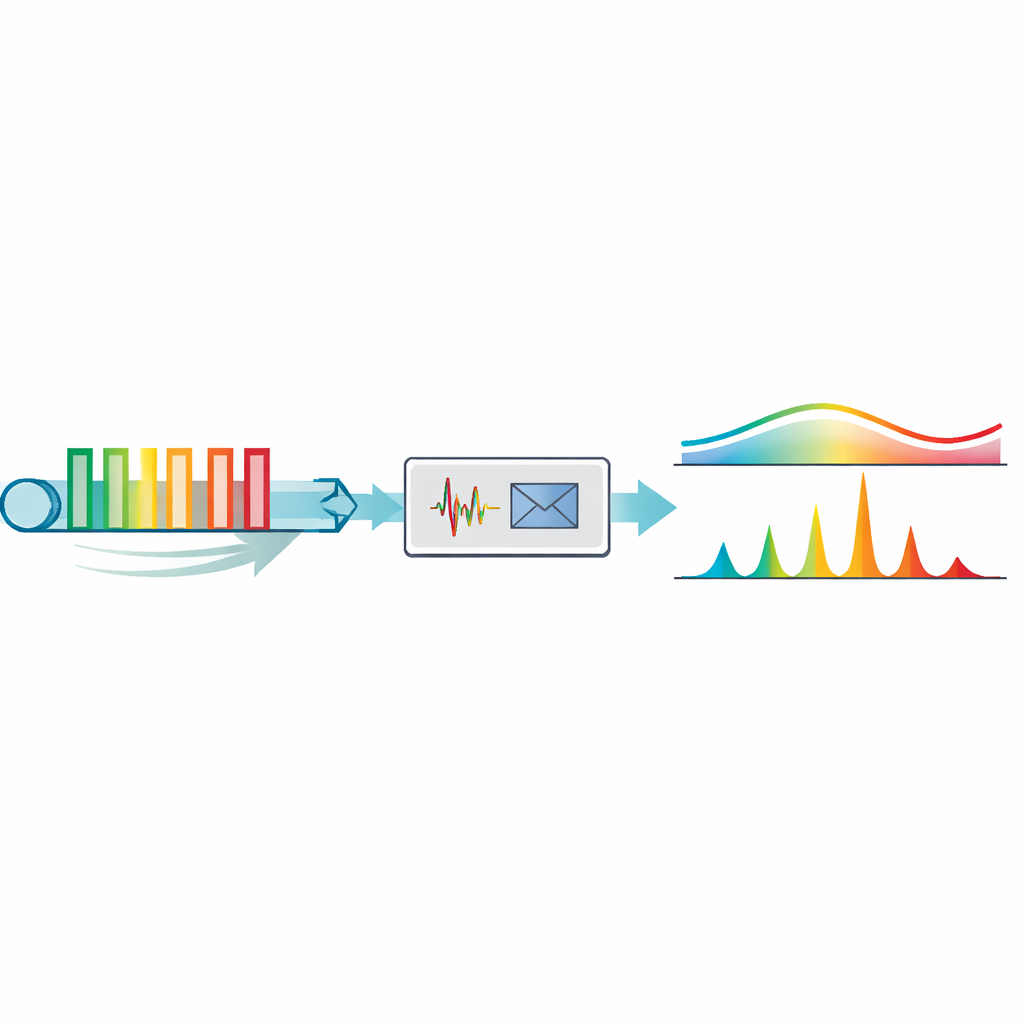
The authors introduce a new scheme called complex-domain square-wave width-chirp pulse compression (CSWPC). Instead of sending a single smooth pulse, they launch a carefully designed train of square pulses whose widths change in time, subtly encoding frequency information into the pulse pattern. The returning Raman glow is then mathematically converted into a complex signal with both amplitude and phase, using a tool known as the Hilbert transform. This makes it possible to run a matched filter—essentially a digital “lock-and-key” comparison with a time-reversed copy of the original pattern—that concentrates the spread-out energy into an ultra-narrow spike, like squeezing a long water wave into a sharp splash.
Sharper Vision, Longer Reach, Better Numbers
Because the final spike is much narrower than the original pulse, the fiber’s spatial resolution is now set by this compressed peak instead of the initial pulse length. In experiments, a 1-microsecond pulse is compressed to a 5-nanosecond response, corresponding to just 0.5 meters along the fiber—about a 200-fold improvement over a traditional system using the same pulse. At the same time, the long starting pulse still carries plenty of energy, so the signal remains strong even after traveling 45 kilometers. A second processing step, called complex-domain envelope extraction denoising, peels away random phase jitters while preserving the true signal strength, which directly tracks temperature. Together, these steps boost the signal-to-noise ratio by over 15 decibels and cut temperature fluctuations at the far end of the fiber down to about 0.11 °C.
What This Means for Real-World Monitoring
In plain terms, this technique lets one standard fiber act as 90,000 closely spaced, highly accurate thermometers over 45 kilometers, without exotic hardware or special fibers. It breaks the old rule that you must sacrifice distance or accuracy to gain detail, by smartly redistributing and compressing the energy of each pulse instead of simply making it shorter. Beyond temperature, the same idea could be adapted to other sensing methods that use light scattered in fibers, potentially enabling single-cable monitoring of strain, vibration, and temperature all at once. This work therefore points toward safer infrastructure, better environmental sensing, and more capable smart networks woven quietly into the world around us.
Citation: Fan, B., Li, J., Zhang, X. et al. 45 km ROTDR with 0.5 m/0.11 °C via complex-domain square-wave width-chirp pulse compression. Light Sci Appl 15, 175 (2026). https://doi.org/10.1038/s41377-026-02245-1
Keywords: distributed fiber sensing, Raman temperature sensing, pulse compression, optical time-domain reflectometry, infrastructure monitoring