Clear Sky Science · en
Power-efficient ultra-broadband soliton microcombs in resonantly-coupled microresonators
Light on a Chip for Everyday Technologies
Many cutting-edge tools, from GPS-like timekeeping to ultra-fast internet links and planet-hunting telescopes, rely on devices that carve laser light into thousands of evenly spaced colors, known as frequency combs. Today these combs are often bulky and power-hungry. This paper shows how to shrink them onto a chip while slashing the power they need, using a clever way of feeding light into tiny ring-shaped structures. The result is a new class of power-efficient “microcombs” that could make high-precision optical technology far more practical and portable.
The Challenge of Doing More with Less Power
Chip-scale frequency combs are created by shining a continuous laser into microscopic rings that trap light and turn it into short pulses circulating around the ring. In the spectrum, these pulses appear as a comb of evenly spaced colors, useful as a ruler for measuring frequencies or as many separate channels for data. Designers want three things at once: a very broad range of colors, very closely spaced lines (so electronics can read the spacing), and strong power in each line. But in standard designs, all three cannot be maximized together when laser power is limited. Pushing for broader span or finer spacing quickly drives up the required pump power beyond what compact on-chip lasers can reasonably provide.
A New Way to Feed the Ring
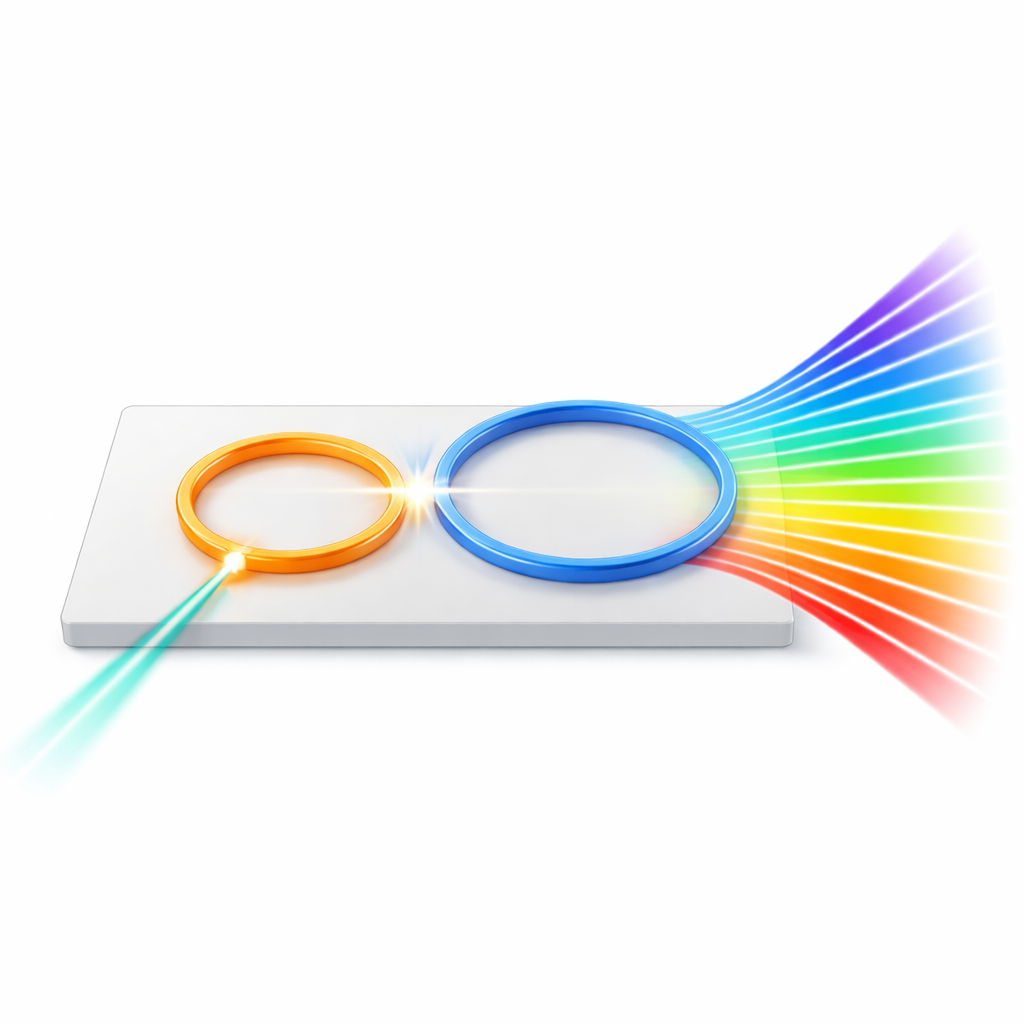
To break this power bottleneck, the authors insert a second ring—called a resonant coupler—between the incoming waveguide and the main nonlinear ring that actually generates the comb. Instead of feeding the main ring directly, the laser first builds up inside the coupler ring, which then hands concentrated energy into the comb-generating ring. By carefully choosing how strongly the two rings talk to each other and how quickly they lose energy, the team can boost the effective power inside the main ring by roughly a hundredfold compared with the same laser power entering through a simple waveguide. This resonant handoff lets the system reach operating conditions that were previously out of reach for integrated combs.
Much Broader Combs with the Same Laser
Using silicon nitride rings made on a standard wafer, the researchers compare the new resonant-coupler design to a conventional single-ring setup with the same geometry and quality. With similar pump powers, the ordinary design produces a moderate comb with only a few hundred useful lines. When they add the resonant coupler, the comb widens dramatically: the span of useful lines triples, reaching nearly a micrometer of optical bandwidth, and the number of lines above a modest power level jumps from hundreds to more than eight hundred. Importantly, achieving the same performance without the coupler would demand several times more laser power—up to about ten times by their estimates—highlighting how efficiently the new scheme uses every milliwatt.
Reaching an Entire Octave on a Chip
The team then tunes the geometry of the main ring to reduce its natural spread of speeds for different colors of light, a property that helps support even wider combs. In this configuration, their resonantly fed rings produce combs that span an entire octave in frequency, meaning the highest color is at least double the frequency of the lowest. They do this at repetition rates in the microwave and millimeter-wave ranges, where the spacing between comb lines is directly readable by standard electronics. Crucially, they achieve these wide, electronically friendly combs with pump powers hundreds of times lower than what earlier continuous-wave designs required for similar line spacings.
Turnkey Operation with an On-Chip Laser
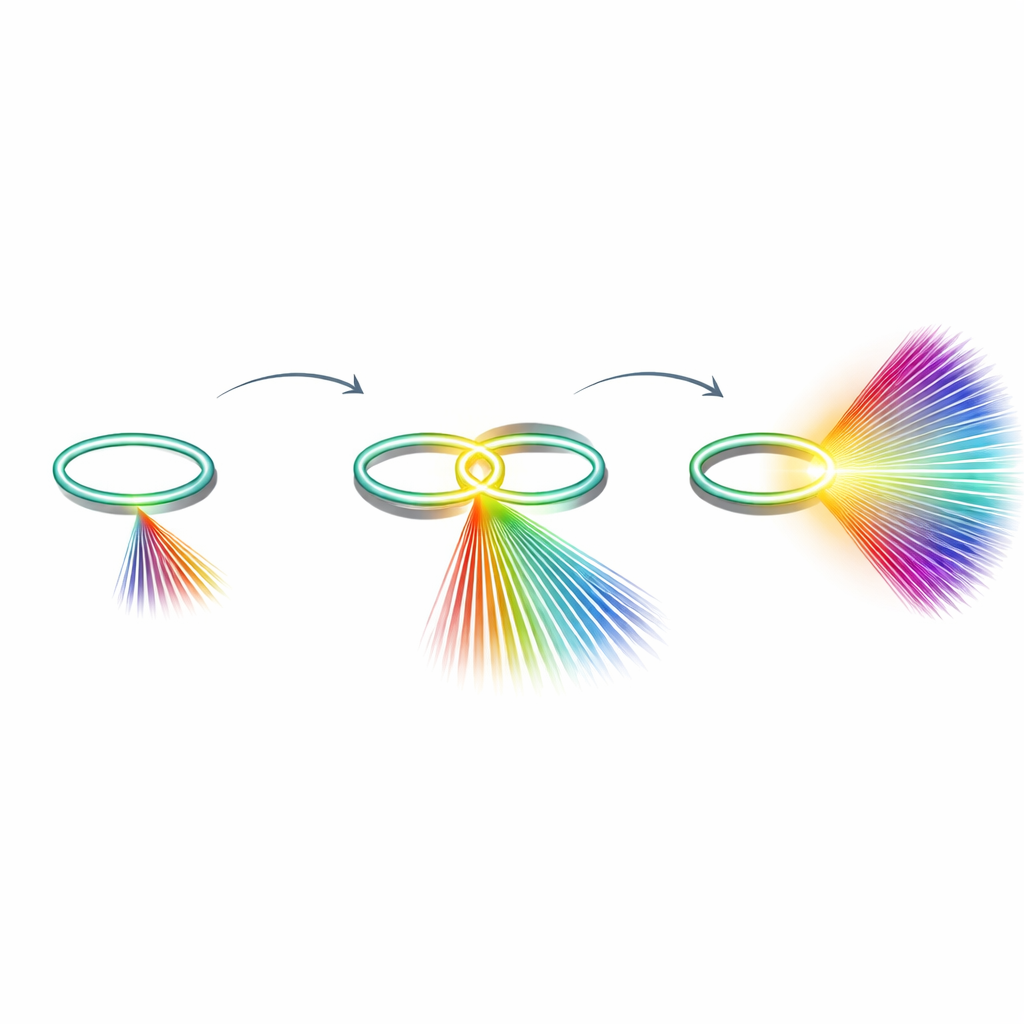
To show real-world practicality, the authors drive their coupled-ring comb using a compact on-chip semiconductor laser that delivers only about 20 milliwatts of optical power. Reflections from the rings gently feed back into the laser, a process called self-injection locking, which naturally narrows the laser’s color and steers the system into a stable single-pulse state. With this simple arrangement and no external optical isolator, the device repeatedly and reliably starts up the desired comb, producing over 170 strong lines and ultrashort pulses just tens of femtoseconds long—among the broadest combs reported at this repetition rate from such a small laser.
Why This Matters for Future Devices
By showing that a smart “pre-amplifier” ring can dramatically reduce the laser power needed for wide, finely spaced combs, this work removes a key barrier to putting precision optical tools into portable, robust packages. The same concepts could enable on-chip optical clocks, massively parallel data links, and compact spectrometers for astronomy, sensing, and medicine, all without resorting to bulky, high-power laser systems. In simple terms, the authors have found a way to make light on a chip work much harder, opening the door to everyday devices that rely on the kind of precise optical timing and measurement once reserved for large physics labs.
Citation: Zhu, K., Luo, X., Wang, Y. et al. Power-efficient ultra-broadband soliton microcombs in resonantly-coupled microresonators. Light Sci Appl 15, 185 (2026). https://doi.org/10.1038/s41377-026-02186-9
Keywords: optical frequency combs, microresonators, silicon nitride photonics, low-power integrated optics, chip-scale optical clocks