Clear Sky Science · en
Stress-driven photo-reconfiguration of surface microstructures via vectorial field-guided lithography
Shaping Surfaces with Beams of Light
Many of the patterns we see in nature—from mountain ridges to wrinkles in skin—arise because materials buckle and bend under stress. This research shows how scientists can now harness light itself to create and steer such stresses inside a special plastic, sculpting tiny surface structures as if they were soft clay. The work opens a path to surfaces whose microscopic shapes can be programmed by a computer-controlled beam, with potential uses in optics, fluid control, and bio-inspired materials.
Why Stress Patterns Matter
Whether in geology or biology, stress often determines how structures grow and reorganize. When internal forces build up, a system can lower its energy by changing shape, breaking its original symmetry and developing ridges, folds, or pillars. Engineers already exploit this idea using heat, humidity, or mechanical forces to wrinkle and fold materials into useful patterns. Light is especially attractive as a tool because it can be aimed without touching, patterned with high precision, and switched on and off quickly. Yet most light-based patterning has treated light simply as a source of energy, ignoring the fact that it also has a direction of oscillation—its polarization—that can carry detailed “instructions” into a material.
A Plastic That Moves Under Polarized Light
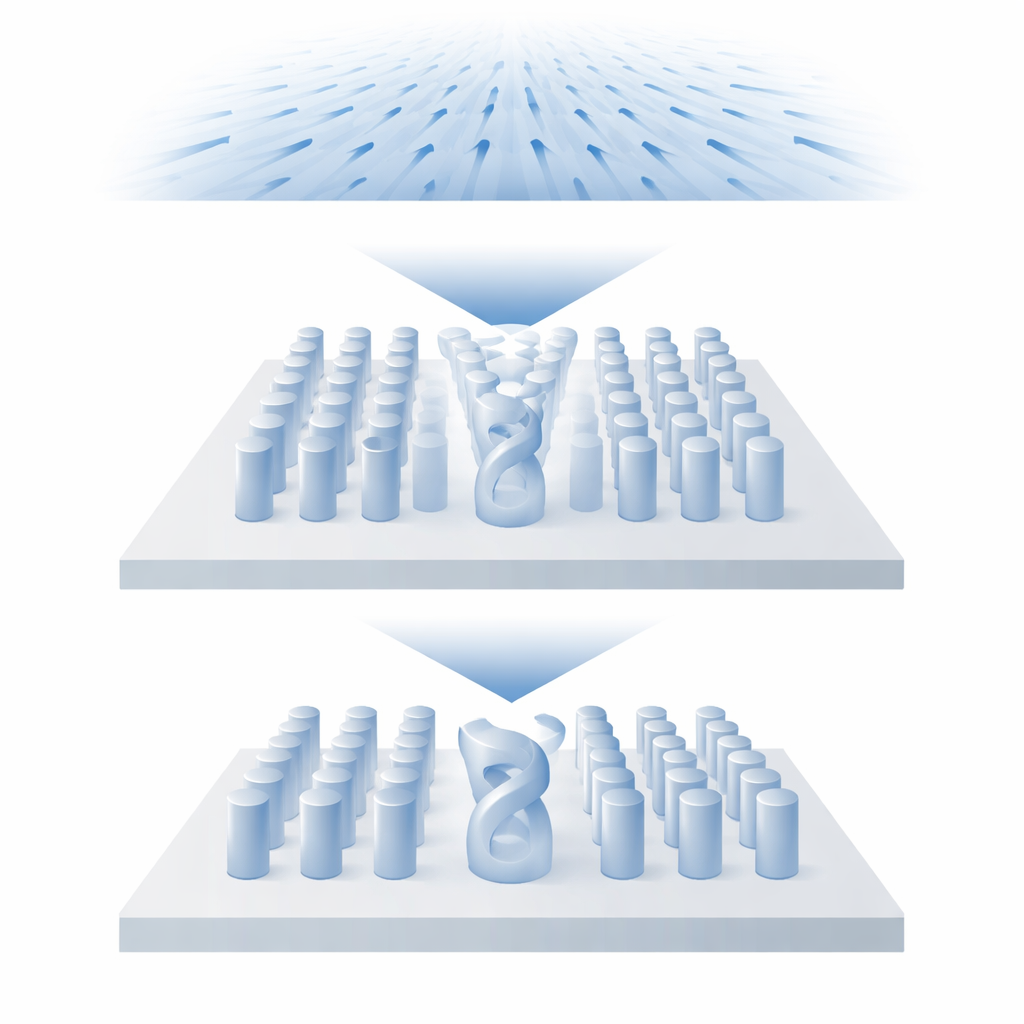
The team focuses on azopolymers, plastics that contain light-sensitive azobenzene molecules. When illuminated with visible or ultraviolet light, these molecules repeatedly change shape and reorient themselves, tending to line up at right angles to the local polarization direction of the light. Because they are rigidly attached to the surrounding polymer chains, their rotation drags the chains with them, building up mechanical stress in preferred directions. In thin films made of these materials, that stress can push the surface up or pull it down, forming tiny hills and valleys that mirror the structure of the light field. By carefully preparing the polymer as arrays of microscopic pillars, the researchers can watch each pillar respond like a tiny mechanical sensor that records the local polarization pattern in its final shape.
From Simple Stretching to Programmable Bending
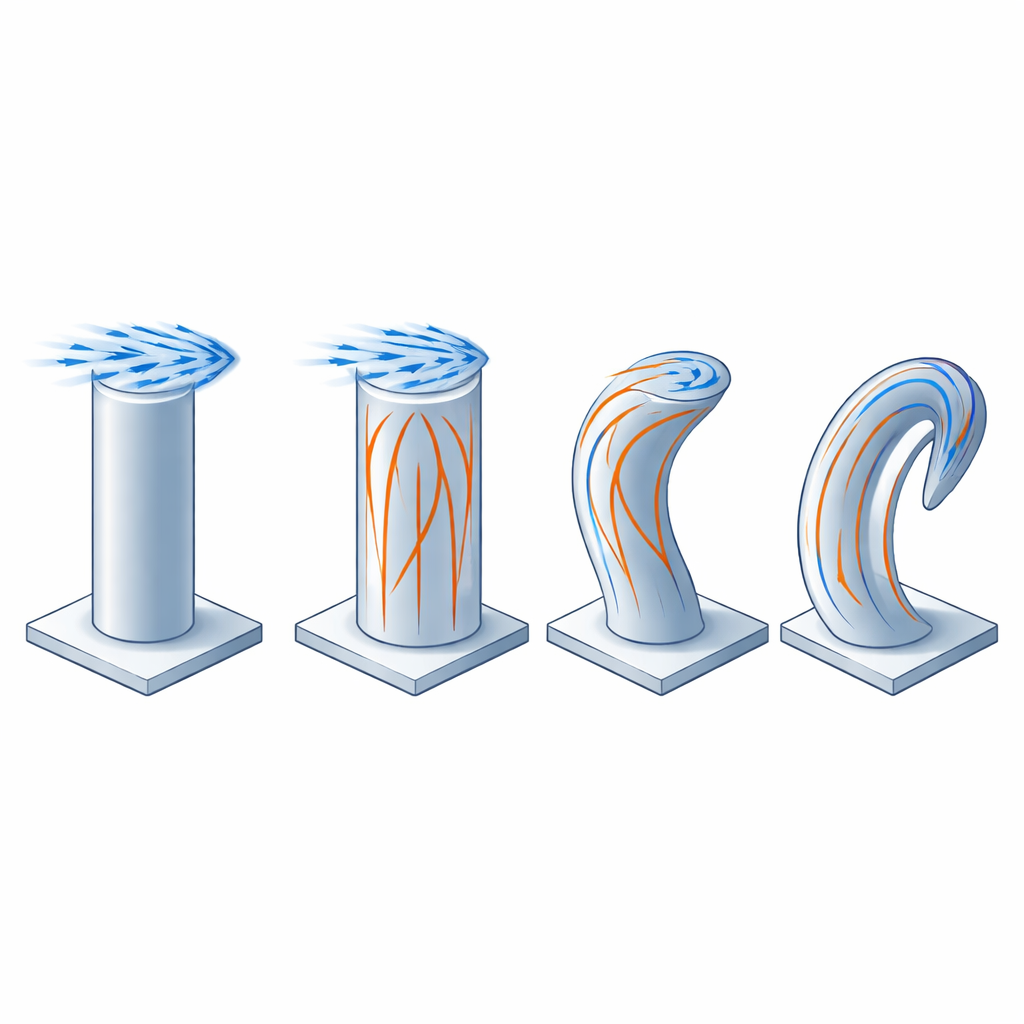
As a starting point, the authors study what happens when a uniform beam of linearly polarized light shines on a regular array of cylindrical pillars. Every pillar sees the same conditions and stretches along the polarization direction while compressing sideways, turning from a round cross-section into an ellipse. They use a detailed physical model, called the Viscoplastic PhotoAlignment (VPA) model, to connect the molecular rearrangements inside the polymer to the resulting stresses and deformations. The model predicts a dominant tensile stress along the polarization direction and weaker compression in the perpendicular directions, leading to a net uniaxial stretch. Experiments and computer simulations closely match, not only in the final shapes but also in how the pillars evolve over time as the light continues to shine.
Drawing Stress Pathways with Structured Light
The real leap comes when the researchers stop using uniform light and instead shape the polarization direction across the beam like a programmable map. They build a “digital polarization rotator” using a spatial light modulator—essentially a tiny display that can change the polarization at each pixel based on a computer-generated image. Projected through a microscope objective, this device can impose smoothly varying or sharply patterned polarization directions over regions only tens of micrometers wide. Each tiny volume inside a pillar experiences a local stress axis set by the local polarization, so that the pillar’s interior fills with curved “stress pathways” that guide how it bends and twists. By designing gentle rotations of the polarization across a single pillar, they create inverted U-shaped or S-shaped pillars; by wrapping the polarization around in a circular fashion, they generate “tripetal” and “quadrupetal” flower-like cross-sections. Combinations of different polarization tiles yield more exotic shapes, such as trident-like structures, and the same strategy can be extended from one pillar to whole arrays.
From Theory to a New Kind of Lithography
A key achievement of this work is that the VPA model successfully predicts all of these complex shapes under a wide range of light patterns, turning it into a true design tool. Instead of trial-and-error experiments, researchers can now work backwards: specify a desired microscopic surface shape and compute the structured light field needed to produce it in a single exposure step. Because the approach relies only on controlling polarization, it can be implemented with many modern light modulators and scaled to larger areas or finer features as hardware improves. In simple terms, the authors have shown how to “draw with stress” inside a light-responsive plastic, using the full vector nature of light as a handle. This vectorial field-guided lithography could underpin future surfaces that steer droplets, direct cell growth, or manipulate light and sound waves, all by virtue of carefully sculpted micro-architecture written by light.
Citation: Januariyasa, I.K., Reda, F., Liubimtsev, N. et al. Stress-driven photo-reconfiguration of surface microstructures via vectorial field-guided lithography. Light Sci Appl 15, 194 (2026). https://doi.org/10.1038/s41377-025-02174-5
Keywords: azopolymer microstructures, polarized light patterning, stress-driven deformation, vectorial lithography, programmable surfaces