Clear Sky Science · en
Evolution of moisture transport properties in cement mortar under marine salt spray environment
Why Sea Air Can Damage Old Buildings
Many of the world’s historic cities sit beside the sea, where salty air constantly bathes stone, brick, and plaster. Over years and decades, this invisible spray can quietly reshape the tiny pores inside building materials, changing how they take up, store, and release moisture. This study looks closely at one common material—cement mortar—to find out how salt from marine spray alters the way water vapor moves through it, and what that means for the long-term health of coastal heritage buildings.
Salt in the Air, Salt in the Walls
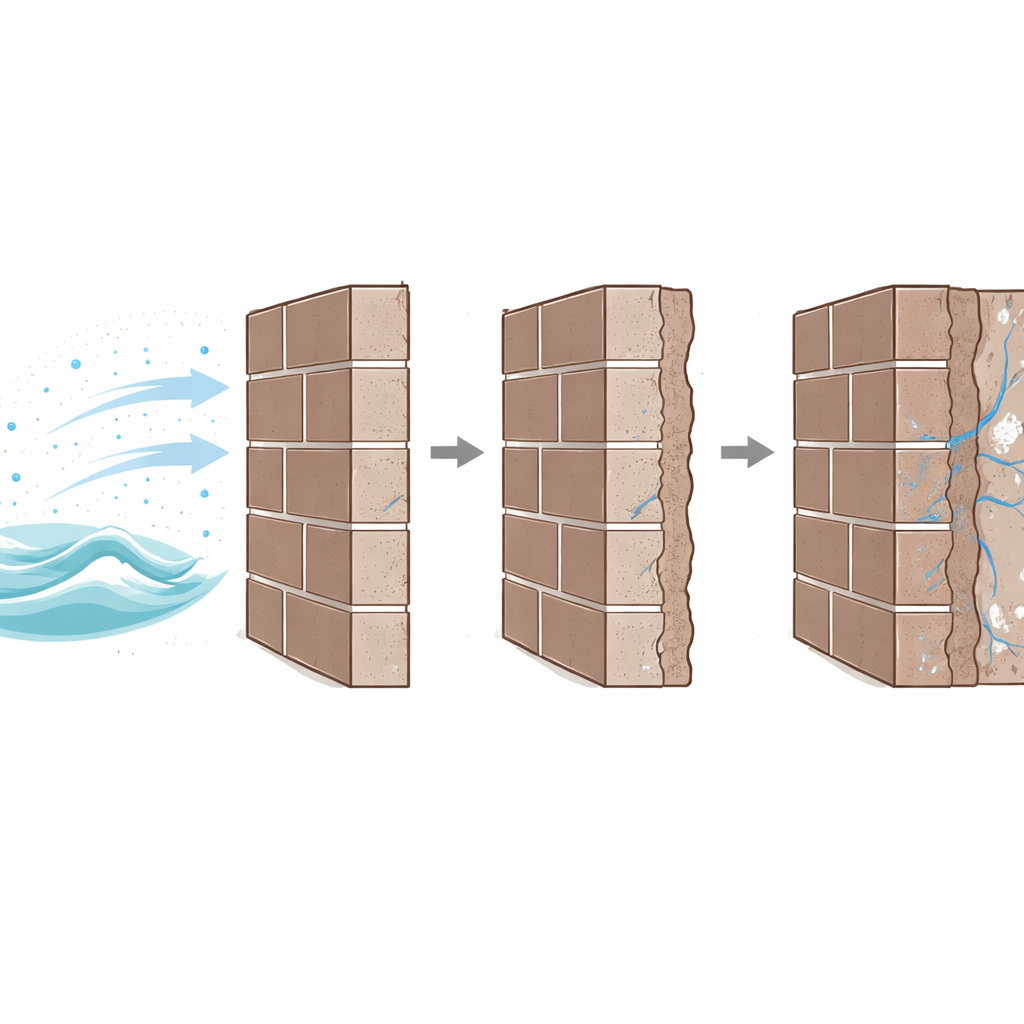
In coastal zones, waves and wind throw up a fine mist loaded with dissolved salt, mainly ordinary table salt. When this spray lands on walls and dries, salt crystals are left behind. Over time, repeated wetting and drying drive these crystals deeper into the material’s pores. Cement mortar, widely used as render and repair material on old buildings, was long assumed to be tough enough to handle this. Yet conservation practice has shown that salt can still clog pores, change how water moves, and ultimately contribute to cracking and surface decay. The authors wanted to measure these effects in a controlled way that mimics real marine exposure.
Speeding Up a Slow Natural Process
To imitate years of seaside weather in the lab, the researchers placed mortar samples in a chamber that sprayed them with a salty fog made from a 5% salt solution, then baked them dry, repeating this cycle up to 35 times. After selected numbers of cycles, they carefully conditioned the samples and measured how easily water vapor could cross each one under two different conditions: a dry test with air on one side much drier than the other, and a humid test with very moist air on one side. At the same time, they probed the internal pore structure using mercury intrusion, which reveals the size and amount of pores, and scanning electron microscopy, which images salt crystals growing in and on the mortar.
Two Opposite Behaviors in Dry and Humid Air
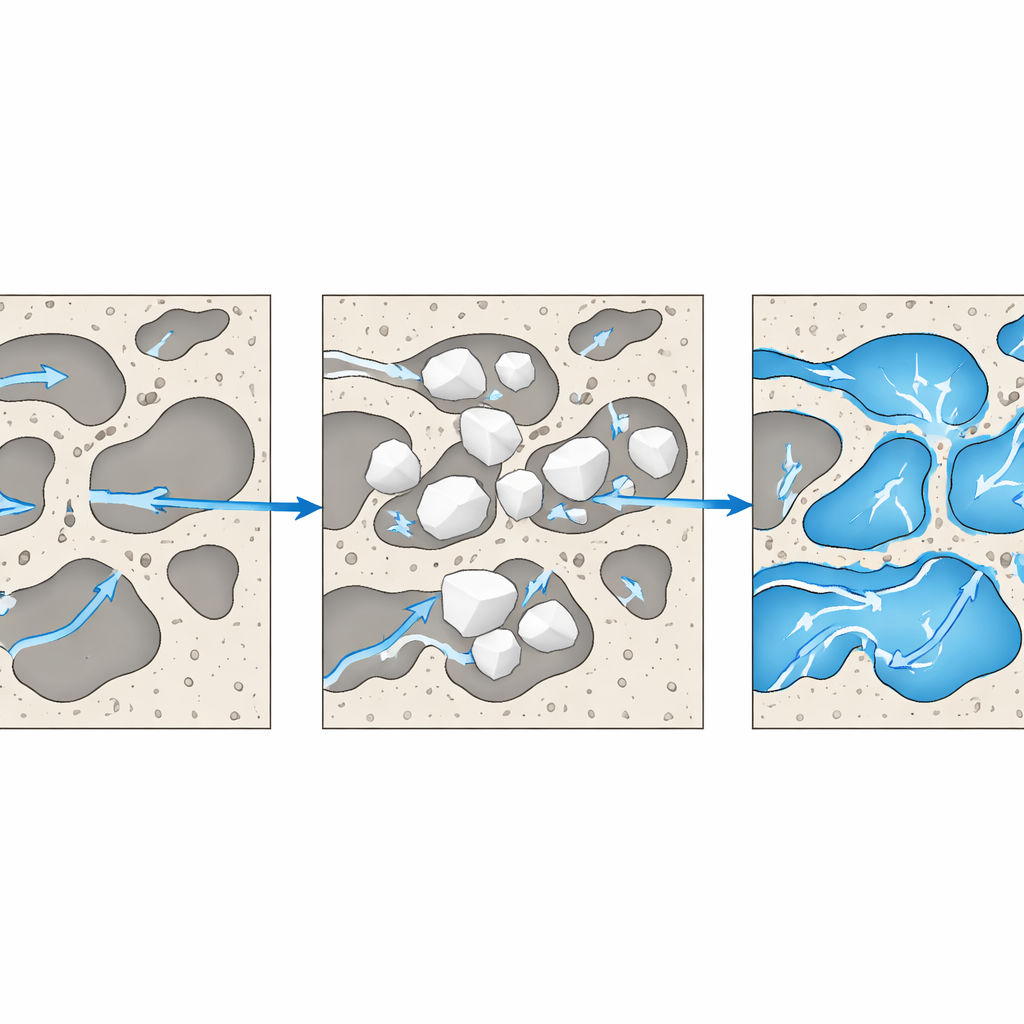
The results showed a striking split personality. Under dry conditions, salt-laden mortar allowed less vapor to pass: the water vapor permeability dropped steadily as more cycles of salt spray were applied. Microscopy revealed why. Salt crystals formed mainly in medium-sized pores close to the surface, cutting down the total pore volume in a key size range by as much as about 40%. In effect, these crystals acted like tiny plugs, forcing water vapor to take more tortuous paths or be blocked entirely. Under humid conditions, however, the story flipped. Once the surrounding air became moist enough, the same salt crystals absorbed water and turned into thin films of salty liquid that connected neighboring pores. These liquid pathways actually helped transport moisture, so the measured vapor permeability rose significantly with increasing salt content.
A Simple Rule for Predicting Moisture Flow
To turn these observations into something designers and conservators can use, the team built a mathematical model that links how easily vapor moves through mortar to two main ingredients: how much salt has built up and how humid the air is. Because the material behaves differently below and above the humidity at which salt starts to dissolve, the model uses two separate equations, one for the “crystal” state and one for the “brine” state. With only the baseline properties of a clean material and an estimate of salt content, the model can adjust standard data to predict how real, salt-contaminated walls will respond under different climate conditions, without repeating the full set of complex measurements each time.
What This Means for Coastal Heritage
For a lay reader, the key message is that salt in sea air does much more than leave white stains on walls. It reshapes the microscopic plumbing inside building materials. When the air is dry, accumulated crystals block the pores and slow down the release of moisture, which can trap damp deeper in the wall. When the air is humid, those same crystals can liquefy and create fast tracks for moisture to move. This study offers a clearer picture of that hidden dance and provides tools to forecast how historic walls will behave as climates change. Such insight can help conservators design better repairs, choose compatible materials, and plan ventilation and insulation strategies that keep treasured coastal buildings standing longer with fewer costly surprises.
Citation: Li, B., Dai, X., He, S. et al. Evolution of moisture transport properties in cement mortar under marine salt spray environment. npj Herit. Sci. 14, 291 (2026). https://doi.org/10.1038/s40494-026-02562-z
Keywords: coastal heritage buildings, salt weathering, cement mortar, moisture transport, marine salt spray