Clear Sky Science · en
Understanding the original morphology and hydraulic behaviour: the ancient rubble-mound conical structures of Aegina, Greece
Ancient Sea Walls with a Hidden Story
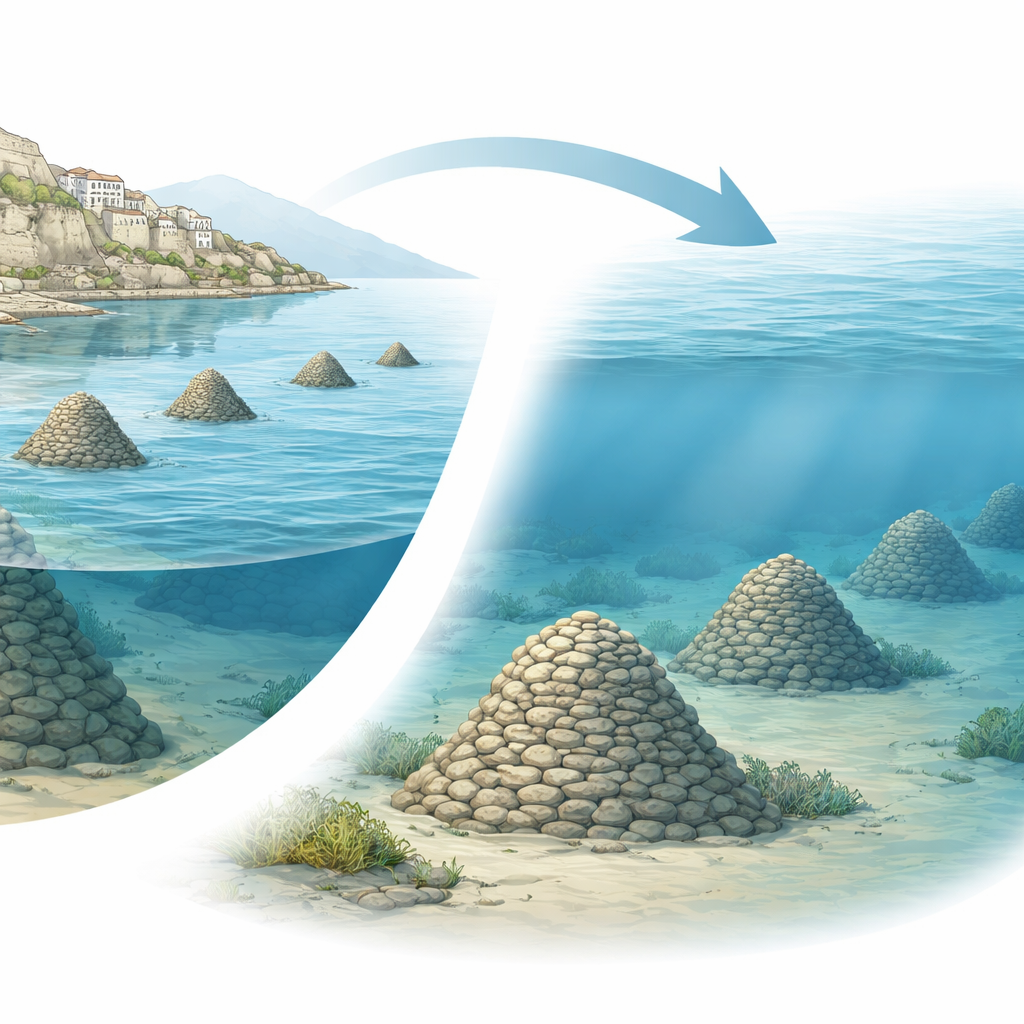
Off the coast of the Greek island of Aegina lies a forest of mysterious stone cones on the seafloor. Built around 480 BCE, these rubble mounds once shaped a busy classical harbor that rivaled Athens. Today they survive as submerged ruins, but this study shows they were once proud, emergent sea structures—carefully engineered to stand up to waves and warships alike. By blending archaeology with hydraulic engineering in the laboratory, the researchers reconstruct how these stone cones were built, how they changed under storms, and why they have lasted for nearly 2,500 years.
Harbor Rivalry in an Ancient Sea Power
Aegina was an early maritime powerhouse of the classical Greek world. Its harbor complex included defensive basins for warships, commercial quays, and two long breakwaters. Scattered offshore, however, lay dozens of strange cone-shaped stone piles with no clear match in ancient or modern harbor design. These Rubble-mound Conical Structures (RmCS) sparked long debate: were they low, hidden breakwaters to quiet waves, or high barriers to block enemy ships? Recent underwater surveys, satellite images, and geophysical scans mapped their shapes, depths, and materials with great precision, revealing over fifty well-preserved cones in sectors with minimal human disturbance.
Rebuilding the Cones in a Wave Tank
To move beyond speculation, the team recreated the ancient structures at reduced scale in a long wave flume. They first chose the best-preserved cones as models and measured their present-day height, base width, slope, and water depth. Seafloor imaging showed that the mounds rest directly on bedrock and sink only about a meter into the sediment. Underwater photos and photogrammetry revealed that the structures are loose limestone blocks, dumped without mortar, forming porous, rough piles. Using these data, the researchers designed a 1:40 scale model and realistic stone size distribution, and reconstructed how builders might have dumped rock from specialized vessels.
How Ancient Builders Shaped Stable Stone Cones
Experiments compared different dumping methods and found that a double-hulled vessel with a central working platform best reproduced the observed cone shape and full design volume. As stones were released in small batches, larger blocks fell quickly and formed a wide, stable base, while smaller pieces filled gaps and raised the crest. Repeated trials produced consistent results: the reconstructed cones reached about 8 meters tall in real scale, with broad bases and side slopes around 44°. Crucially, when researchers accounted for ancient sea level—likely 1.75 to 2.5 meters lower than today—their models showed that the RmCS originally stuck 0.7 to 1.4 meters above the water surface. These were not timid, hidden reefs; they were visible, emergent features, probably meant to control access as well as calm the sea.
From Tall Towers to Underwater Ridges
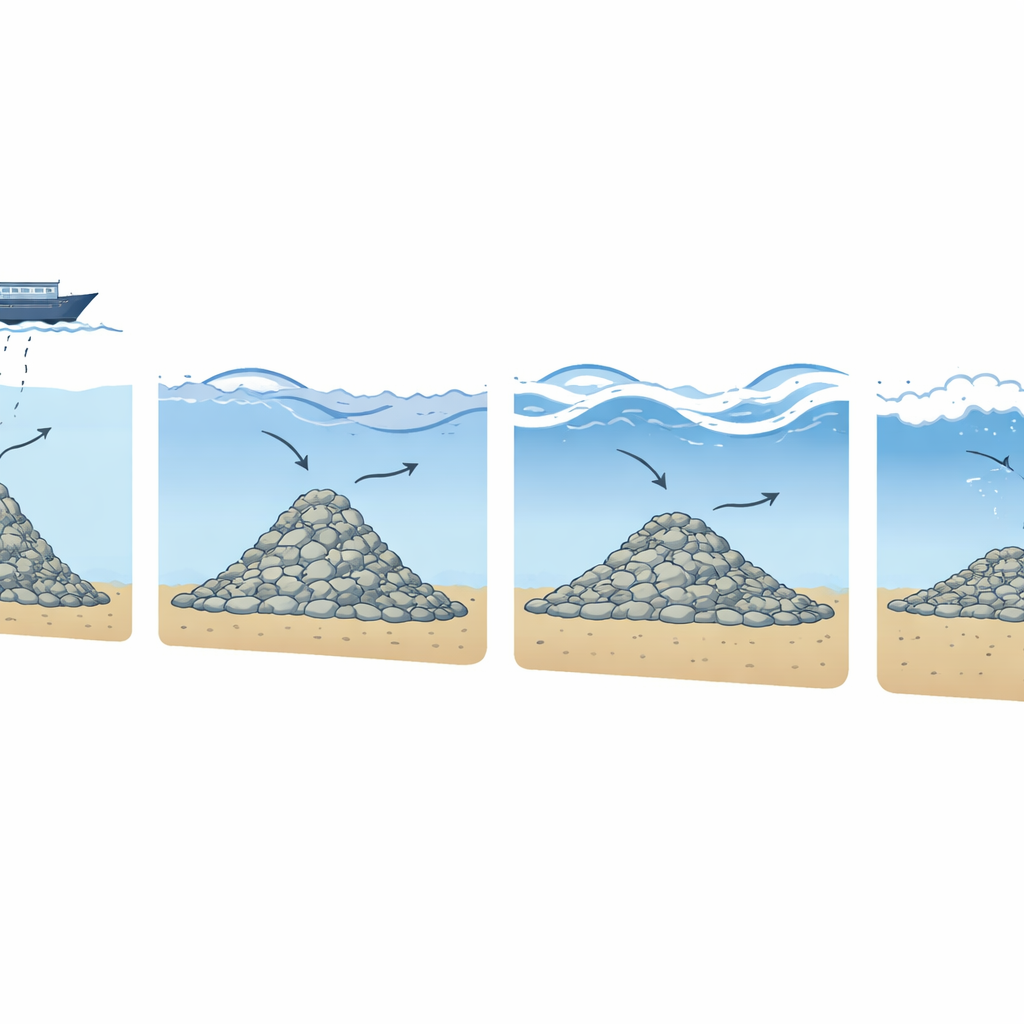
Next, the team exposed the reconstructed cones to thousands of waves representing 40 years of local storm conditions, scaled to the full 2,500-year lifespan of the harbor. They steadily increased wave height and tracked how the mounds changed using high-resolution 3D laser scans. The key driver of change was significant wave height: as waves grew stronger, they chipped away at the crest and rolled stones down the flanks, widening the base while lowering the top. After moderate to strong storms, further damage became minor, and the cones settled into a stable form: about 5 meters tall, with wider bases and crests now lying below the water surface. This evolution matched the real underwater structures remarkably well—over 82% of measured parameters from the field fell within the range of the laboratory results.
What These Stone Cones Tell Us Today
To a non-specialist, the message is clear: these ancient engineers knew what they were doing. The RmCS were built high and wide on purpose, with oversized bases and extra "freeboard" above the waves to allow for long-term erosion while staying functional. Over centuries, storms shaved off their tops and spread stones outward until the cones reached stable, submerged shapes that we see on the seabed today. By marrying archaeological evidence with physical modeling, this study turns static ruins into a dynamic story of construction, wear, and resilience. It not only explains how Aegina’s harbor defenses survived for millennia, but also offers tools to assess the future stability of coastal heritage sites facing rising seas and changing storms.
Citation: Frontini, M., L. Lara, J., G. Canoura, L. et al. Understanding the original morphology and hydraulic behaviour: the ancient rubble-mound conical structures of Aegina, Greece. npj Herit. Sci. 14, 298 (2026). https://doi.org/10.1038/s40494-026-02556-x
Keywords: ancient harbors, coastal engineering, underwater archaeology, wave flume experiments, maritime heritage