Clear Sky Science · en
Macro laser profilometry scanner applied to paintings on canvas, wood, metal, and leather supports
Seeing Hidden Stories on Painting Surfaces
Museum paintings may look flat to the naked eye, but their surfaces are full of tiny hills, valleys, cracks, and fingerprints that record both the artist’s hand and centuries of aging. This study presents a new way to “map” those landscapes in three dimensions using a custom laser scanner, helping conservators understand how paintings on wood, canvas, metal, and leather are built, how they change over time, and how best to preserve them without ever touching the artworks.
A Gentle Laser for Fragile Masterpieces
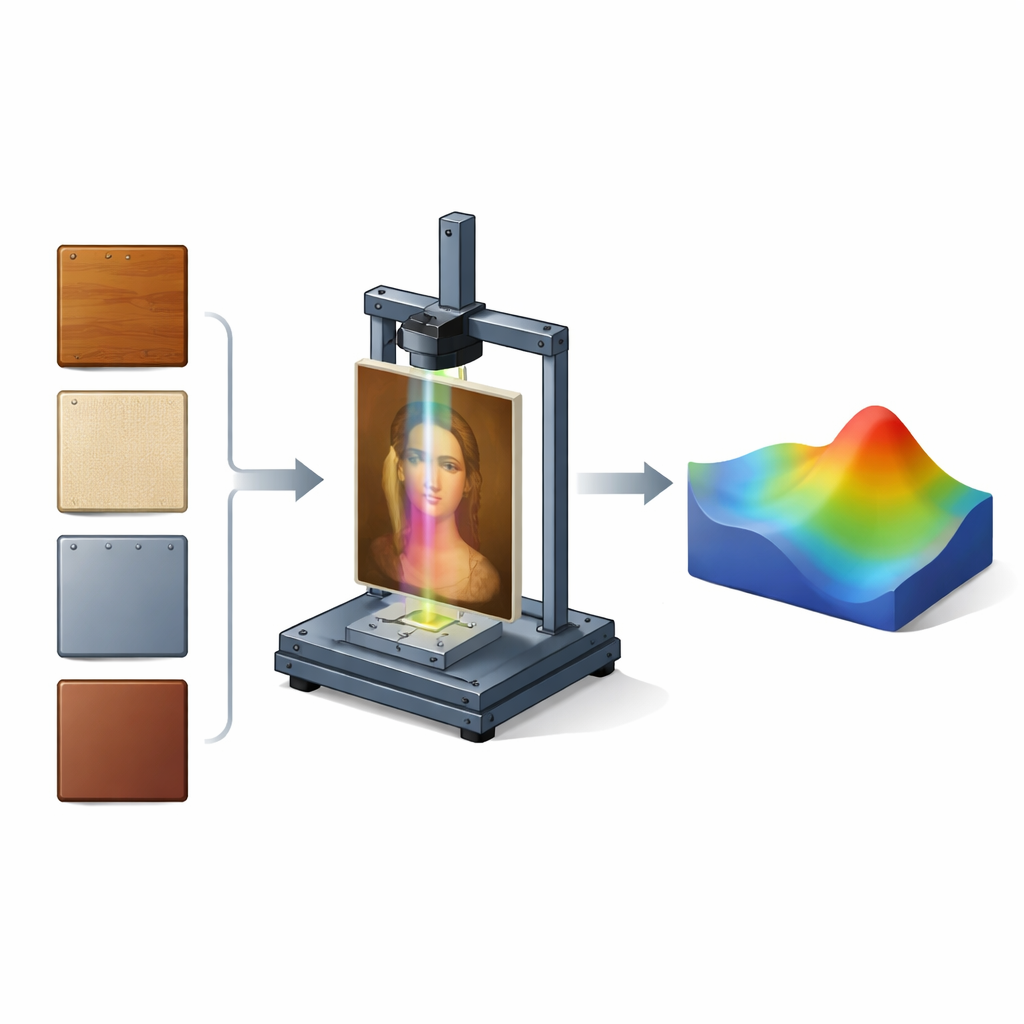
The researchers built a macro laser profilometry scanner that can survey relatively large areas of a painting while still detecting height differences of just a few micrometers—far thinner than a human hair. A violet laser projects a thin line of light onto the surface; a sensitive camera, mounted at an angle, records how that line bends as it crosses bumps and dips. By sliding the laser head across the painting with motorized stages and controlling everything with Python software, the team reconstructs detailed 3D maps of the surface. Unlike traditional 3D scanners optimized for buildings or statues, this system is tailored to flat but finely textured artworks and can be brought directly into museum restoration labs.
Four Paintings, Four Different Bones
To test the system, the team examined four oil paintings held at the Gallerie Nazionali di Arte Antica in Rome, each on a different support: a large wood panel, a canvas, a narrow leather strip, and a small copper plate. At a broad scale, the 3D maps reveal how each support shapes the overall “geometry” of the picture. In the wood panel, the scanner clearly resolves the four joined boards and shows how the panel has warped by more than a centimeter, with joints and cracks standing out as sharp ridges and valleys. On the canvas, the surface appears slightly concave: the center sits several millimeters behind the edges fixed to the frame, signaling a loss of tension that would be hard to quantify by eye alone. The leather painting shows a subtle seam where two pieces were joined and stretched, while the copper painting appears remarkably smooth, reflecting the industrial rolling that produced the metal sheet.
Tiny Ridges Reveal Technique and Trouble
Zooming in, the same data expose delicate details in the paint layers themselves. On the panel painting, filtered height images highlight incisions in the preparatory ground and the fine relief of brushstrokes, allowing the sequence of working steps—scratching the ground, blocking in forms, glazing, then adding highlights—to be read from surface topography. On the canvas, the scanner detects a sharp step in thickness between two areas, matching a hidden earlier image buried beneath the visible composition, and differentiates regions where the canvas weave still shows from areas where deep cracks dominate. On the leather support, the maps reveal a hidden join and decorative stamped motifs in the corners—likely made with metal punches before painting—along with wrinkles and tiny losses where the aging leather has shrunk beneath the paint.
Metal Surfaces and Invisible Damage
The copper painting offers another kind of insight. Here, the 3D relief shows how different colored areas age differently, with dense crack networks forming especially in darker passages rich in oil binder. Raised blisters, barely noticeable in standard photographs because of later retouching, stand out clearly in the height data as zones where paint is detaching from the metal. On the back of the plate, the scanner records tool marks from roughening the surface to improve adhesion and even captures an accidental fingerprint impressed into the copper—an intimate trace of the artist that becomes a stable, measurable feature of the object’s history.
New Eyes for Conservators and Historians
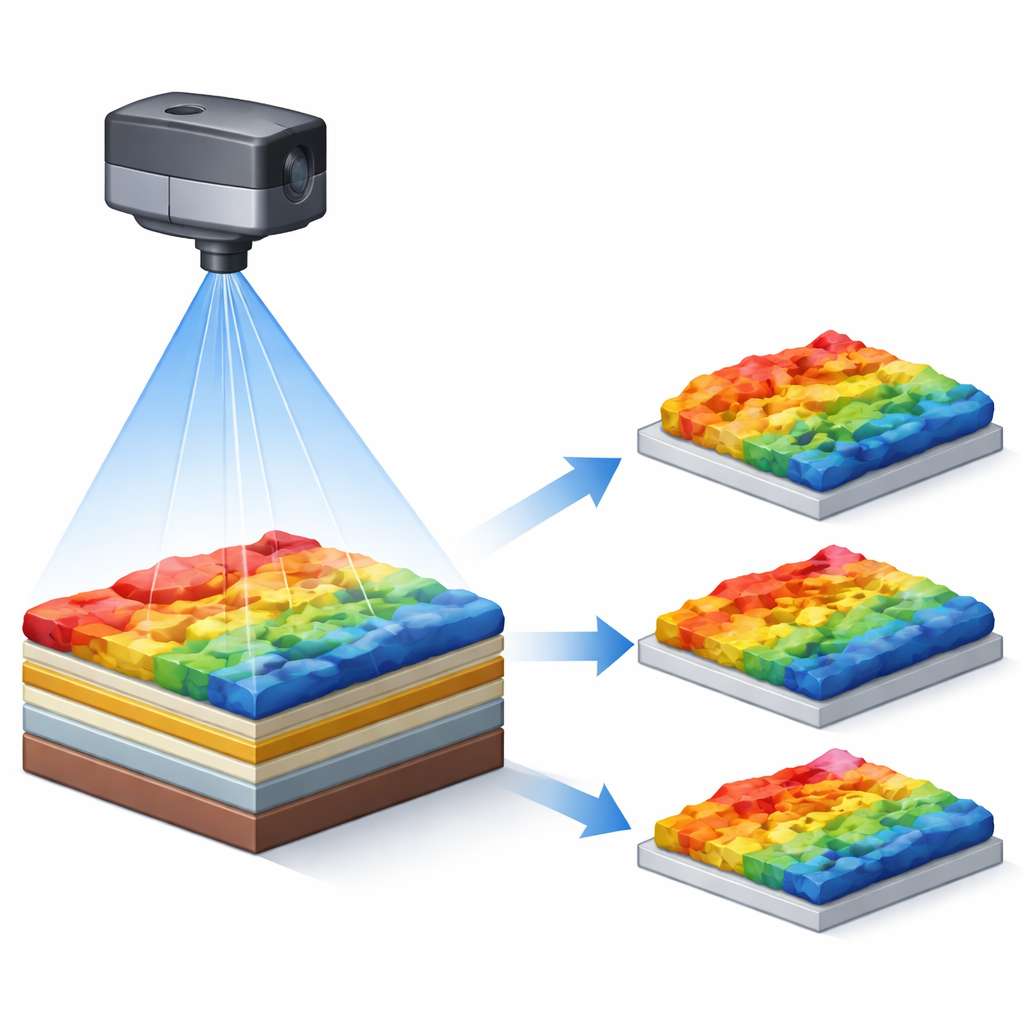
Beyond producing striking 3D images, the technique gives conservation professionals a quantitative reference for the shape of a painting at a given moment. Because the scanner is non-contact, portable, and fast, the same areas can be remeasured over months or years to track slow warping of wooden supports, slackening of canvases, or the spread of cracks and lifting paint. While it does not replace chemical or subsurface analyses, macro laser profilometry adds a powerful layer of information that bridges broad visual inspection and microscopic study. In practical terms, it helps museums diagnose problems earlier, plan treatments more precisely, and document the subtle physical stories written into the surfaces of artworks.
Citation: Iorio, G., Graziani, V., Merucci, C. et al. Macro laser profilometry scanner applied to paintings on canvas, wood, metal, and leather supports. npj Herit. Sci. 14, 275 (2026). https://doi.org/10.1038/s40494-026-02544-1
Keywords: art conservation, 3D surface scanning, cultural heritage, laser profilometry, painting diagnostics