Clear Sky Science · en
Jiandu point cloud registration using high-resolution data and generalized t-student kernel
Ancient Records Meet Modern Technology
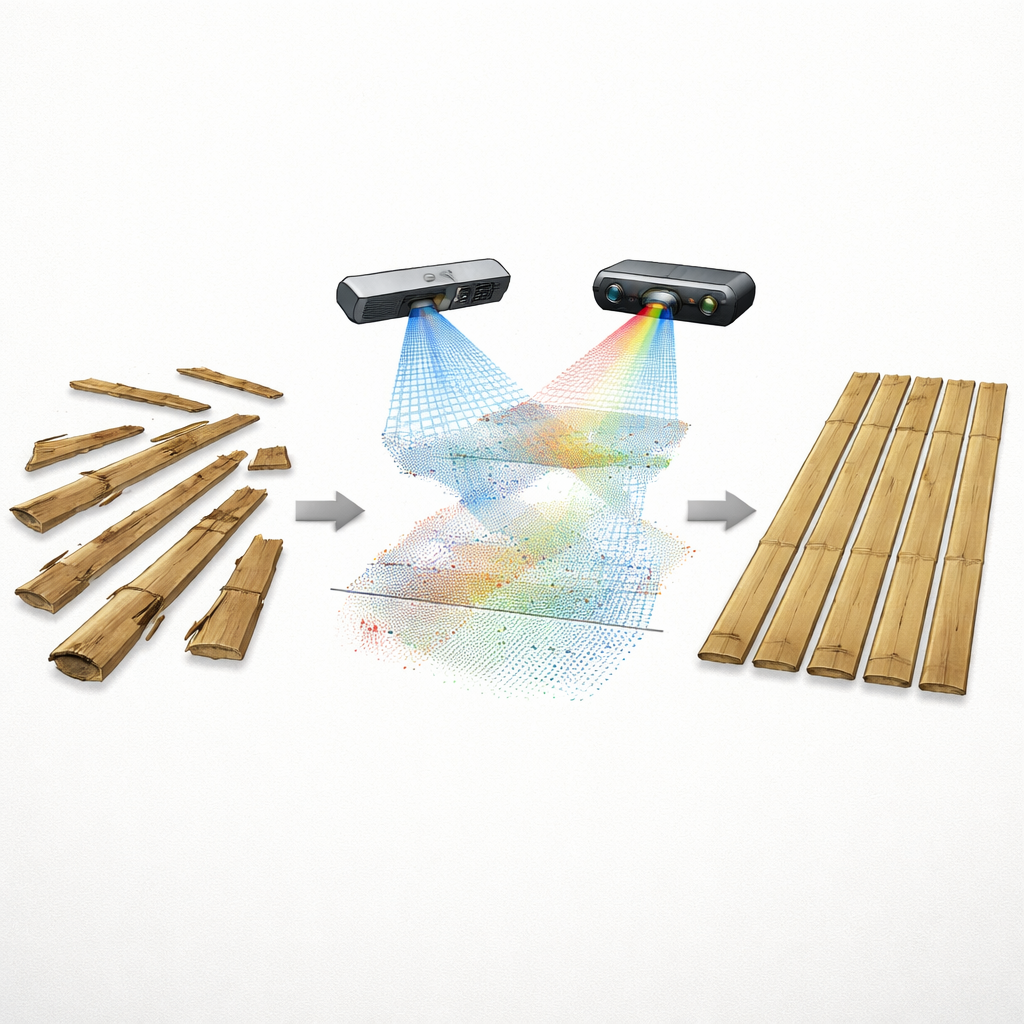
Bamboo and wooden slips known as Jiandu are among the most important witnesses to early Chinese history, preserving everything from tax records to classic literature. Yet most of these narrow, timeworn strips survive only as broken and fragile fragments that are risky to handle and painfully slow to reassemble by hand. This study presents a new digital technique that uses detailed 3D scans and advanced mathematics to virtually "snap" these pieces together with far higher precision and reliability, helping protect the originals while restoring long-lost texts and information.
The Challenge of Repairing Fragile History
Reconstructing Jiandu is far more difficult than solving an ordinary jigsaw puzzle. Each slip is thin, slightly warped by centuries underground, and often chewed away at the edges. The fracture surfaces are irregular and worn, and the original ink and wood grain are faded or disturbed. Modern 3D scanners can capture these objects as dense clouds of points in space, but existing software struggles to align them. It must reach sub-millimeter accuracy, cope with missing chunks and rough edges, and ignore random noise from lighting, sensors, and the environment. Many popular algorithms either lose their way when surfaces are incomplete or get confused by noisy measurements, leading to misaligned joins or unstable results.
A Smarter Way to Read Shape and Texture
To overcome these obstacles, the authors design a registration framework that treats each fragment not just as raw geometry but as a rich combination of shape and surface appearance. First, they analyze the tiny orientations of local patch surfaces at multiple scales, effectively building a refined map of how each fracture face bends and twists. They then use the way neighboring regions connect to one another to keep this description topologically consistent, reducing the risk that features from damaged areas are matched incorrectly. At the same time, the method converts color data into a space that better matches human perception and uses both 3D distance and color similarity when proposing how two fragments might fit.
Letting Texture Direction Guide the Match
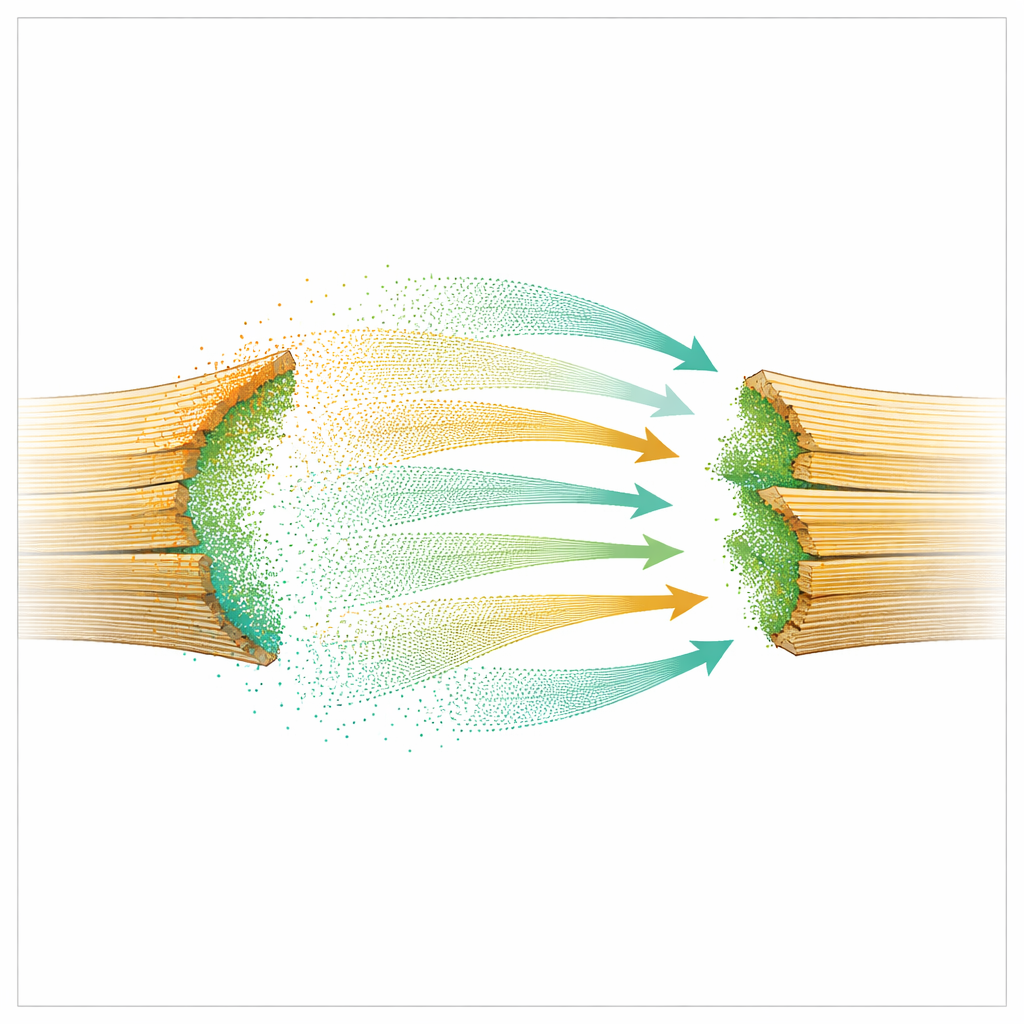
A distinctive contribution of the work is that it treats surface texture as a directional clue rather than mere decoration. Jiandu surfaces often show aligned bamboo fibers and elongated ink strokes, whose orientation tends to continue smoothly across a break. The algorithm measures the direction of these texture gradients from RGB-D images linked to the 3D points and then enforces a strict rule: two candidate points can only be paired if their texture directions agree within a small angle. This screens out matches that might look geometrically close but would break the natural flow of the writing or wood grain. As a result, joins are more faithful not only in shape but also in how the visual patterns run across the reconstructed slip.
Standing Firm Against Noise and Damage
Real fragments rarely match the neat assumptions of textbook mathematics. Outlying points arise from chipped edges, missing areas, and measurement glitches, creating a "heavy-tailed" pattern of errors. Standard least-squares methods assume a gentler noise distribution and are easily pulled off track by such outliers. The authors instead borrow a tool from robust statistics known as a generalized Student’s t kernel. In practice, this means that as the mismatch between two points grows large, the algorithm automatically down-weights its influence, preventing a few bad correspondences from derailing the overall alignment. Combined with the geometric and texture cues, this makes the iterative fitting process much more stable in the messy conditions typical of archaeological data.
Putting the Method to the Test
The team evaluates their framework on multiple Jiandu datasets obtained with an industrial 3D scanner and a high-resolution camera, capturing both fine shape and subtle surface details. They compare their approach against classical point-matching methods and recent learning-based techniques that rely on neural networks trained on large datasets. Across tests that vary the starting orientation of fragments and add artificial noise, the new method consistently produces smaller errors in both rotation and translation, while maintaining reasonable computation times. Ablation experiments, where individual components are selectively removed, show that each part—surface normals, texture direction checks, and the robust kernel—contributes to the final jump in accuracy, with the full combination performing best.
Digital Puzzles for Preserving the Past
In simple terms, this work offers heritage scientists a sharper digital tool for reassembling fragile written records without touching them. By fusing careful descriptions of shape, the flow of surface textures, and a noise-resistant optimization strategy, the method can more reliably determine how broken Jiandu fragments fit together. That means clearer reconstructions of ancient documents, less risk of damage to irreplaceable artifacts, and a more scalable path to handling the hundreds of thousands of slips already excavated. Although designed for Jiandu, the same ideas could be adapted to other fractured relics, bringing the power of precise 3D computation to the broader task of reading and preserving the material traces of the past.
Citation: Zhang, Q., Wang, C., Qi, Y. et al. Jiandu point cloud registration using high-resolution data and generalized t-student kernel. npj Herit. Sci. 14, 267 (2026). https://doi.org/10.1038/s40494-026-02533-4
Keywords: Jiandu reconstruction, 3D point cloud registration, digital cultural heritage, texture-guided alignment, robust optimization