Clear Sky Science · en
Structural stability risk threshold of classical garden rockeries based on elastoplastic theory
Why Cracks in Garden Rocks Matter
Visitors to classical Chinese gardens often admire their towering rock mounds and winding caves without realizing that these stone artworks can quietly edge toward collapse. This study asks a practical question with big implications for heritage sites: at what point do small cracks in a man‑made rock hill turn into a genuine structural danger? By combining advanced computer simulations with on‑site observations in a historic garden, the authors propose a clear way to pinpoint when a picturesque rockery passes from healthy, to damaged, to on the verge of falling apart.
From Surface Cracks to Hidden Weakness
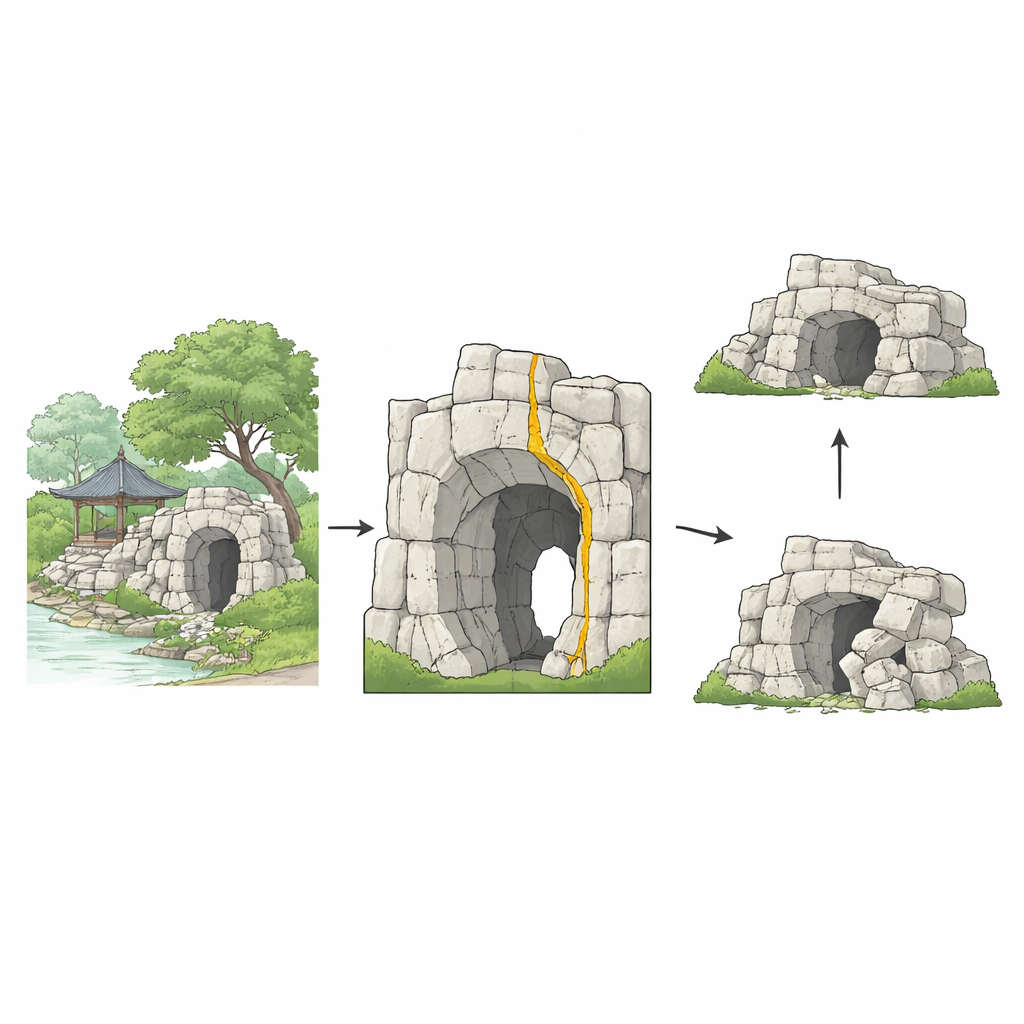
Classical garden rockeries are built from stacked blocks of brittle limestone shaped into cliffs, caves, and arches. Over decades, they suffer from many types of damage, including uneven settling of the foundations, stones tilting out of place, and roots prying their way into joints. Among these problems, cracks are especially worrying: once they appear, they tend to grow and accelerate other forms of decay. Earlier research focused on how individual cracks start and lengthen within the rock, using a mathematical approach that assumes the material behaves like a perfectly elastic spring right up to the point where it breaks. That work helped identify where the most dangerous cracks would appear, but it did not show how continued cracking eventually undermines the entire rockery.
Watching a Rockery Fail in Slow Motion
To bridge this gap, the authors extend their analysis from the scale of a single crack to that of the whole structure. They focus on a well‑known rock feature called the Small Rock Mountain Adobe in He Garden, Yangzhou, and in particular on its central cave, where uneven settlement of the ground has already triggered visible cracking. Using detailed laser scans, they build a three‑dimensional computer model of the cave and subject it to virtual loading that mimics the real foundation sinking. This allows them to watch, step by step, how cracks emerge, cut through the cave wall and roof, and eventually compromise the supporting pillars. A key tool is the so‑called load–displacement curve, which records how much pushing force the rockery can bear as a function of how far it moves or deforms.
Five Stages from Safe to Collapse
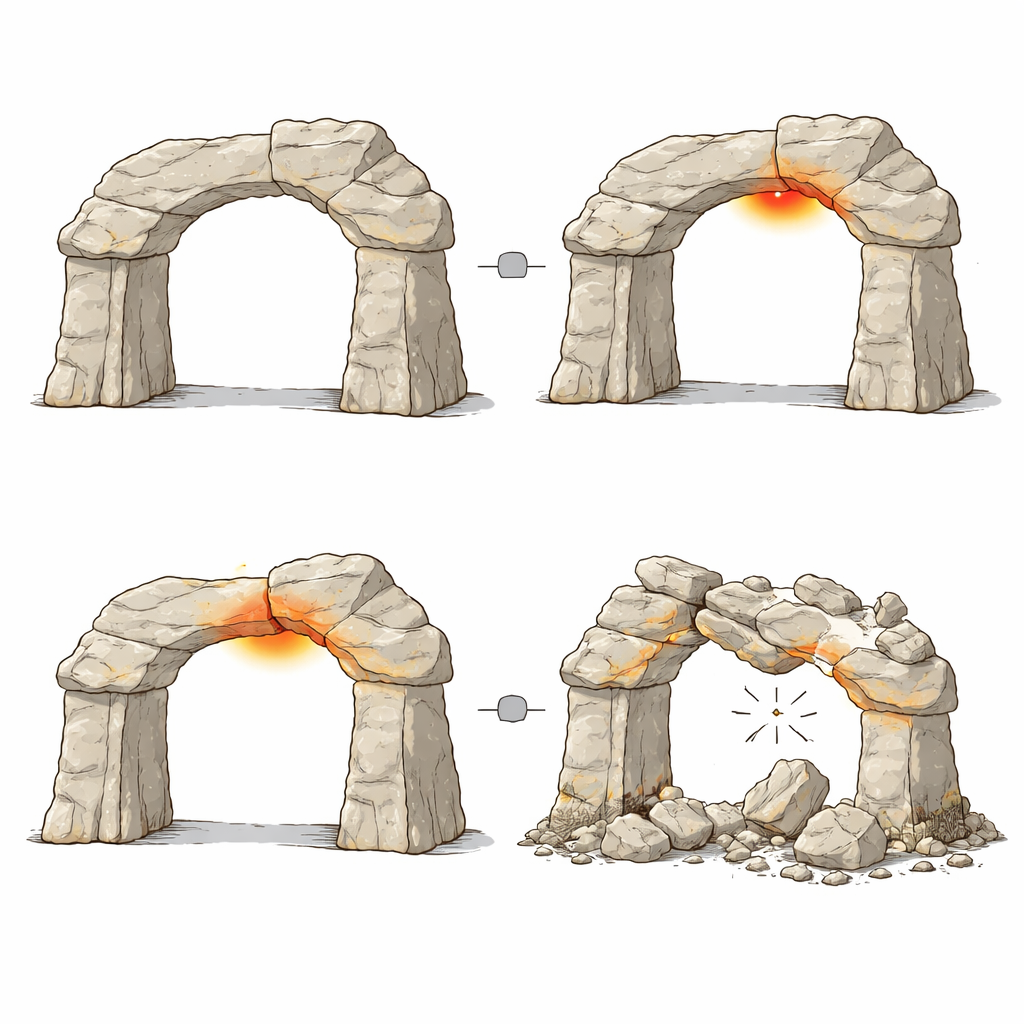
By tracking both the growth of crack surfaces and the overall deformation of the structure, the researchers identify a sequence of five stages in the life of the rockery. First comes a stable stage with no cracks. Next, cracks begin to lengthen cleanly, while the rest of the structure still behaves as if it were elastic; this is the stage of linear crack propagation. The third stage begins when one of these cracks becomes a "through‑crack" that cuts completely through a critical part of the cave. At this point, the visible crack area stops increasing much, but the internal volume of damaged rock and the settlement of the structure grow rapidly: the rockery as a whole is now in a damaged state. In the fourth stage, the rockery enters structural instability; large regions near the cave walls, roof, and pillars show intense deformation, and the load–displacement curve bends sharply, revealing that the structure is losing stiffness. Finally, in the collapse stage, the simulated rockery reaches its peak load, can no longer carry additional weight, and its supporting zones fail.
Seeing Beyond Cracks with Plastic Deformation
A crucial advance in this work is the use of an elastoplastic model, which allows the stone to behave elastically at first and then to undergo permanent deformation once a certain stress is exceeded. This contrasts with the earlier, purely elastic crack model, which cannot capture the widespread internal yielding that occurs after a through‑crack forms. By calibrating the plastic behavior of limestone in standard laboratory‑style tests, and then applying it to the full rockery model, the authors can map the expanding zones of intense strain inside the cave. They show that after the through‑crack appears, the traditional elastic approach still predicts the crack path but misses a growing "plastic" halo that spreads from the crack tip to the cave roof and pillars, silently eroding the safety margin long before pieces would actually fall.
What This Means for Garden Caretakers
For heritage managers, the outcome is a practical, staged set of warning thresholds. Rather than treating all cracks as either harmless or catastrophic, the framework distinguishes between early, mostly cosmetic cracking and later stages where hidden deformation signals approaching collapse. By reading the shape of the load–displacement and stress–strain curves from numerical simulations, caretakers can decide when to monitor more closely, when to reinforce foundations or supports, and when to restrict access to a risky cave or arch. Although demonstrated on one rockery in a single garden, the method offers a roadmap for diagnosing structural health in similar stone features worldwide, helping to keep beloved historic landscapes both authentic and safe for future visitors.
Citation: He, Z., Fu, L., Wang, Z. et al. Structural stability risk threshold of classical garden rockeries based on elastoplastic theory. npj Herit. Sci. 14, 269 (2026). https://doi.org/10.1038/s40494-026-02532-5
Keywords: garden rockery stability, cultural heritage conservation, rock cracking, finite element simulation, structural collapse risk