Clear Sky Science · en
A review of recent efforts in digitalization and application of endangered scripts
Why Saving Vanishing Writing Matters
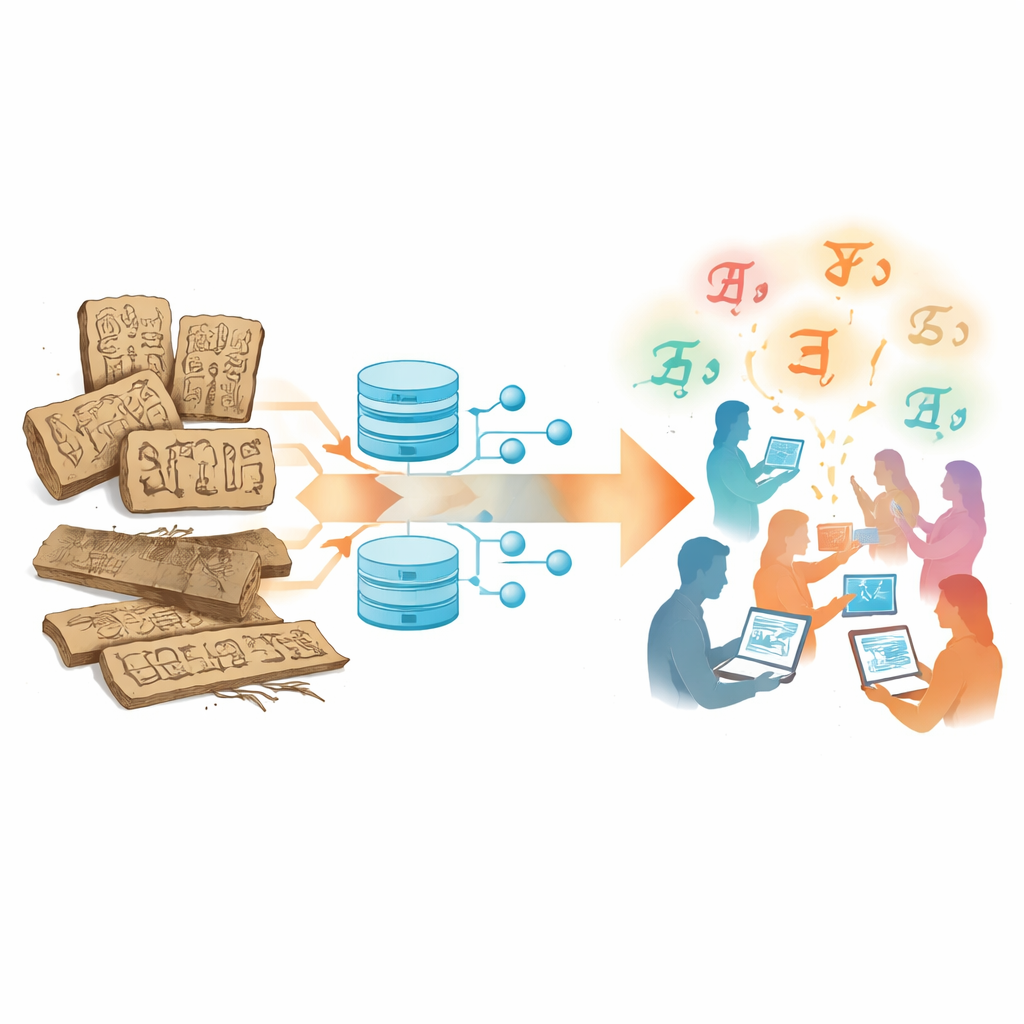
Across the world, thousands of communities use unique writing systems that carry their history, beliefs, and everyday knowledge. Many of these scripts are now rarely written or read, crowded out by global languages and modern technology. This article examines how computers and design tools are being used not just to store images of these endangered scripts, but to help them live again in classrooms, phones, games, and art. It argues that true safeguarding means moving from simply preserving scripts in digital archives to revitalizing them as part of people’s lives.
From Living Traditions to Digital Shadows
The paper begins by explaining what makes a script endangered. Unlike a spoken language, which relies on sounds and grammar, a script is the visible system of marks used to write that language. A script can be shared by many languages or one language can switch scripts over time. Scripts become endangered when everyday uses fade: they may survive only in religious rituals, specialist scholarship, or decorative art. Younger people often cannot read them, schools stop teaching them, and modern computers do not support them well. When that happens, much more than spelling is lost. The way a community organizes knowledge, relates to land and spiritual life, and even thinks about the world is often tied to how its script shapes reading and writing.
Digital Heritage and the Promise of Technology
Digitizing these scripts is part of a broader movement called digital heritage, which uses cameras, scanners, databases, and interactive media to safeguard cultural treasures. Early efforts mostly focused on scanning objects and storing them safely. Today, the field is far more ambitious and interdisciplinary: historians, computer scientists, designers, and community members work together. For endangered scripts, this means going beyond photographing old manuscripts. It involves encoding characters so they can appear on any device, designing fonts and keyboards, training machines to read difficult handwriting, and building tools that allow communities to write, search, translate, and remix their own heritage. The article stresses that technology should be guided by cultural context and community priorities, not the other way around.
Three Stages: Keeping Scripts Alive, Active, and Applied
To make sense of 120 recent studies from 2011 to 2025, the authors propose a three-step pathway they call Alive, Active, and Applied. In the Alive stage, work concentrates on basic survival in the digital world: assembling datasets of scanned pages, cleaning damaged images, teaching computers to recognize characters, standardizing fonts, and building core software libraries. This is where most research sits today, reflecting the huge effort needed just to make rare writing systems visible and usable on screens. The Active stage goes deeper, using language technologies to understand and connect meaning. Here, researchers build tools that convert between scripts, translate into major languages, map relationships between concepts, and analyze how scripts are used in texts and online communities. These projects turn static images into searchable, interpretable knowledge.

Bringing Scripts Back into People’s Lives
The final stage, Applied, looks at how endangered scripts can again be used by children, families, and the wider public. Studies in this group develop mobile learning games for scripts such as Javanese, Sundanese, Sasak, and Baybayin, turning memorization into playful challenges. Others build online platforms where communities can store memories, design input systems for everyday writing, or create immersive experiences using virtual reality, letting visitors explore ritual spaces or women’s writing traditions. Designers experiment with illustration, animation, and user interfaces that weave scripts into contemporary visual culture. Although this kind of work is still a minority, it directly supports intergenerational learning, pride, and everyday use—crucial ingredients for long-term survival.
Toward Revitalization, Not Just Preservation
Looking across the field, the authors highlight both progress and gaps. Research output has grown sharply, and new methods such as generative artificial intelligence, transfer learning, and few-shot recognition are helping overcome scarce and fragile data. Yet most tools still serve specialists rather than communities, and many projects stop at technical demonstrations instead of fully developed public applications. The article calls for closer partnerships with Indigenous communities, more attention to emotional connection and ease of use, and stronger involvement from creative disciplines like design, media art, and storytelling. In plain terms, saving a script means more than filing it safely in a digital vault; it means ensuring that people can learn it, enjoy it, and adapt it to new media so that these unique ways of seeing and writing the world can continue to grow.
Citation: Shi, JQ., Tsung, F. & Zhang, K. A review of recent efforts in digitalization and application of endangered scripts. npj Herit. Sci. 14, 268 (2026). https://doi.org/10.1038/s40494-026-02522-7
Keywords: endangered writing systems, digital heritage, script revitalization, Indigenous languages, computational linguistics