Clear Sky Science · en
Depth-dependent degradation of archaeological timber in an arid burial environment: a multi-indicator case study
Why old wooden treasures still matter
When we picture ancient tombs, we often think of gold and ceramics, but wooden beams, doors and coffins quietly hold just as much history. In the dry northwest of China, some of this timber has survived for more than a thousand years, yet it is slowly falling apart in ways very different from wood that rots in wet ground. This study looks closely at wood from a Tang Dynasty tomb to see how decay changes from the surface to the inner core, and how this knowledge can help museum conservators decide how best to protect fragile wooden relics.
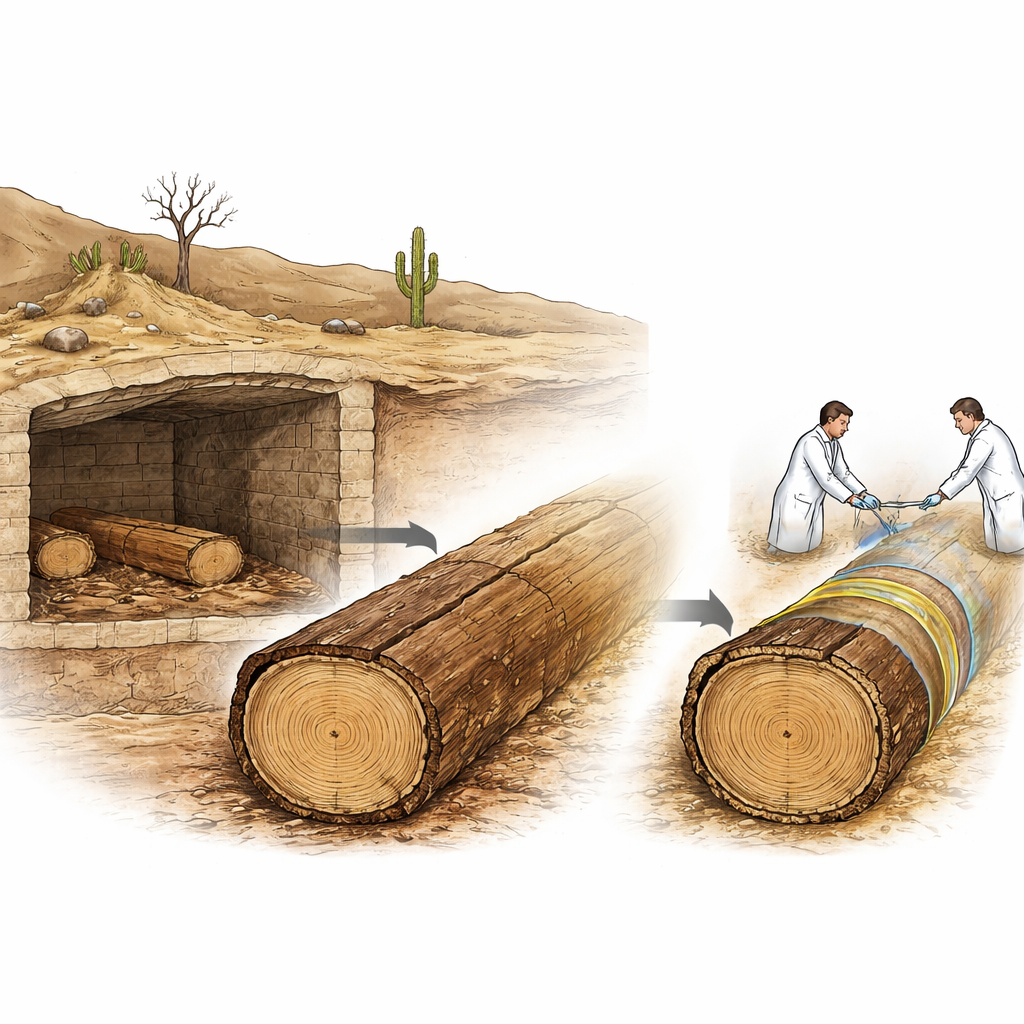
A dry tomb in the desert
The research focuses on the tomb of Murong Zhi in Gansu Province, an area with very little rainfall and wide swings in temperature. Inside the tomb, larch wood was used for door panels, coffin supports, wedges and a carved horse figure. Because all these pieces lay in the same dry soil, they offer a rare chance to study how the burial setting affects wood over time. The team cut small blocks from different objects and, for the thick doors and coffin supports, sliced them layer by layer from the outer surface inward. This allowed them to compare the state of the wood at different depths under nearly identical environmental conditions.
Peering inside ancient wood
To understand how the wood had changed, the scientists used a battery of tests. Microscopes revealed how the tiny cells that give wood its strength had loosened, thinned or collapsed. Simple measurements of density and water uptake showed how much solid matter had been lost and how easily the wood could soak up moisture. Other instruments probed the chemistry and structure of the cell walls, tracking how the long sugar chains that make wood stiff had broken down and how the remaining material had become more open and disordered. They also measured how many dissolved salts and other small molecules had built up inside by checking electrical conductivity and how much material was released when the wood was gently heated under vacuum.
A damaged shell and a sound core
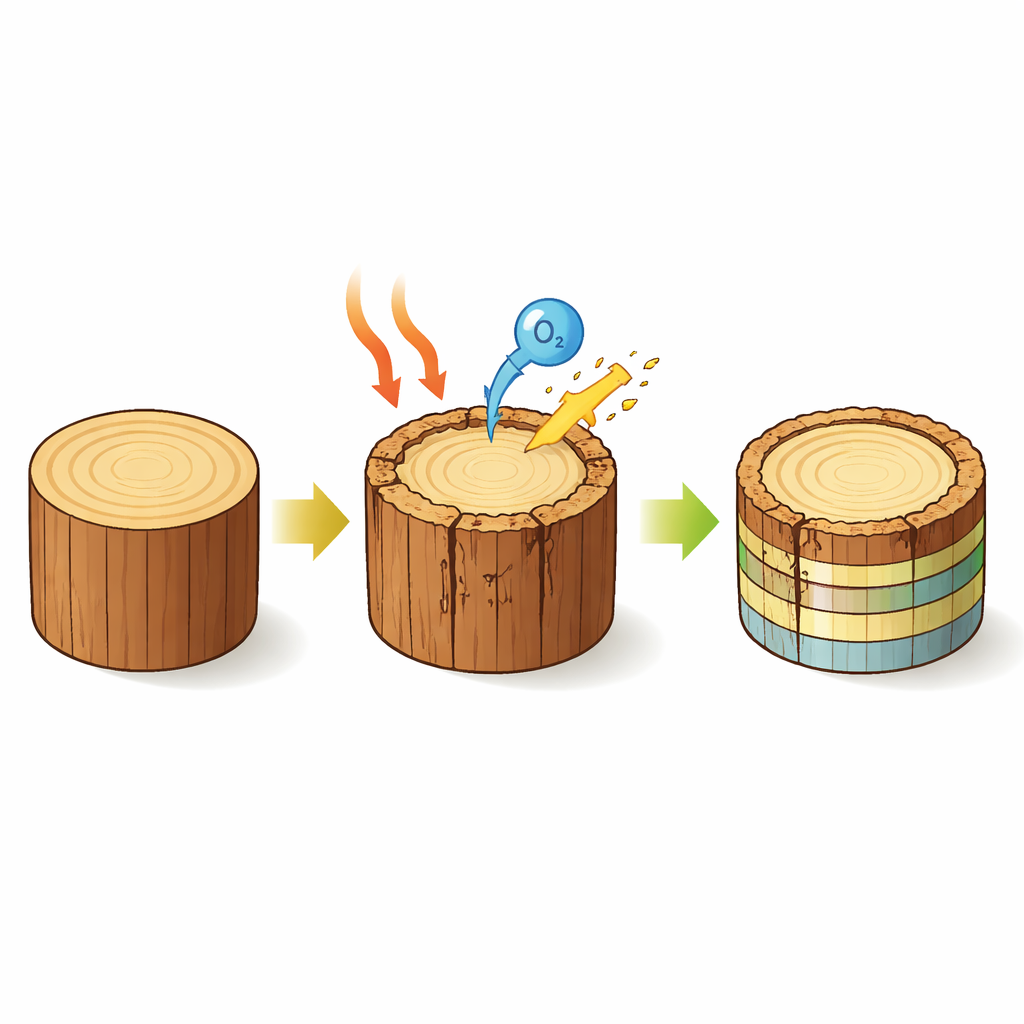
Across all these different tests, a clear pattern emerged. The outer few millimetres of the door panels and other exposed parts were the most damaged: they were lighter, could hold much more water, and showed severe breakdown of the cell walls under the microscope. Chemical signals linked to key wood components were greatly weakened, and the orderly crystalline regions within the wood had partly dissolved into a more chaotic form. These outer layers also contained more dissolved salts. In contrast, samples taken deeper inside beams, supports and carved pieces looked much closer to fresh larch. Their cells were still well formed, they held less water, and their internal structure remained more regular. In other words, the wood had weathered from the outside in, forming a fragile shell around a comparatively sound core.
How dry decay differs from wet decay
This shell-like pattern is quite different from what is often seen in waterlogged sites such as shipwrecks or wetlands, where microbes can tunnel deep into the wood and hollow it out from within. In the dry Gansu tomb, low moisture likely kept fungi and bacteria at bay. Instead, slow chemical reactions with oxygen, temperature swings and the movement of soluble salts in and out of the outer layers appear to have driven the damage. Salts can crystallize and dissolve repeatedly as humidity changes, creating tiny stresses that crack and weaken the outer shell, while the inner core remains buffered and relatively stable. The wood thus records centuries of exposure to a harsh but mostly dry underground climate rather than active biological attack.
Guiding the saving of wooden heritage
By combining many different indicators—physical, chemical and structural—the authors propose a practical way to grade how badly archaeological wood from dry sites has degraded from surface to core. This framework can help conservators judge where strengthening treatments are truly needed and how deeply protective liquids should penetrate. In the case of the Murong Zhi tomb wood, the results suggest that conservation efforts should focus mainly on reinforcing the weakened outer shell, while disturbing the well-preserved inner core as little as possible. Understanding this subtle pattern of decay turns old beams and coffin boards into scientific records of their burial environment, and offers a more rational basis for preserving wooden heritage in arid regions around the world.
Citation: Zhong, L., Lu, M., Chen, Y. et al. Depth-dependent degradation of archaeological timber in an arid burial environment: a multi-indicator case study. npj Herit. Sci. 14, 238 (2026). https://doi.org/10.1038/s40494-026-02520-9
Keywords: archaeological wood, arid burial, timber conservation, material degradation, cultural heritage