Clear Sky Science · en
A multi-ethnic shared dwelling culture: spatial typological distribution patterns and formation mechanisms of China’s Ganlan architectural heritage
Homes on Stilts Across Many Peoples
Imagine a house lifted high above the ground on wooden legs, airy and cool in summer, safe from floods below. These stilt houses, called Ganlan in China, are not a curiosity from a single village—they are part of a vast living tradition shared by dozens of ethnic groups across southern China and much of East and Southeast Asia. This study shows how these homes connect climate, landscape, and human history, and why understanding them matters for protecting heritage and guiding the future of rural life.
Ancient Houses with Deep Roots
Ganlan houses have been around for over 7,000 years, evolving from early tree‑nest dwellings and closely tied to the rise of rice farming in warm, wet regions. Their basic idea is simple: raise the living floor above ground, put storage and animals below, and shelter everything under a steep roof. Archaeological finds from the Yangtze River region show that the building techniques behind Ganlan, such as sophisticated wooden joints, were among the earliest expressions of Chinese timber construction. Over time, this stilt‑house idea spread south and west, appearing in many cultures from the Chinese mainland to islands and neighboring countries, creating a broad “crescent” of similar homes with local twists.
Building a Giant Map of Stilt Homes
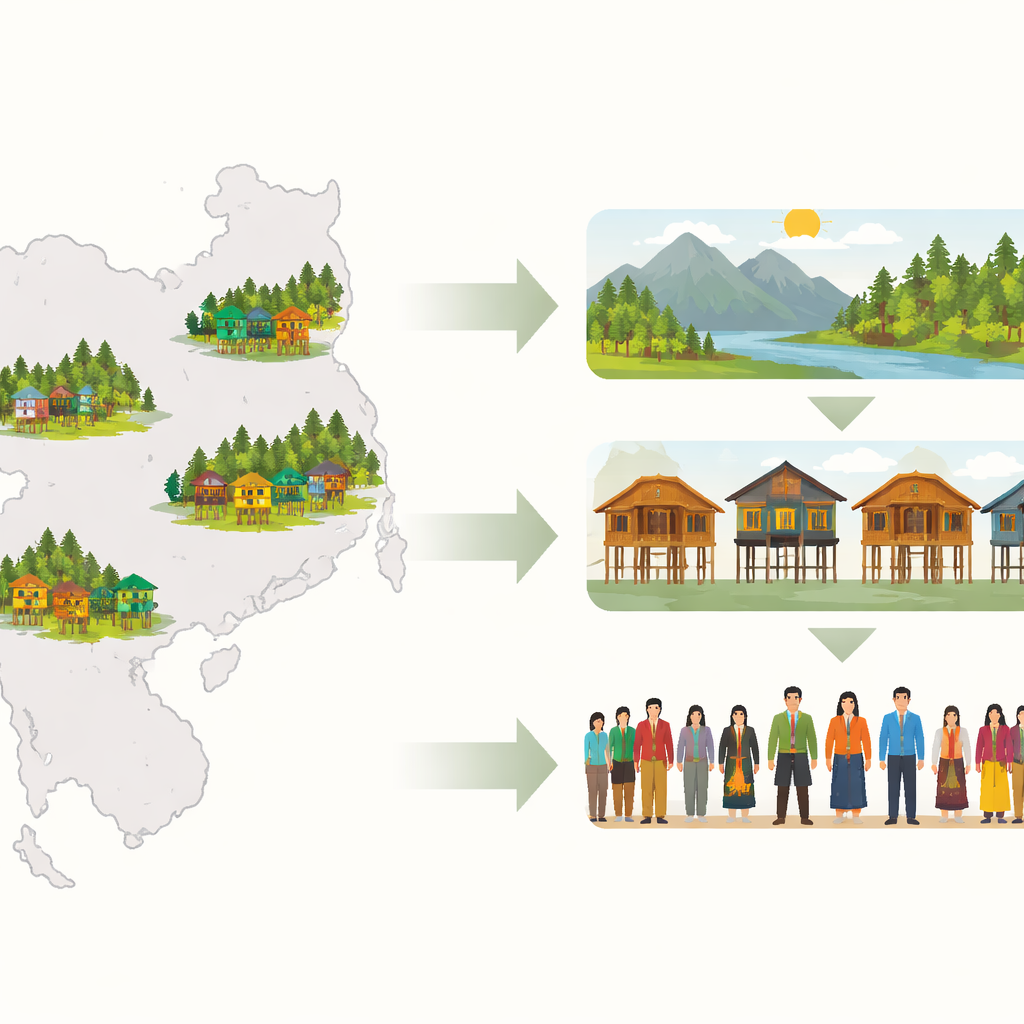
Until now, most research looked at individual villages or building details. This study takes a bird’s‑eye view. The authors gathered information on 32,985 Ganlan buildings in 13 provinces, linked to 35 ethnic groups and thousands of villages. They combined maps, satellite data, village surveys, old local chronicles, and tens of thousands of photos. Using geographic information systems and statistical clustering, they sorted Ganlan into five main types, based on where they sit in the landscape (mountain, river, flatland), how high they are raised, how open or enclosed they feel, and how their wooden frames are put together. This database lets them see not just where Ganlan exists, but how forms shift across mountains, river basins, climates, and cultural boundaries.
Where the Stilt Villages Cluster
The results show that Ganlan houses are strongly concentrated in the mountainous south of China, especially along the borders of Guizhou, Guangxi, Hunan, Hubei, and Chongqing. Here, dense “belts” of stilt villages appear, often in steep, forested valleys with heavy rainfall. Some counties and prefectures in Guizhou, Guangxi, and Hunan have especially high densities of Ganlan homes. Overall, five large types line up in a west‑to‑east chain: from very simple bamboo stilt houses in tropical Yunnan near the Myanmar border, to timber houses on dramatic canyon slopes, then more mature multi‑storey wooden stilt houses, then half‑stilt, half‑ground houses, and finally almost fully ground‑based courtyard houses that still retain traces of stilt construction.
Shaped by Weather, Land, and Forests
The study shows that nature sets the stage. Ganlan almost never appears in dry or cold regions. Instead, these houses cluster in humid subtropical and tropical zones with high rainfall, high humidity, and long warm seasons—places where raising the floor keeps people and timber away from damp ground and floodwaters, and where open under‑floors and pitched roofs help air flow and heat escape. Topography matters too: Ganlan is most common between about mid‑mountain elevations and moderate slopes, where tall posts can adapt to uneven ground and reduce the need to cut terraces into hillsides. Forest and bamboo resources are just as important. In rainforest areas with abundant bamboo, the simplest stilt houses are mostly bamboo structures. In evergreen forests rich in fir and pine, more durable timber frames dominate, supporting larger, taller houses.

Guided by Migrations and Cultural Exchange
Nature alone does not explain the pattern. The researchers traced historical migration routes of the ancient Baiyue peoples from the Yangtze basin toward the southwest and the coast, and compared these paths with today’s Ganlan distribution. They found strong links: as groups moved along rivers and across plateaus, they carried stilt‑house know‑how with them, blending it with local customs. Later, as Han Chinese culture and state power expanded into minority regions, building styles shifted again. Fully raised and open stilt houses gradually mixed with ground‑level courtyard layouts and more formal room arrangements. In some frontier zones, houses became half on posts and half on foundations; in others, enclosed courtyards with only small stilted sections emerged. Interestingly, the study finds that nearby groups tend to converge on similar stilt‑house forms even when they are ethnically different, suggesting that neighbors and shared landscapes influence building styles more than ethnic labels alone.
Why These Old Houses Matter Today
To a non‑specialist, Ganlan houses can seem like picturesque wooden villages perched on hillsides. This study reveals them instead as a long‑running experiment in how people adapt their homes to climate, terrain, and social change. The five stilt‑house types and their west‑to‑east sequence capture a balance between “natural selection” by environment and “cultural selection” through migration, trade, and policy. Understanding these patterns helps heritage planners move beyond saving a few famous villages toward protecting whole cultural landscapes and “corridors” of related settlements. It also offers living lessons for designing comfortable, low‑impact rural housing that works with, rather than against, steep slopes, heavy rain, and limited land—ensuring that these ancient homes on stilts can inspire sustainable futures as well as preserve the past.
Citation: Min, T., Zhang, T. A multi-ethnic shared dwelling culture: spatial typological distribution patterns and formation mechanisms of China’s Ganlan architectural heritage. npj Herit. Sci. 14, 233 (2026). https://doi.org/10.1038/s40494-026-02507-6
Keywords: stilt houses, Ganlan architecture, vernacular heritage, ethnic migration, rural China