Clear Sky Science · en
Positron annihilation spectroscopy reveals microstructural differences in Goryeo celadon from two kiln regions
Looking Inside Famous Greenware
Celadon from Korea’s Goryeo dynasty is prized for its soft green glaze and has long been divided into “everyday” and “elite” wares based on where it was fired. But can modern physics actually see differences in quality hidden inside these centuries‑old ceramics? This study applies a high‑energy technique, better known from nuclear and materials science, to test whether celadon from two major kiln regions really does differ beneath the surface.

Two Kilns, One Big Question
The researchers focused on celadon made in Haenam and Gangjin, two coastal kiln complexes in southwestern Korea that supplied shipborne trade during the Goryeo dynasty. Historical records and archaeological finds suggest that Gangjin operated as a state‑run, high‑quality production center, while Haenam produced more routine, coarser vessels for a shorter time. From underwater finds near each region, the team selected twelve well‑preserved sherds, six from each kiln area, and asked a simple question: do these two traditions leave a distinct physical fingerprint in the clay itself?
Conventional Tests Find Similarities
First, the team turned to an array of standard tools used in heritage science to characterize ceramics. X‑ray methods were used to identify the main minerals and overall chemical make‑up of the clay bodies and glazes. Electron microscopy provided close‑up images of the cross‑sections, revealing glaze thickness and visible pores, while another technique probed the form of iron that helps control glaze color. Together, these methods painted a clear overall picture: both Haenam and Gangjin bodies are based on similar clay rich in silica and alumina, fired hot enough to form the same key minerals. The glazes also overlap strongly in their main components and in the balance of iron that governs green and brown tones. Minor differences in some glaze ingredients showed up, but not enough to sort the sherds cleanly by region.
A New Way to See Hidden Voids
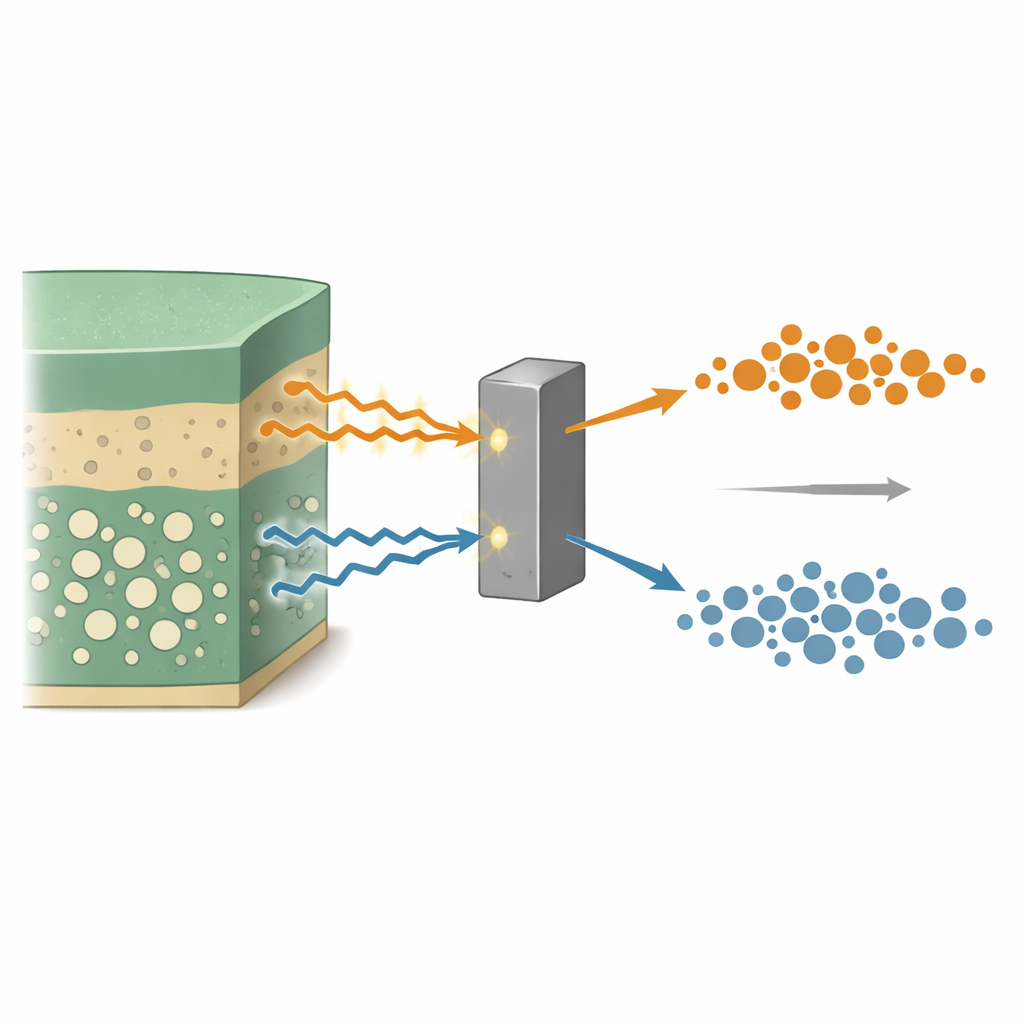
To move beyond what the eye and traditional instruments can see, the researchers introduced Doppler broadening spectroscopy, a member of the family of positron annihilation techniques. Instead of looking at grain size or color, this method senses tiny empty spaces inside the clay body—vacancies and sub‑nanometer pores that form and close during firing. A radioactive source placed against the sherd sends short‑lived particles into the ceramic; how they disappear carries information about how tightly packed the atoms are and how much “free space” exists at extremely small scales. Crucially, this probe averages over a wide volume, capturing the overall internal compactness of each fragment rather than just a few microscope fields of view.
Defect Patterns Reveal Regional Differences
Here the two kiln groups finally pulled apart. A single measurement from the positron technique, known as the S‑parameter, differed clearly between Haenam and Gangjin bodies. All Gangjin samples clustered at lower values, pointing to fewer or smaller hidden voids and a denser microstructure, while all Haenam samples sat at higher values, indicating more open space at the tiniest scales. Statistical tests showed that the ranges did not overlap and that the contrast between groups was strong, even though only six pieces from each region were measured. Just as importantly, this contrast did not track with simple chemical indicators such as the ratio of glass‑forming ingredients in the body, suggesting that firing practice and sintering—how the clay packed and fused during heating—played a larger role than recipe alone.
What This Means for Understanding Craft
For non‑specialists, the key message is that the team has found a way to “hear” differences in how historic potters managed their kilns, even when the clay recipe and glaze chemistry look nearly the same. The denser internal structure of the Gangjin celadon pieces matches their long‑standing reputation as high‑grade wares produced under closer official control, while Haenam’s more open structure echoes its association with coarser products. The authors caution that the sample is small and that more work, including controlled firing of modern test pieces, is needed before specific temperatures or firing schedules can be read off from these measurements. Still, the study shows that positron‑based methods can uncover hidden structural signatures in archaeological ceramics, opening a new window onto how choices made by craftspeople centuries ago shaped the quality and character of the objects we admire today.
Citation: Jeong, Y., Choi, H., Han, M.S. et al. Positron annihilation spectroscopy reveals microstructural differences in Goryeo celadon from two kiln regions. npj Herit. Sci. 14, 228 (2026). https://doi.org/10.1038/s40494-026-02500-z
Keywords: Goryeo celadon, heritage science, ceramic microstructure, positron annihilation, kiln technology