Clear Sky Science · en
Prism-OBI: a novel framework for oracle bone inscription recognition via visual perception and feature decoupling
Ancient Clues in Cracked Bones
More than three thousand years ago, people in ancient China carved questions to the gods onto animal bones and turtle shells, creating the earliest known Chinese writing. Today, these oracle bone inscriptions are precious clues to early history—but most survive only as worn, cracked fragments that are extremely hard to read, even for experts. This paper introduces Prism-OBI, a new artificial intelligence system designed to see through the damage, separate meaningful strokes from geological clutter, and help scholars unlock these fragile records at scale.
Why Old Bones Are Hard to Read
Oracle bones have endured millennia underground, squeezed by soil, soaked and dried by changing weather, and fractured by excavation. The writing is often faint, broken, or missing, and the bone surfaces are full of cracks and stains that look deceptively similar to the carved strokes. Traditional approaches either relied on experts painstakingly comparing each sign by eye, or on standard character-recognition software built for clean, modern printed text. Both approaches struggle when a single character might be split by a crack, partly eroded, or drawn in slightly different shapes by different scribes and over different eras. As a result, much of this material remains underused, locked behind the difficulty of simply identifying which character is which.
Teaching Computers to See Past the Damage
Prism-OBI tackles this problem by breaking recognition into two carefully coordinated stages rather than using one giant end-to-end model. In the first stage, the system focuses only on where characters are on a rubbing of a bone, not on what they mean. Before any AI looks at the image, a two-step cleanup process boosts contrast and filters out speckled scanner noise, making the strokes stand out more clearly. The cleaned rubbing then passes into a customized detector, based on a fast object-detection network, that has been re-engineered to be “degradation-aware.” It separates broad shapes from fine details, highlights likely stroke patterns, downplays random cracks, and combines information across multiple sizes so that both tiny and large characters can be spotted reliably. The output of this stage is a set of tight boxes around each suspected character patch. 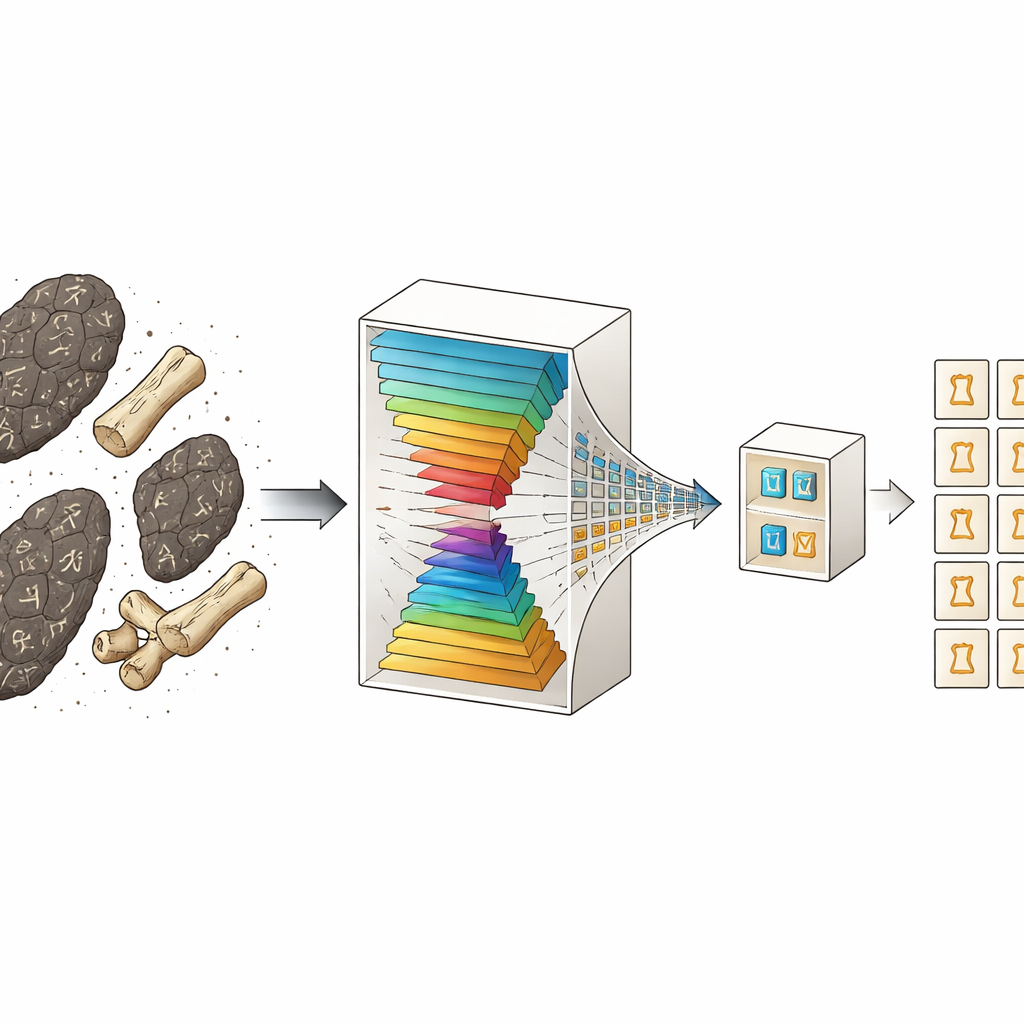
From Cropped Signs to Recognized Characters
In the second stage, each cropped character patch is resized to a standard square and fed into a deep neural network classifier adapted from a widely used vision model. This classifier specializes in telling apart hundreds of subtly different signs in the OBC306 dataset, which contains over 300,000 oracle bone characters across 306 categories, each linked to a modern Chinese equivalent. Because the detector has already done the hard work of cleaning and isolating characters, the classifier can concentrate on fine distinctions in stroke shape and layout—such as tiny hooks, breaks, or intersections—rather than fighting the background noise of the original rubbing. Tests show that this pairing of a focused detector with a strong classifier yields higher recognition accuracy than simpler, single-stage systems, while still running fast enough for near real-time use. 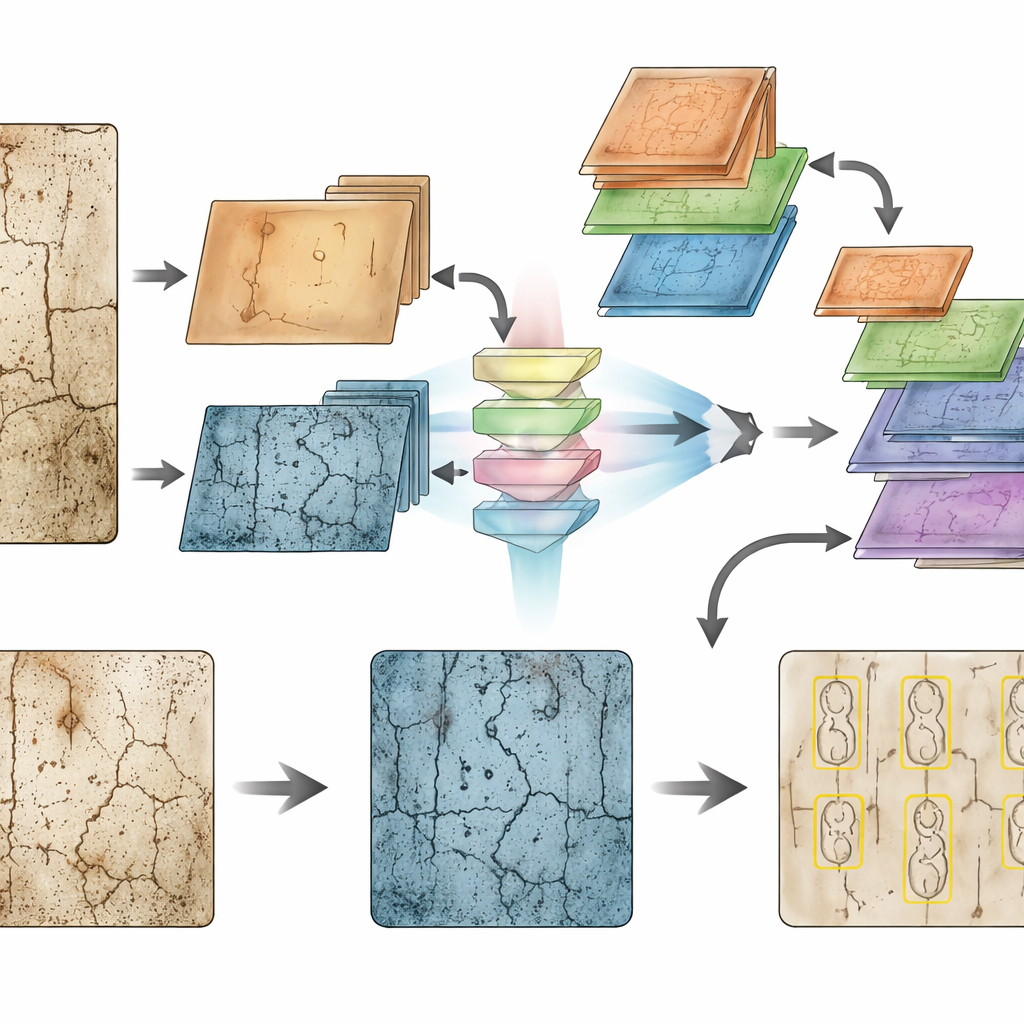
Looking Under the Hood of the New Detector
Behind the scenes, Prism-OBI’s detector uses several tailored tricks to cope with badly degraded artifacts. One module splits the visual signal into low-frequency components (overall contours) and high-frequency components (sharp edges) so the model can treat broad shapes and delicate stroke tips differently, then applies attention mechanisms to emphasize consistent stroke patterns over random fissures. Another module builds a pyramid of views at different scales and learns how much to trust each, which improves detection of both tiny characters and larger ones without being overwhelmed by noise. A third module learns to weigh features from different network layers instead of simply stacking them, helping preserve informative signals while muting unreliable ones. Finally, the detection head explicitly encodes horizontal and vertical position, which is vital in crowded layouts where neighboring characters otherwise blur together.
What the Results Mean for Cultural Heritage
On a standard oracle bone detection dataset, the enhanced detector significantly improves precision, recall, and overall quality of bounding boxes compared with the baseline model, reducing both missed characters and false alarms from cracks. Combined with the classifier, the full Prism-OBI framework achieves strong character recognition performance while processing roughly 32 images per second on a laptop GPU. Early qualitative tests even show that the same detector, without retraining, can meaningfully localize characters in other ancient scripts such as bronze inscriptions and seal script, though fine-tuning is still needed for best results. For non-specialists, the key takeaway is that Prism-OBI offers a practical, extensible path toward automatically reading heavily damaged ancient writings. By cleanly separating “where is the writing?” from “what does it say?”, the system turns messy, fractured bone surfaces into structured, searchable text, helping historians and archaeologists explore humanity’s earliest written records more quickly and thoroughly than ever before.
Citation: Li, J.W., He, J.R., Wu, J.R. et al. Prism-OBI: a novel framework for oracle bone inscription recognition via visual perception and feature decoupling. npj Herit. Sci. 14, 218 (2026). https://doi.org/10.1038/s40494-026-02493-9
Keywords: oracle bone inscriptions, ancient script recognition, deep learning, cultural heritage digitization, computer vision