Clear Sky Science · en
Multi-modal NMR-SEM approach for deciphering salt crystallization-freeze-thaw synergistic damage in limestone
Why Stone Buddhas Slowly Crumble
High on the cliffs of China’s Longmen Grottoes, thousands of carved Buddhas have survived more than 1,500 years of history. Yet their greatest threat today is not invading armies but tiny crystals of salt and the yearly cycle of freezing winters and warm summers. This study asks a simple, urgent question for heritage conservators and curious visitors alike: how exactly do water and salt team up with cold to hollow out the limestone that supports these irreplaceable carvings?
A Rocky Cliff Under Daily Attack
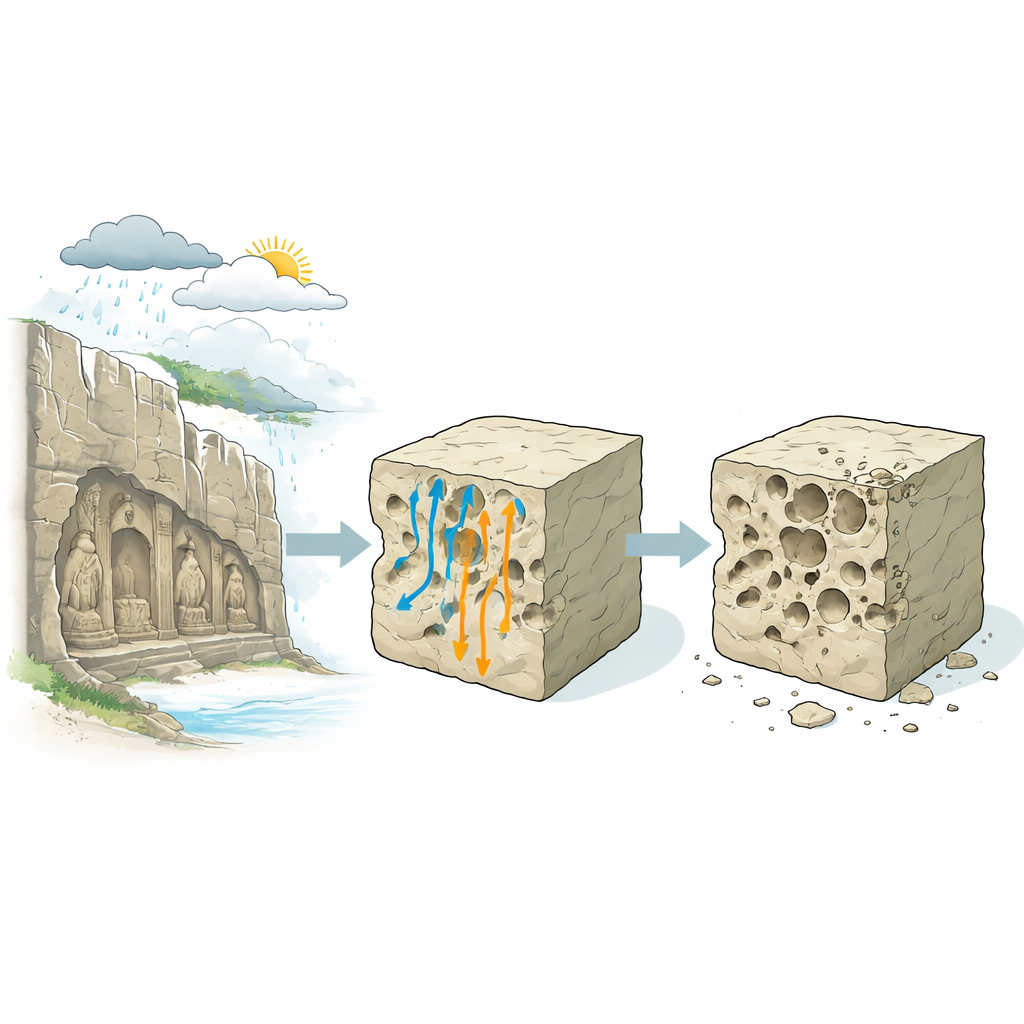
The Longmen Grottoes sit in a damp river gorge where stone surfaces are constantly soaked, dried, chilled and warmed. Rain and seepage water carry dissolved salts—mainly common table salt and sulfate salts—into the porous limestone. In winter, temperatures swing from well below freezing to far above, expanding and contracting the rock. Over centuries, these gentle but relentless changes open cracks, loosen grains and cause pieces of the cliff face to flake away. To protect the site, conservators need to see inside the rock and follow this damage as it unfolds, not just guess from the crumbling surface.
Peering Inside the Stone Without Breaking It
The researchers combined two powerful tools to track damage from repeated “salt crystallization–freeze–thaw” (SCFT) cycles. Nuclear Magnetic Resonance (NMR) let them picture how water sits in pores throughout the interior of small limestone cylinders, turning changes in the rock’s hidden voids into measurable signals. Scanning Electron Microscopy (SEM) provided detailed images of the stone’s surface at the grain scale, allowing computer software to “color in” pores and calculate how much empty space had formed. They soaked test samples in plain water, salty sodium chloride solution and sodium sulfate solution, then drove them through up to 90 daily cycles of wetting, drying, freezing and thawing that mimic the grotto microclimate.
From Tiny Voids to Gaping Pathways
Seen through the microscope, the stone’s journey from intact to weakened unfolds in three stages. During the early cycles, water and ice first open hairline gaps along grain boundaries, increasing the number of the smallest pores. With continued cycling, these pores begin to link together into channels, and surface grains start to dissolve or detach, especially where salt is present. In the final stage, many small and medium pores merge into larger cavities and through-cracks. NMR measurements show that the volume of large pores can roughly double, and the overall porosity of the samples rises sharply—by more than 70% in the salt-rich tests. This growing network of wider pathways makes it even easier for fresh salty water to invade, setting up a vicious circle of damage.
Why Some Salts Are Worse Than Others
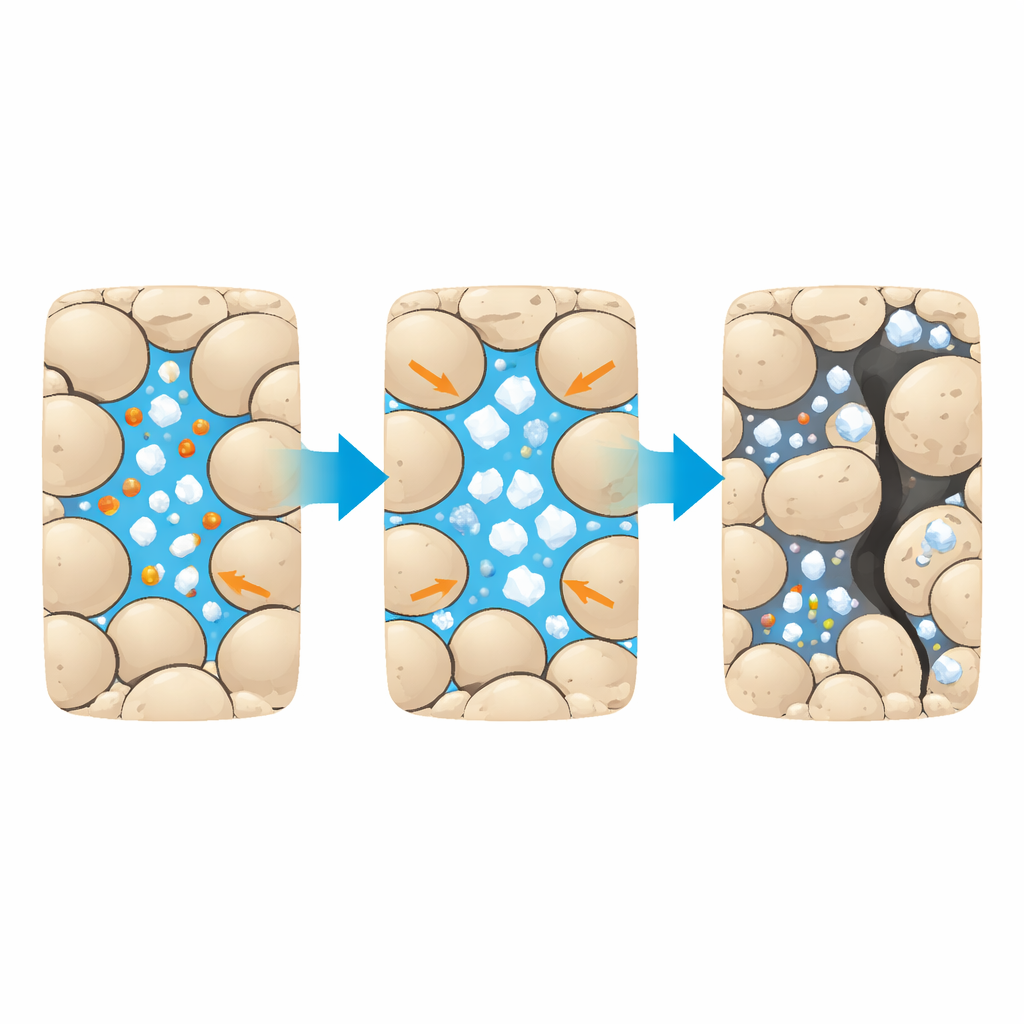
Not all salts attack the limestone in the same way. Sodium chloride increases how easily key minerals dissolve and, when it crystallizes as the water dries or freezes, it presses hard against pore walls. Sodium sulfate, by contrast, tends to form a thin layer of new mineral that partly coats the grains even as it enlarges pores. The study finds that chloride-bearing solutions produce the most severe breakdown, with more large pores and more irregular damage patterns than either sulfate solutions or pure water. By tracking changes in the “fractal dimension” of the pore network—a measure of how complex and interconnected it becomes—the authors show that salt-laden samples develop more tangled, less uniform internal structures than those exposed only to freezing water.
What This Means for Saving Carved Cliffs
For non-specialists, the main takeaway is that the Longmen limestone is not simply cracking from cold or dissolving in rain; it is being reshaped from the inside out by the partnership of salt and temperature swings. The new NMR–SEM approach gives conservators quantitative markers—such as porosity, pore size mix and fractal complexity—that reveal when the rock has moved from harmless microcracking into dangerous, fast-spreading deterioration. That knowledge can guide practical measures like controlling salt-laden moisture, moderating temperature swings near carvings, and prioritizing the most vulnerable zones for intervention before the stone loses its inner strength and priceless figures begin to fall.
Citation: Wang, Z., Wang, Y., Zhao, Y. et al. Multi-modal NMR-SEM approach for deciphering salt crystallization-freeze-thaw synergistic damage in limestone. npj Herit. Sci. 14, 280 (2026). https://doi.org/10.1038/s40494-026-02485-9
Keywords: stone weathering, salt crystallization, freeze–thaw damage, cultural heritage conservation, limestone pores