Clear Sky Science · en
Efficient generation of human dorsal spinal GABAergic progenitors for the treatment of spinal cord injury
New Hope for Spinal Cord Damage
Spinal cord injury can instantly change a life, robbing people of movement and bringing constant, burning pain that current treatments rarely ease. This study explores a new way to repair some of that damage using carefully engineered human cells that restore a natural “brake” system in the spinal cord, with the goal of reducing chronic pain and improving movement after injury.
How Injury Disrupts the Spine’s Inner Balance
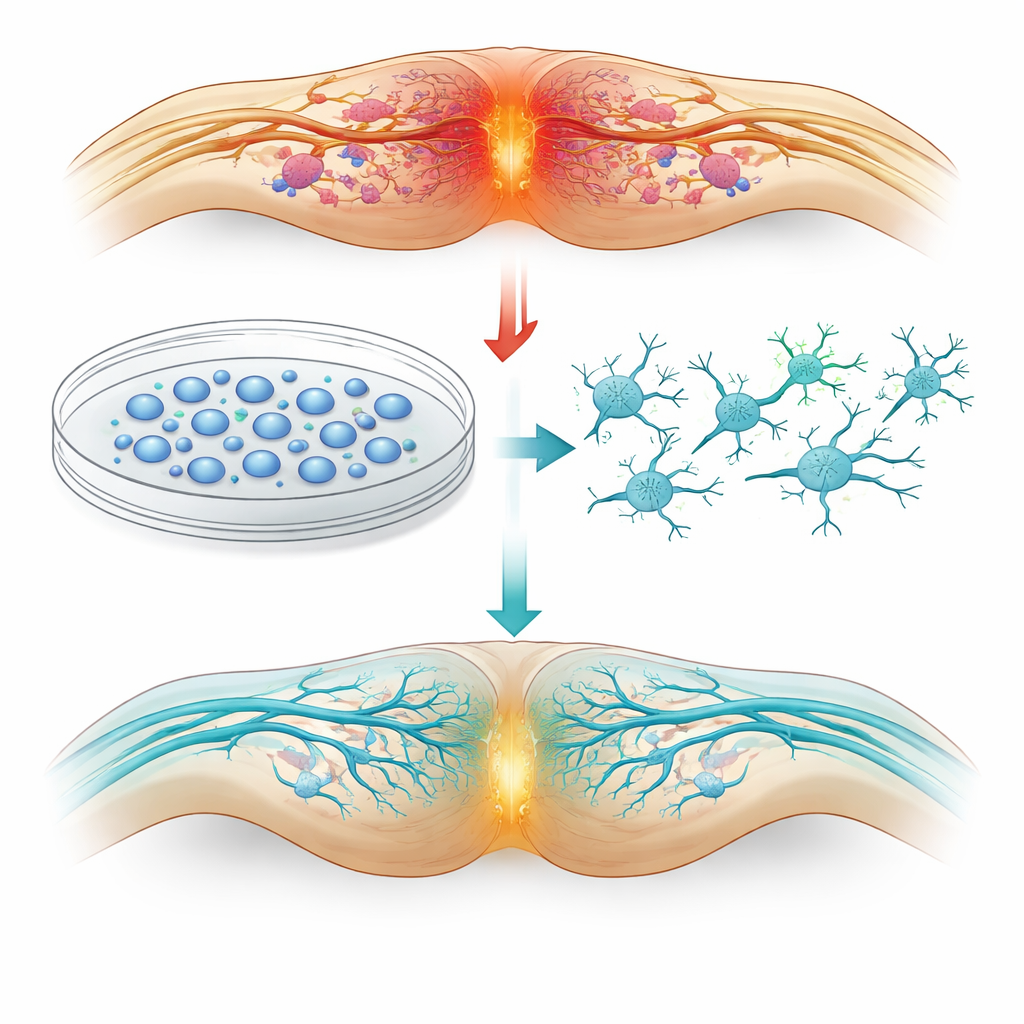
After a serious blow to the spine, many nerve cells die quickly, and the surrounding tissue becomes inflamed and toxic. A key casualty is a group of local “brake” cells that release the calming messenger GABA in the back (dorsal) part of the spinal cord. When these GABA-releasing cells are lost, excitatory cells fire too much, glutamate levels soar, and nerve circuits become hyperactive. This overactivity is closely linked to central neuropathic pain, where even light touch or mild temperature changes can feel unbearable, and it also drives further cell death and long-term disability.
Building Replacement Brake Cells in the Lab
Instead of relying on the body’s limited ability to heal, the researchers turned to human pluripotent stem cells—cells that can in principle become any tissue. Using knowledge from developmental biology, they selected a small set of genetic “switches,” or transcription factors, that normally steer young cells in the embryo toward becoming GABA-producing neurons in the dorsal spinal cord. By briefly turning on three of these switches—PTF1A, LBX1 and ASCL1—they rapidly reprogrammed stem cells into what they call induced GABAergic progenitors. These lab-grown cells carry the same regional identity as dorsal spinal neurons and are primed to mature into GABA-releasing nerve cells.
Putting Engineered Cells into Injured Spines
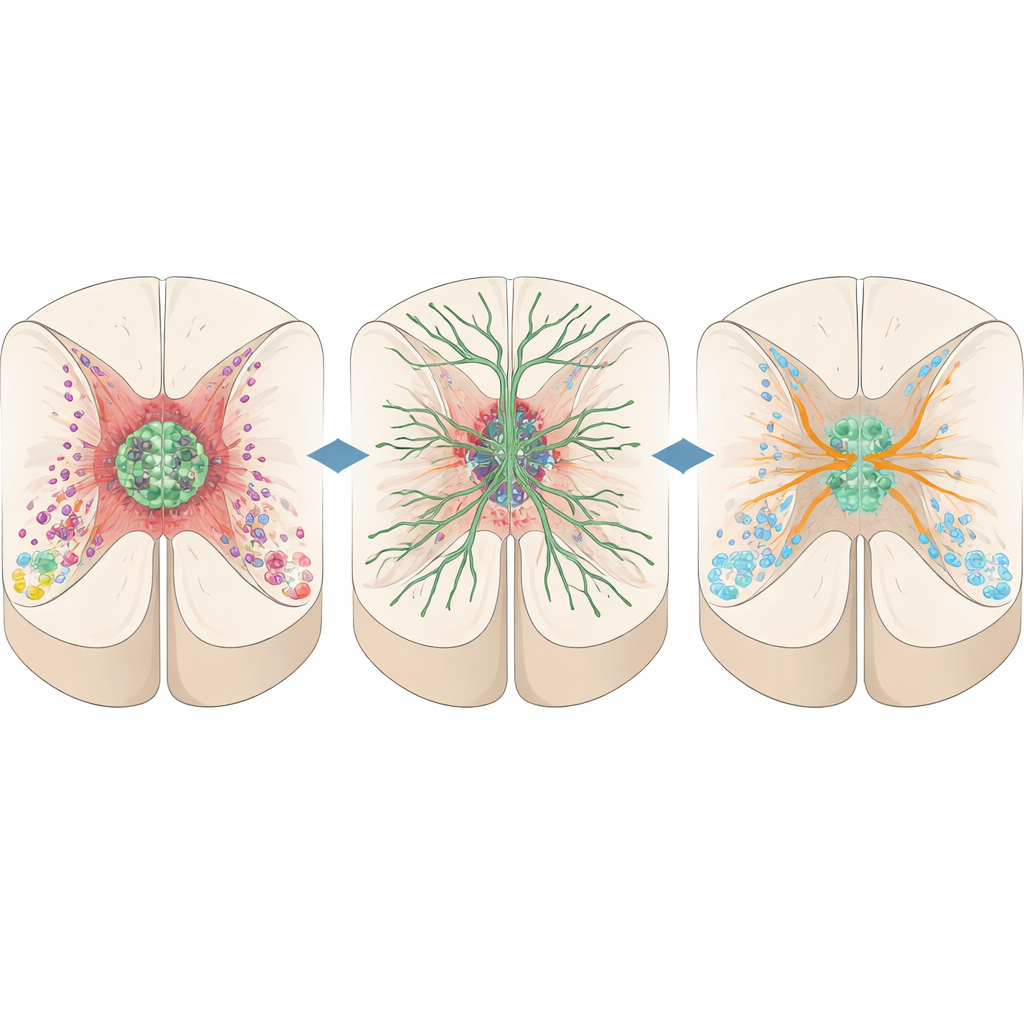
The team tested these progenitors in rats with a moderate contusion injury that mimics many features of human spinal cord trauma, including the delayed onset of chronic pain. Ten days after injury, they injected the human progenitor cells directly into the damaged region and compared them with a more generic batch of spinal progenitor cells. The induced GABAergic progenitors survived well in the harsh, inflamed environment and matured quickly into inhibitory neurons that extended long fibers through and beyond the scarred area. In contrast, the generic cells tended to stall, become support cells, or remain clustered near the injury.
Calming the Environment and Reconnecting Circuits
Remarkably, the transplanted GABA progenitors did more than replace lost cells. They reshaped the injury site itself. Animals receiving these cells showed fewer dying host cells near the lesion, reduced buildup of scar-forming molecules that normally block regrowth, and a quieter immune response. Host neurons around the graft were more likely to survive and to show markers of healthy maturation. Long-distance nerve fibers from the brain re-entered the graft, formed synapse-like contacts with the human cells, and then reconnected to networks farther down the spine. The grafted cells also appeared to boost local inhibitory circuits in the dorsal horn, reinforcing the spine’s natural pain-damping pathways.
Real Gains in Pain Relief and Movement
These biological changes translated into meaningful improvements in behavior. Rats that received the GABA progenitor grafts showed earlier and stronger relief from mechanical and temperature sensitivity, signs that their chronic pain was easing. Over time, they also walked more steadily, with better paw placement and higher locomotor scores than animals given control cells or no cells at all. Because the transplanted cells both restore inhibitory signaling and make the environment more hospitable to regeneration, they offer a two-pronged strategy: directly calming overactive circuits while protecting and reconnecting surviving neurons.
What This Could Mean for Patients
This work does not yet represent a ready-made therapy for people, but it points to a powerful concept: building region-matched, inhibitory neuron progenitors that can survive, wire into damaged spinal circuits and blunt the cascade that leads to chronic pain and further degeneration. If similar cells can be produced safely and at scale for humans, they may one day form part of a cell-based treatment that not only lessens central neuropathic pain after spinal cord injury but also helps patients regain more movement and independence.
Citation: Feng, X., Wan, Y., Peng, M. et al. Efficient generation of human dorsal spinal GABAergic progenitors for the treatment of spinal cord injury. Exp Mol Med 58, 832–847 (2026). https://doi.org/10.1038/s12276-026-01665-8
Keywords: spinal cord injury, GABAergic neurons, stem cell therapy, neuropathic pain, neural regeneration