Clear Sky Science · sv
Observation of resonance of kagome flat band doublet
A new way electrons behave in a special metal
Most of the time, electrons in a solid behave either like roaming waves or like fixed magnets tied to particular atoms. In this study, scientists explore a metal built on a kagome lattice, a pattern of corner-sharing triangles, where both kinds of electrons coexist and interact in an unusual way. Understanding this dance between mobile and more localized electrons can reveal how strange forms of magnetism and possibly even new types of superconductivity emerge in real materials.
A lattice made of triangles and a special kind of stillness
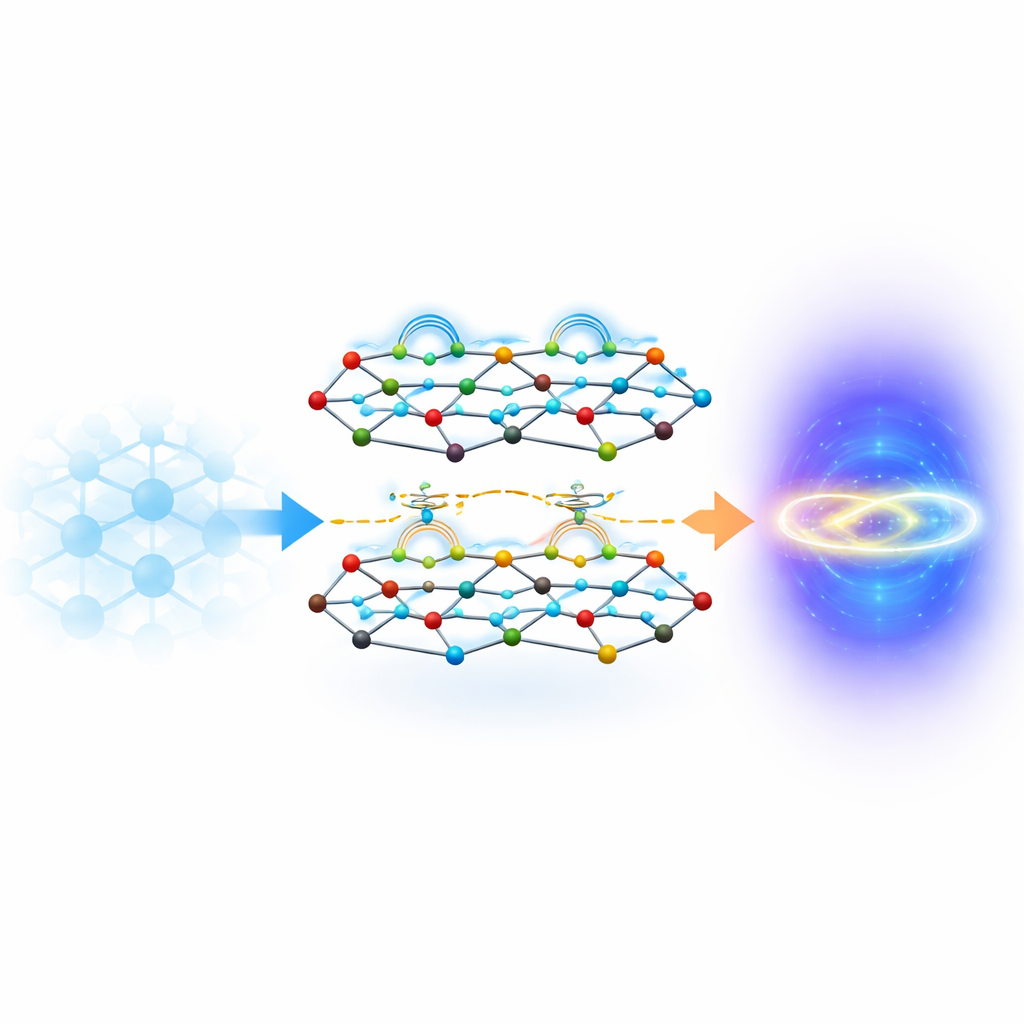
The material at the heart of this work is CsCr₆Sb₆, a crystal made of stacked bilayers of kagome nets, where chromium and antimony atoms form repeating triangles. This geometry forces some electron states to become nearly flat in energy, meaning the electrons do not gain or lose energy as they move in certain directions and therefore act almost as if they are localized. At the same time, other electron states spread out in energy and move freely through the crystal. This built-in coexistence of flat and dispersive states makes CsCr₆Sb₆ a promising place to look for “flat band resonance,” a situation where localized and mobile electrons lock together and strongly boost the electronic signals near the energy where conduction happens.
Watching electrons with light
To see how these different electron states behave, the researchers used angle-resolved photoemission spectroscopy, a technique that shines photons on the material and measures the energies and directions of electrons that escape. By varying the energy and polarization of the incoming light, they built a detailed map of how electrons move in momentum and energy. They found clear evidence of both dispersive bands, which form electron and hole pockets, and flat bands that appear as nearly horizontal lines in these maps. The flat bands are closely tied to chromium d orbitals and remain essentially two dimensional because the kagome bilayers are widely spaced, reducing coupling between layers.
A resonance that appears only in the cold
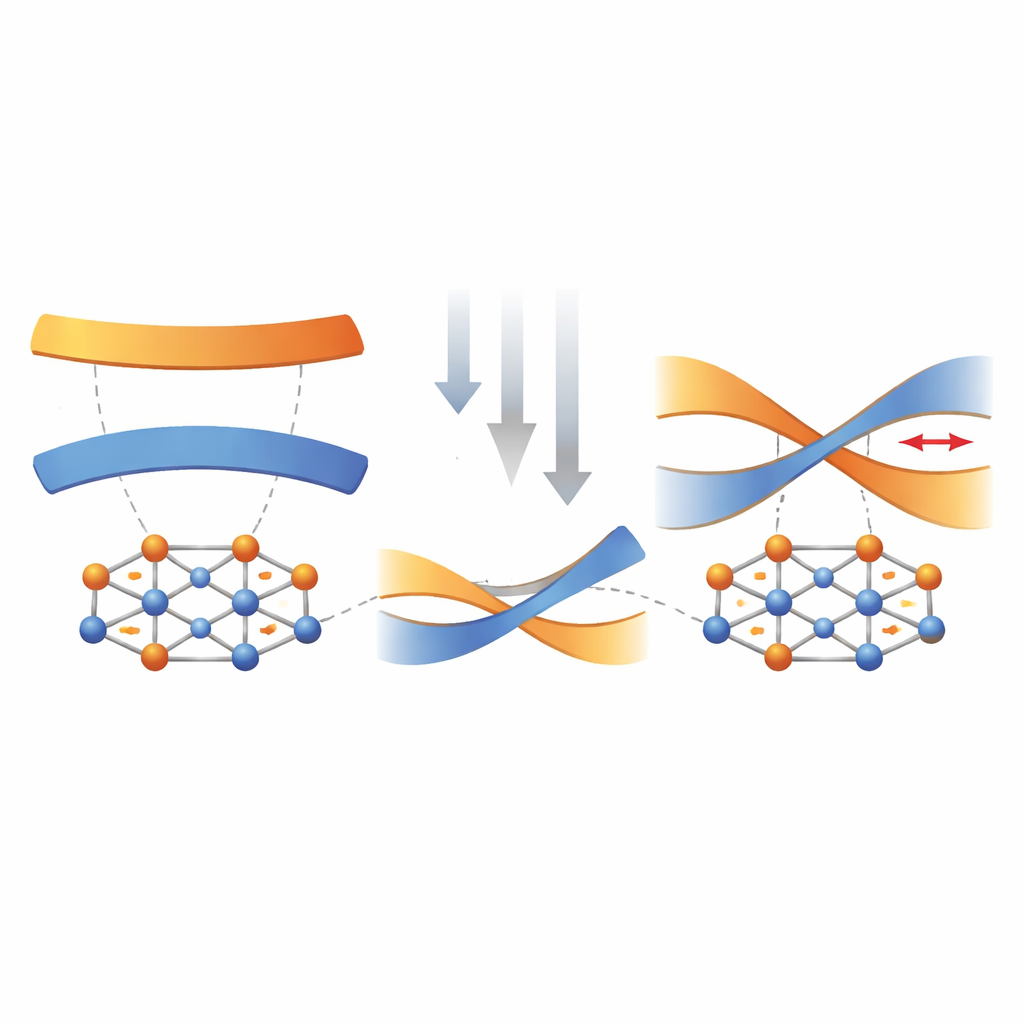
When the team cooled CsCr₆Sb₆, they observed a striking change. At higher temperatures, only the bottom of one mobile band was visible near the key energy level. As the temperature dropped, three flat band features emerged and sharpened, and a pronounced peak developed just below the conduction energy, signalling a coherent resonance of the flat bands. This peak and its satellites weakened rapidly as the material was warmed again, disappearing above about 70 to 80 kelvin. Transport measurements on the same material show a kink in the electrical resistance near 72 kelvin, indicating the onset of short-range antiferromagnetic correlations, where neighboring local moments tend to point in opposite directions without forming a long-range ordered pattern.
Magnetism and electron pairing join forces
The temperature at which the flat band resonance appears is not random: it coincides with the development of these short-range antiferromagnetic correlations. In heavy-fermion metals, a well-known class of materials with localized f electrons, Kondo screening usually builds up gradually and often competes with magnetic order. In contrast, in CsCr₆Sb₆ the resonance emerges together with, rather than against, the magnetic correlations. The authors suggest that the frustrated triangular geometry of the kagome lattice strengthens local magnetic fluctuations, which in turn both suppress simple long-range order and create a favorable environment for the resonance between flat and mobile electrons. Advanced theoretical calculations that include electron correlations support the presence of flat bands and a crossover between incoherent and coherent behavior but also highlight that existing models must better capture the close tie between magnetism and the resonance.
Why this matters for future quantum materials
By directly observing flat band resonance in a kagome bilayer metal and linking it to short-range antiferromagnetic behavior, this work delivers experimental proof of a long-sought phenomenon. For a general reader, the key message is that by carefully arranging atoms in a triangular pattern and tuning how strongly different layers talk to each other, scientists can design materials where electrons become both heavy and highly interactive. Such systems are fertile ground for unconventional superconductivity and exotic topological phases, where electrical currents may flow without resistance or host protected edge states. CsCr₆Sb₆ thus serves as a model platform for engineering and exploring new quantum states that arise from the subtle partnership between electron motion and magnetism.
Citering: Zhang, R., Jiang, B., Liu, X. et al. Observation of resonance of kagome flat band doublet. Nat Commun 17, 4013 (2026). https://doi.org/10.1038/s41467-026-70779-4
Nyckelord: kagome lattice, flat band, quantum materials, antiferromagnetism, Kondo physics