Clear Sky Science · en
Long-distance academic invitations: a case for an air travel bioethics
Why Flying for Work Is Everyone’s Business
Most of us think of academic travel as a normal part of scientific life: experts fly in, give talks, meet colleagues, and fly out again. This article asks us to look at those flights in a new way. It argues that the air miles racked up when scholars are invited from far away are not just a private matter of career and courtesy, but carry real consequences for the planet and for people’s health—especially for those who have contributed least to climate change. Focusing on bioethicists, the author makes the case for an emerging “air travel bioethics” that treats long-distance invitations as a serious moral question, not just a logistical one. 
How Planes Change the Planet and People’s Lives
The article begins by situating air travel within the broader picture of global warming. Human activity has already warmed the planet by about one degree Celsius, driving more intense heat waves, storms, floods, and other disruptions. These changes harm human health directly, through heat stress and extreme weather, and indirectly, by damaging food supplies, spreading infectious diseases, worsening air and water quality, and fueling conflict and displacement. Crucially, the burdens fall hardest on low- and middle-income countries that have contributed the least to greenhouse gas emissions and have fewer resources to protect public health. Air travel, though only one sector, plays a meaningful role in these emissions, and its climate effects are amplified by complex processes in the upper atmosphere. Business and professional flights are a minority of global trips, but they are often taken by relatively privileged groups and can be reduced more easily than flights tied to basic needs.
Academia Wakes Up to Its Flight Footprint
Within international research communities, climate concerns are beginning to reshape long-established habits. Studies show that many academics worry about climate change yet hesitate to fly less, partly because institutions still reward frequent travel. Others report personal “tipping points” where guilt or concern push them to cut back. A growing “Green Conferencing” movement promotes online or hybrid meetings, fewer but more meaningful conferences, regional hubs, and incentives to use trains instead of planes. These efforts, however, have mainly focused on big conferences and their organizers and attendees. The paper highlights a quieter but important practice that has received less scrutiny: one-off or small-scale long-distance invitations, such as asking a colleague from another continent to give a talk, join a workshop, or visit a lab.
Why Bioethicists Have Extra Responsibilities
Bioethics is a diverse field that often examines topics like medical research, artificial intelligence in health care, pandemic response, and global health justice. Many of these issues are inherently international, making cross-border dialogue crucial. Yet bioethics also presents a special case: its practitioners explicitly study health, fairness, and responsibility. The author argues that bioethicists therefore carry a specific professional duty to consider the climate impacts of their own work, including travel. On the health side, ignoring how emissions harm present and future patients would undermine the quality of ethical analysis. On the justice side, theories of climate fairness typically hold that people in wealthy countries should not consume scarce “emissions space” for nonessential activities when others still lack basics like secure housing and food. That logic applies with particular force to optional long-distance flights for academic prestige or convenience, especially when low-carbon alternatives exist.
What to Weigh When Inviting or Accepting
Turning from principles to practice, the article outlines concrete factors that hosts and invitees should weigh. Prevention comes first: could an online meeting or a regional gathering achieve almost the same benefits as flying someone across the globe? Distance and flight class matter, since long-haul and premium seats have much higher per-person emissions; tools exist to calculate this footprint. The expected scientific gain from meeting in person is another key element: are new collaborations, conflict resolution, or deep methodological exchanges likely, or is the main draw simply a famous name on a poster? Questions of seniority raise fairness concerns: senior scholars often fly more and may already enjoy strong visibility, while junior researchers may rely on occasional travel to build careers. The author also flags more controversial influences—tourism, carbon offsets, and the desire to feel honored—as motives that should be treated with caution rather than as straightforward justifications. 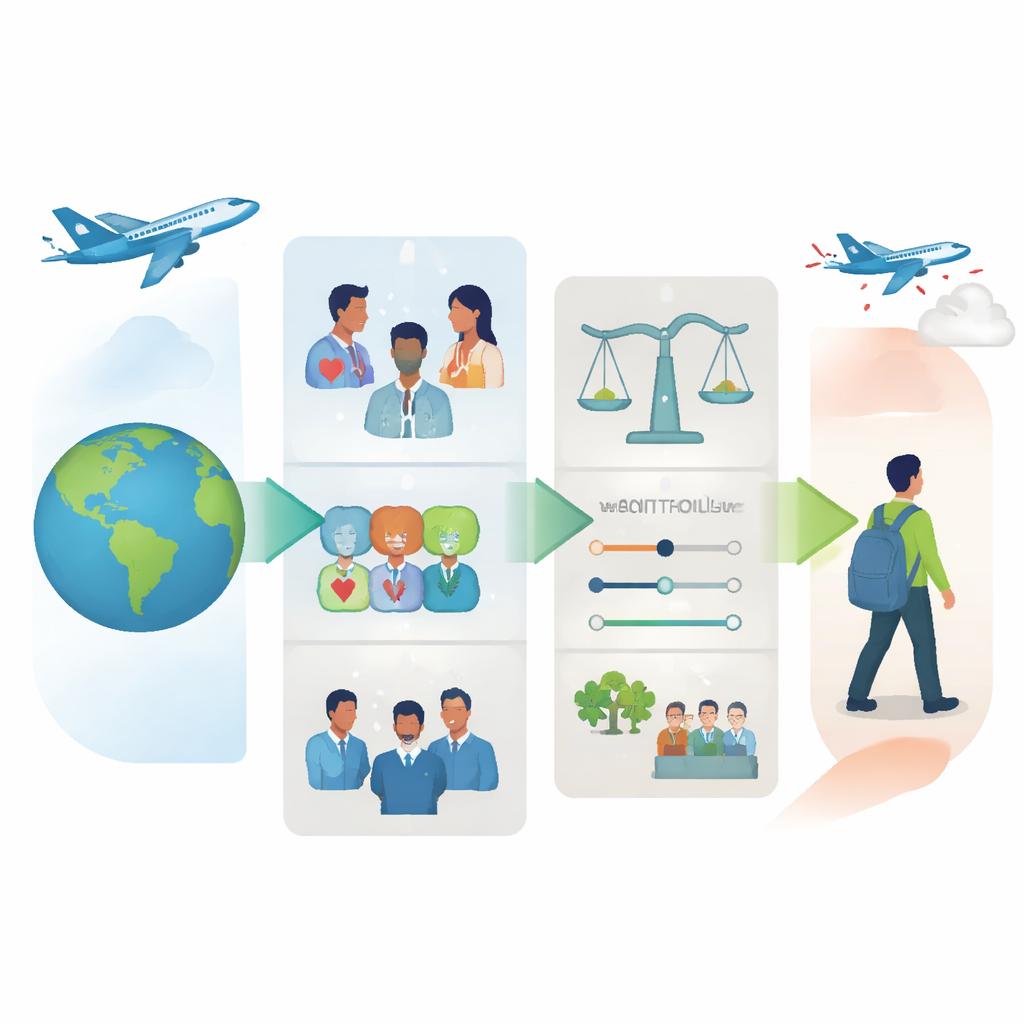
Rethinking Invitations for a Fairer Future
In the end, the article argues that long-distance academic invitations should no longer be treated as neutral perks of the job. For bioethicists in particular, caring about health and justice means recognizing that every intercontinental flight has ripple effects far beyond the seminar room. The author calls for an explicit “air travel bioethics” that helps individuals, institutions, and eventually policymakers set fair limits, design low-carbon alternatives, and talk openly about travel choices without stigma or hypocrisy. By cleaning up its own house—reassessing when and why people are asked to fly—the bioethics community can preserve its credibility and offer a model for other fields seeking to align their everyday practices with the values they publicly defend.
Citation: Salloch, S. Long-distance academic invitations: a case for an air travel bioethics. Humanit Soc Sci Commun 13, 611 (2026). https://doi.org/10.1057/s41599-026-07410-w
Keywords: academic air travel, bioethics, climate justice, green conferencing, professional ethics