Clear Sky Science · en
Beyond simple transmission: sequential mediation and gender moderation in the relationship between parental educational anxiety and adolescent help-seeking avoidance
Why parents’ school worries matter for teens
Across many families, concern about children’s grades has become a constant background noise. This study explores what happens when that concern hardens into ongoing anxiety, and how it shapes the way teenagers respond when they struggle in class. Instead of simply passing pressure from parent to child, the research uncovers a more subtle pathway involving social support, confidence, and differences between boys and girls in how they cope.
When fear of failure keeps teens silent
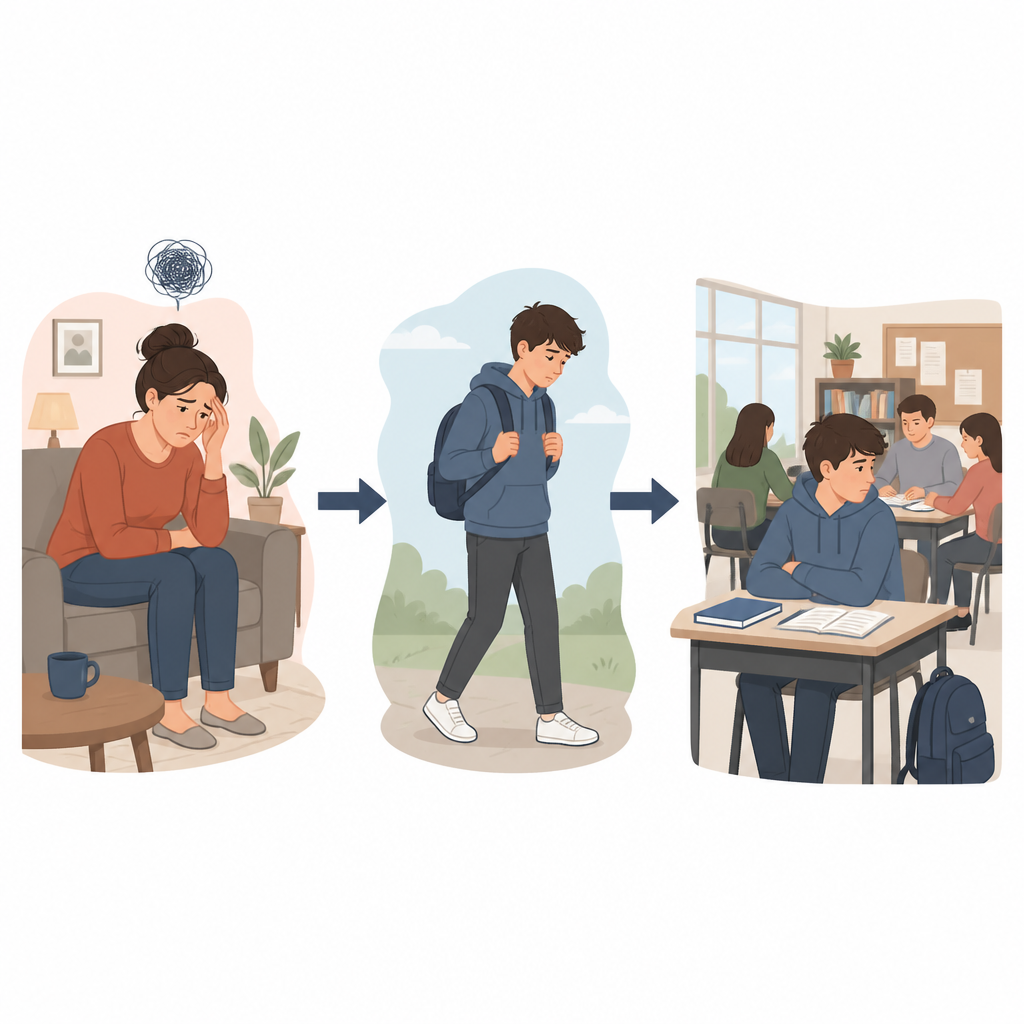
At the heart of the study is a common but often hidden behavior: avoidant academic help seeking. This is when students choose not to ask questions, hide confusion, or guess on assignments even when they know they need help. The researchers surveyed 695 Chinese adolescents aged 14 to 18 and their parents to see how parents’ educational anxiety relates to this pattern. They found a clear link: the more worried parents were about school success and future prospects, the more likely their teenagers were to avoid asking for help. In high-pressure families, teens may see every question as a possible sign of failure, and staying quiet can feel safer than risking disapproval or embarrassment.
Support networks and inner confidence
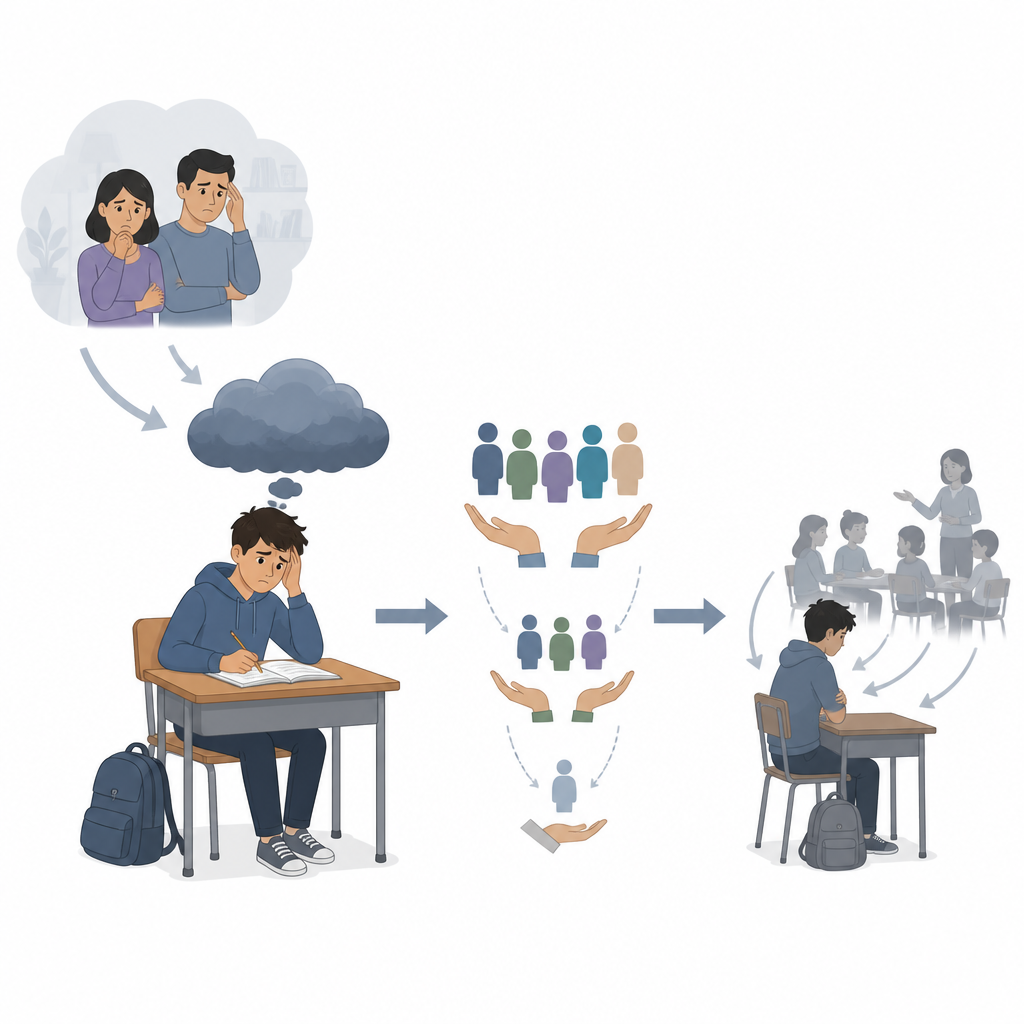
The study shows that this is not just a simple cause-and-effect story. Two psychological factors in teens play key roles: perceived social support and self-efficacy. Perceived social support is how strongly a young person feels that family, friends, and teachers are “on their side.” Self-efficacy is their basic belief that they can handle challenges. When parents are highly anxious, teens tend to feel more pressure and control and less warmth and understanding. Over time, they may come to expect little genuine support from others. This weaker sense of backing from their social world makes it harder to believe they can cope with school problems, which in turn makes them more likely to keep quiet instead of reaching out.
A chain from home climate to classroom behavior
Using detailed statistical models, the authors tested whether parental anxiety affects help avoidance directly, indirectly, or both. They found evidence for a chain: higher parental anxiety is linked to lower perceived social support, which is linked to lower self-efficacy, which finally predicts more avoidance in seeking help. Each link in this chain explains part of the overall connection, with reduced social support playing the largest role. In other words, teens in anxious households are not only afraid of slipping up; they may also feel they lack a safe, encouraging network and the inner resources to face academic difficulty openly.
Boys, girls, and different paths to avoidance
The researchers also examined whether this process worked the same way for male and female students. They found a striking difference. For boys, parental anxiety had a strong direct link to avoiding help, even after accounting for social support and self-confidence. Boys in anxious families were especially likely to shut down and handle school problems alone. For girls, the direct link disappeared. Instead, parental anxiety influenced them mainly by eroding their sense of social support, which then led to greater help avoidance. The basic roles of support and confidence were similar across genders, but where the pressure “entered” the system differed.
What this means for families and schools
Overall, the study suggests that when parents are constantly anxious about school, teens are more likely to hide their struggles, cutting themselves off from teachers and classmates who could help. This happens partly because teens feel less supported and less capable, and it plays out differently for boys and girls. For families and schools, the message is clear: easing anxious pressure and strengthening warm, reliable support can encourage young people to speak up when they are stuck. Building teens’ confidence and making help-seeking feel safe are key steps toward healthier learning, especially in cultures where academic competition is intense.
Citation: Zhao, H., Sun, M., Zhu, X. et al. Beyond simple transmission: sequential mediation and gender moderation in the relationship between parental educational anxiety and adolescent help-seeking avoidance. Humanit Soc Sci Commun 13, 661 (2026). https://doi.org/10.1057/s41599-026-07017-1
Keywords: parental educational anxiety, adolescent help-seeking, self-efficacy, social support, gender differences