Clear Sky Science · en
The synergistic effects of urban soundscapes, building spacing, and green wall on the perceived restorativeness of window views: a VR-based investigation with EEG and psychological assessments
Why the view from your window matters
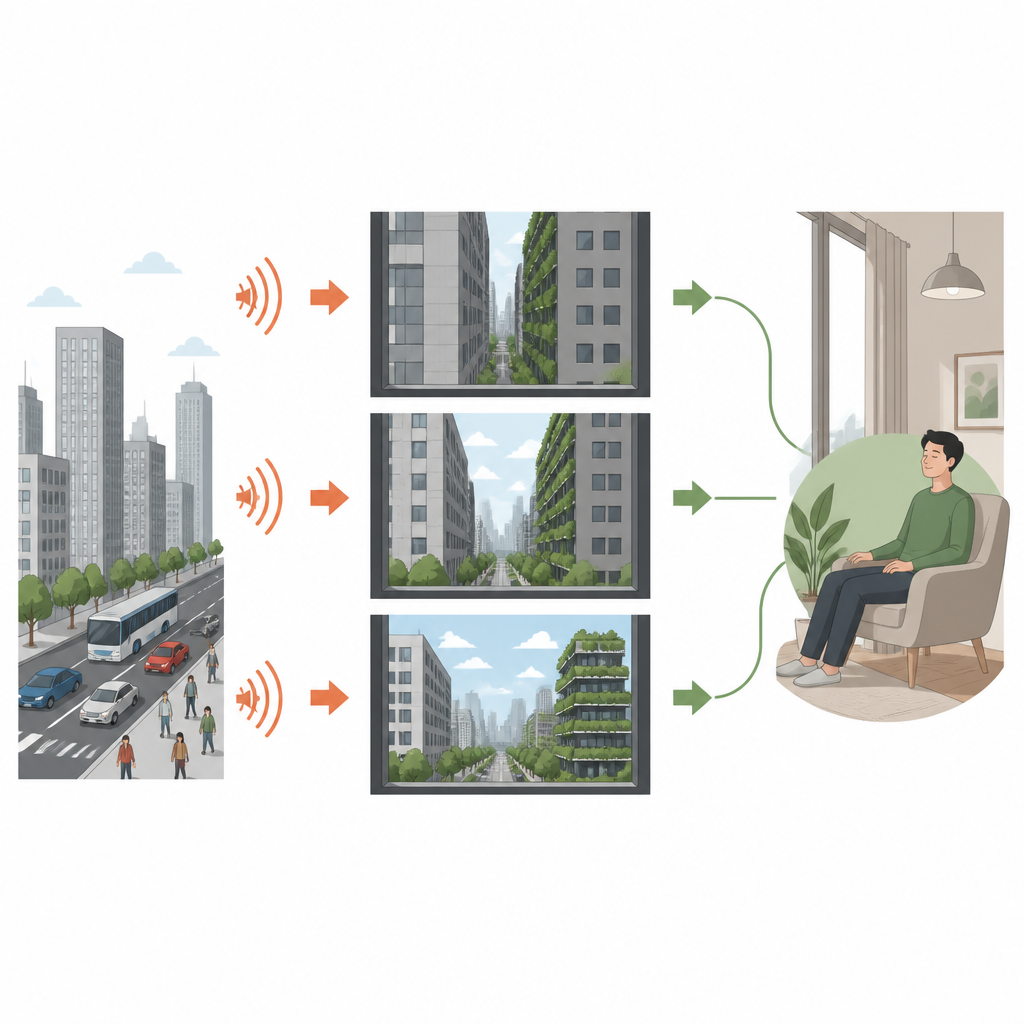
For many city dwellers, the only glimpse of the outside world is through an apartment or office window. This study explores how what you see and hear through that window can quietly shape your mood, stress levels, and ability to think clearly. Using virtual reality and brainwave recordings, the researchers show that the spacing between buildings, the presence of greenery on walls, and everyday urban sounds combine in surprising ways to either soothe or strain the mind.
What the researchers set out to test
The team created 24 realistic virtual window views from a high-rise flat. They varied three key ingredients: how far away the facing building was (10, 15, or 20 meters), whether that facade was a bare wall or covered with a lush green wall, and which sound filled the room (silence, traffic noise, people talking, or ventilation hum). Four hundred eighty young adults experienced one of these scenes through a virtual reality headset while their brain activity was recorded and they completed questionnaires about how calm, restored, or anxious they felt.
How window views changed feelings and anxiety
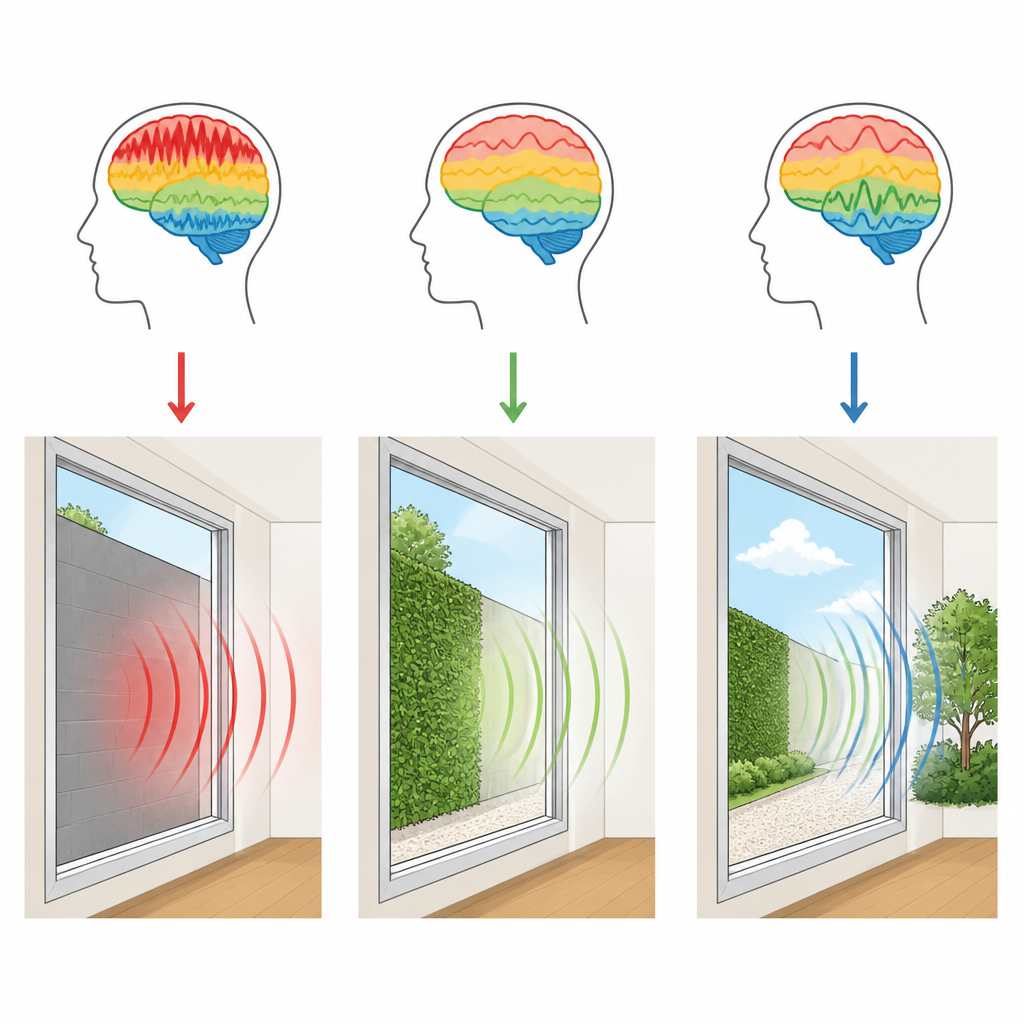
Across all sound conditions, looking at a green wall instead of a bare wall made people feel more refreshed and less anxious. More distance between buildings also helped: views across 15 or 20 meters felt more open and less oppressive than a cramped 10-meter gap. However, the benefits of extra distance tailed off after 15 meters, suggesting that there is a useful range rather than a simple rule that farther is always better. Noise mattered strongly. Silence paired with a green wall produced the strongest sense of mental recovery, while traffic noise remained stressful even when greenery was present, showing that pleasant sights cannot fully cancel harsh sounds.
What the brainwaves revealed about hidden effects
Electroencephalography, which tracks patterns of brainwaves, added a deeper layer to the story. Green walls generally increased alpha activity, a pattern linked with relaxed alertness, confirming that people were not only saying they felt calmer but their brains were behaving that way. Yet the details depended on the sound and spacing. Under traffic noise, a faraway green wall at 20 meters raised slow-wave activity and lowered fast waves, a combination suggesting a passive, mentally switched-off state rather than healthy relaxation. In contrast, with conversation noise, a close green wall at 10 meters reduced fatigue-related activity and boosted signals tied to focused attention, implying that the greenery helped people engage more actively with their surroundings.
The sweet spot for calm focus
In quieter settings, such as silence or steady ventilation sounds, a mid-range spacing of about 15 meters with a green wall produced what looked like an ideal brain pattern: strong signs of calmness with neither drowsiness nor over-arousal. At this distance, people’s brains showed fewer signs of mind-wandering and more of a settled, outward-looking focus. By comparison, very close green walls under monotonous ventilation noise could actually increase signs of mental fatigue, likely because rich visual detail clashed with a dull, unchanging sound background, forcing the brain to work harder to integrate mixed signals.
What this means for city living
To a layperson, the main takeaway is that not all "green views" are created equal. A strip of plants on the building opposite, the gap between facades, and the type of everyday noise outside together determine whether a window offers true mental relief. Green walls almost always help, especially where space is tight or noise is high, but their impact is strongest when paired with suitable spacing and a gentler sound environment. For architects and planners, this work suggests that designing healthier high-rise homes is less about a single fix and more about tuning visual space, greenery, and sound as a whole so that the view from the sofa or desk becomes a quiet ally in daily restoration rather than an unnoticed source of strain.
Citation: Liu, Y., Li, W. The synergistic effects of urban soundscapes, building spacing, and green wall on the perceived restorativeness of window views: a VR-based investigation with EEG and psychological assessments. Humanit Soc Sci Commun 13, 647 (2026). https://doi.org/10.1057/s41599-026-07009-1
Keywords: urban soundscape, green wall, window view, psychological restoration, EEG