Clear Sky Science · en
The effect of traditional sports culture on modern social governance in China
Why old games matter today
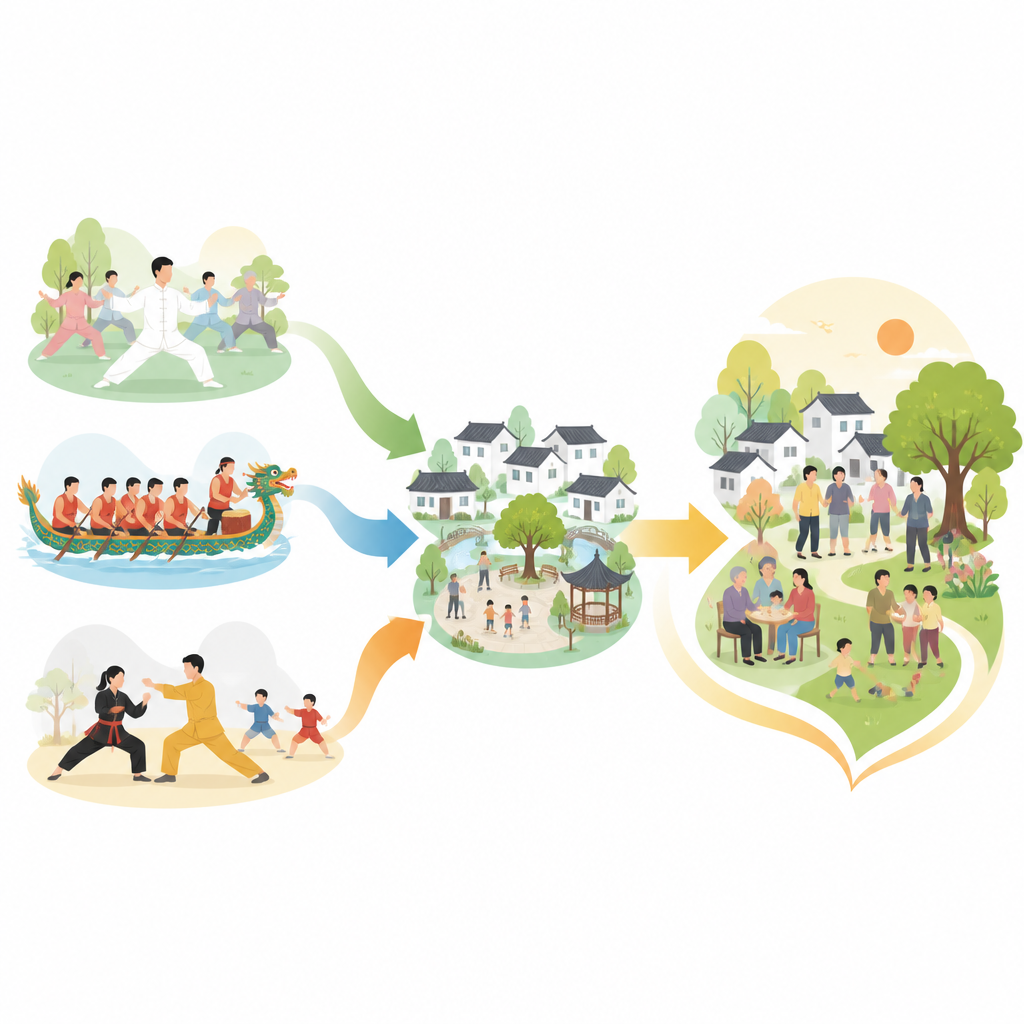
Across China, people still gather at dawn for Tai Chi in parks, race dragon boats on rivers, and practice traditional wrestling and martial arts in local clubs. This paper asks a simple but important question: can these time honored sports do more than keep people fit? The author explores how traditional Chinese sports may quietly strengthen community bonds, civic spirit, and the way ordinary people take part in local public life.
From village games to shared rules
Traditional sports did not start as hobbies or modern fitness trends. They grew out of everyday needs such as self defense, farming life, and village celebrations. Over centuries they absorbed ideas about fairness, respect, and proper behavior, becoming living lessons in how people should treat one another. In China, activities like martial arts, dragon and lion dances, and dragon boat racing now carry stories about helping the weak, playing fair, and honoring teachers and elders. These shared customs act like an informal rulebook that shapes how people behave well beyond the sports field.
Sports as a school for character
The paper explains that traditional sports teach more than skills of the body. They encourage self discipline, patience, modesty, teamwork, and tolerance. A student who trains in a martial arts school, or joins a festival dance group, is expected to control emotions, respect partners, avoid harming others, and cooperate with the group. Over time, these habits spill into daily life at home, at work, and in the neighborhood. The author connects this to wider ideas about culture, arguing that these quiet lessons help people feel responsible for their community and more willing to join in common projects.

Testing the link between sport and community
To see whether these ideas hold up in real life, the study surveyed 486 adults aged 18 to 62 from 18 provinces across China. Half of them regularly practiced a traditional sport such as dragon boat racing, Tai Chi, wushu, chujiu, or traditional wrestling. Participants rated, on a simple five point scale, how strongly they felt they belonged to their community and how active they were in social life beyond their family. The same people were surveyed again after six months, but only if they had kept training throughout that period.
What regular practice seemed to change
The results showed clear patterns. People who had practiced a traditional sport for at least six months reported noticeably higher feelings of belonging and higher social activity than they had at the start. Those involved in these sports also scored higher than people who did not take part at all. The type of sport did not matter much: whether rowing a dragon boat or practicing Tai Chi, the changes were similar. Participants with university education tended to report stronger community identity and activity, while differences between men and women, and between city and rural residents, were small. The author suggests that the gains may come from psychological factors such as greater self confidence, better mood, and more chances to meet others through regular training.
From personal change to better local life
Beyond the numbers, the paper gathers examples of how traditional sports are woven into community projects. Dragon boat teams have helped drive river clean ups, village dance groups have drawn older gamblers into healthier routines, and campus martial arts classes have supported students under stress. Festivals and national events featuring Tai Chi or minority sports attract visitors, bring income, and showcase local pride. Taken together, these cases show how traditional sports can anchor networks of volunteers, cultural groups, and local leaders who work together on public problems.
What this means for everyday society
For readers outside the research world, the message is straightforward: when people regularly join in traditional sports, they often feel more connected to neighbors and more willing to help with shared tasks. The study does not claim that sports alone can fix every social challenge, and it notes that more careful research is needed with objective measures of behavior. Still, the findings suggest that supporting local, culturally rooted sports may be a practical way for towns, cities, and villages to strengthen trust, identity, and participation in community life.
Citation: Li, L. The effect of traditional sports culture on modern social governance in China. Humanit Soc Sci Commun 13, 657 (2026). https://doi.org/10.1057/s41599-026-07002-8
Keywords: traditional sports, social cohesion, community identity, Chinese culture, social governance