Clear Sky Science · en
Too risky for the road but safe for schools? Rethinking smart glasses in the science classroom
Why high tech glasses matter for schools
Smart glasses are moving from science fiction to everyday life, promising to help students see instructions, translate text, and record experiments as they happen. This article asks a simple but unsettling question: if these devices are considered risky enough to limit on the road, why are they slipping quietly into science classrooms with so few rules? By comparing school policies with strict driver distraction laws, the authors show that smart glasses raise safety, privacy, and fairness concerns that families and educators cannot ignore.
What smart glasses can really do
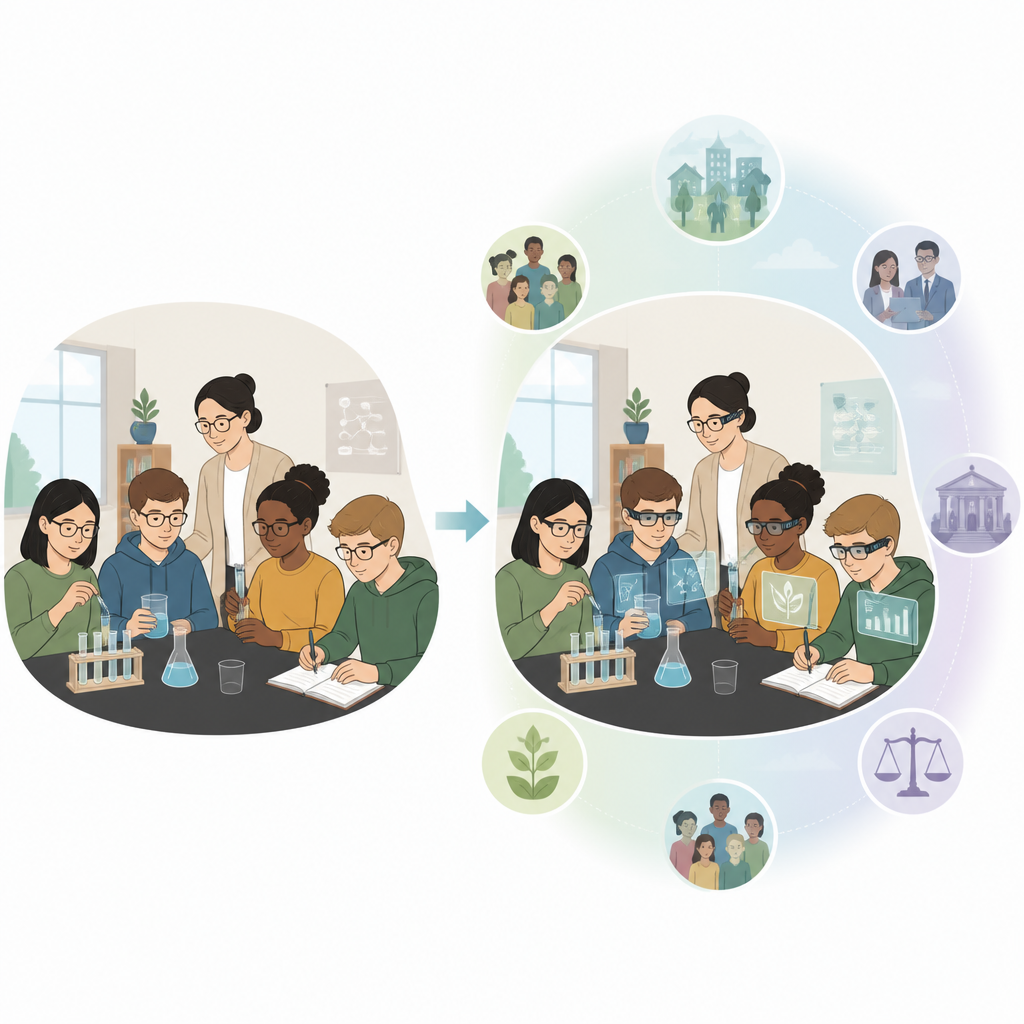
Modern smart glasses look almost identical to ordinary eyewear, yet they contain cameras, microphones, speakers, sensors, and AI helpers. In a science lab, they could identify equipment, translate technical terms, read out instructions, and offer step by step guidance as students handle chemicals or build circuits. For some learners, this could make lessons more accessible and engaging. But the same features also allow constant, often invisible, recording and analysis of everyone in view, including classmates who never agreed to be filmed, and teachers whose every move might be captured, stored, and fed into commercial systems.
From cool classroom tool to quiet surveillance
The article illustrates how ordinary school scenes could change once smart glasses become common. A teacher might live stream a lab demonstration to help absent students or parents follow along, but then forget to stop recording when walking into private spaces. A student could covertly broadcast an exam or share clips from class online using glasses that look like regular prescription lenses. Parents buying smart glasses so their child can see better might not realise that built in AI can whisper real time answers during tests or feed detailed data about their child’s behaviour to companies. These scenarios are not wild fantasies; they mirror abilities that current and near future devices already have.
What road safety rules can teach schools
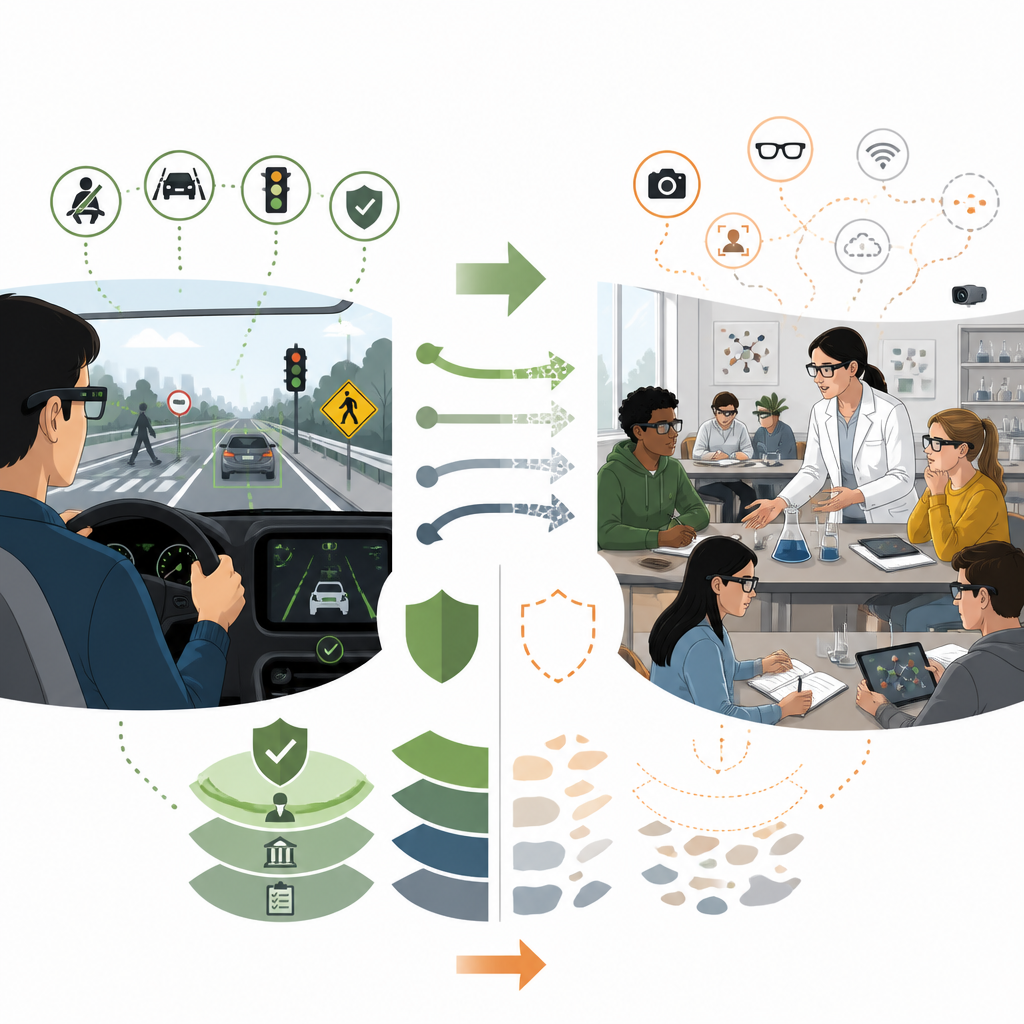
To highlight the gap in school policy, the authors turn to a very different setting: driving. In the Australian state of Victoria, road authorities have created detailed rules that treat smart glasses and other wearables as possible sources of distraction and danger. Devices are carefully sorted into types, such as portable or wearable, and the law spells out which kinds of use are banned for different drivers. Smart glasses face particularly tough limits because they sit in the user’s direct line of sight and can keep feeding visual and audio information, whether or not the driver is actively touching them. Cameras and fines back up these rules, showing that the risks are taken seriously at a system level.
Where school policies fall silent
Education policies across Australia, in contrast, have focused mostly on mobile phones and say little or nothing specific about smart glasses, even though they can be more immersive and harder to detect. The authors’ analysis shows that this silence leaves critical questions unanswered: Who is responsible when data from the classroom is captured and shared? How should schools balance accessibility for some students with the privacy of others? Should restrictions differ for younger students, older students, and teachers, the way they do for novice and experienced drivers? Without clear guidance, the burden shifts unfairly to individual teachers and principals, who must make case by case decisions about fast changing technologies.
Why the authors call for clearer rules
In closing, the article argues that smart glasses are not just teaching aids, but part of a wider web of data collection and automated judgment. Leaving them largely unregulated in science classrooms risks normalising quiet, continuous surveillance in places where young people should be safe to learn, question, and make mistakes. The authors suggest that education systems borrow the forward looking mindset used in road safety: classify devices clearly, set common limits based on risk, and protect the rights and agency of students and teachers. For families and schools, the message is that asking hard questions now is essential if smart glasses are to support learning without eroding trust.
Citation: Arantes, J., Welsman, A. Too risky for the road but safe for schools? Rethinking smart glasses in the science classroom. Humanit Soc Sci Commun 13, 624 (2026). https://doi.org/10.1057/s41599-026-06988-5
Keywords: smart glasses, science education, wearable technology, student privacy, education policy