Clear Sky Science · en
The mediating role of energy consumption in the impact of thermal environment change on carbon emissions: evidence from the Yangtze River Economic Belt, China
Why hotter cities matter for everyone
Across the globe, summers are getting hotter and heat waves are lasting longer. For people living in big cities, this does not just mean uncomfortable nights and higher air conditioning bills. It also means more strain on power systems and more carbon released into the air. This study looks at how these pieces fit together in one of China’s most important regions, the Yangtze River Economic Belt, and asks a simple question with big consequences: as city surfaces warm, how much extra energy do we use, and how much more carbon do we emit?
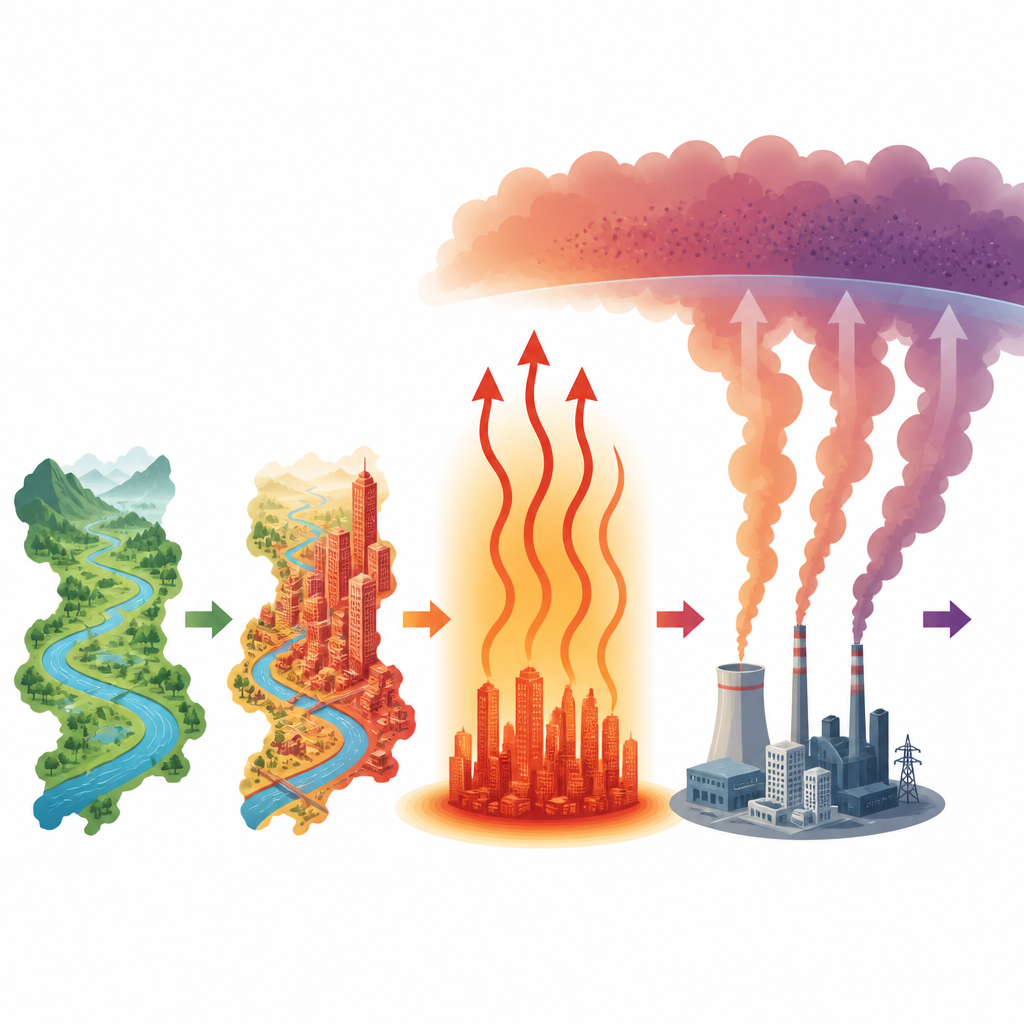
Following the trail from heat to pollution
The researchers start by focusing on three linked parts of the urban environment: heat at the ground surface, energy consumption, and carbon emissions. They call this connected chain the thermal–energy–carbon, or TEC, linkage. Using more than two decades of satellite temperature data, detailed energy statistics, and a global carbon emissions dataset, they track 109 cities along the Yangtze River from 2000 to 2022. Over this period, high-heat surface areas and total energy use both grew sharply, and regional carbon emissions more than tripled. Cities such as Shanghai and Chongqing, along with fast-growing provincial capitals like Wuhan and Nanjing, stood out as major contributors to this rise.
Measuring how heat drives energy use
To move beyond simple correlations, the study applies econometric models that test how changes in surface warmth are linked to changes in emissions while holding other factors constant. The results show a clear pattern: as hot surface zones expand, city-level carbon emissions also rise. Part of this increase is direct, reflecting the extra work cooling systems must do during hotter periods. But a large share is indirect. The authors find that higher heat significantly raises overall energy demand, especially for electricity. This added energy use then leads to higher carbon emissions in a system that still relies heavily on fossil fuels. Their calculations suggest that about 59 percent of the effect of surface warming on emissions flows through this extra energy consumption.
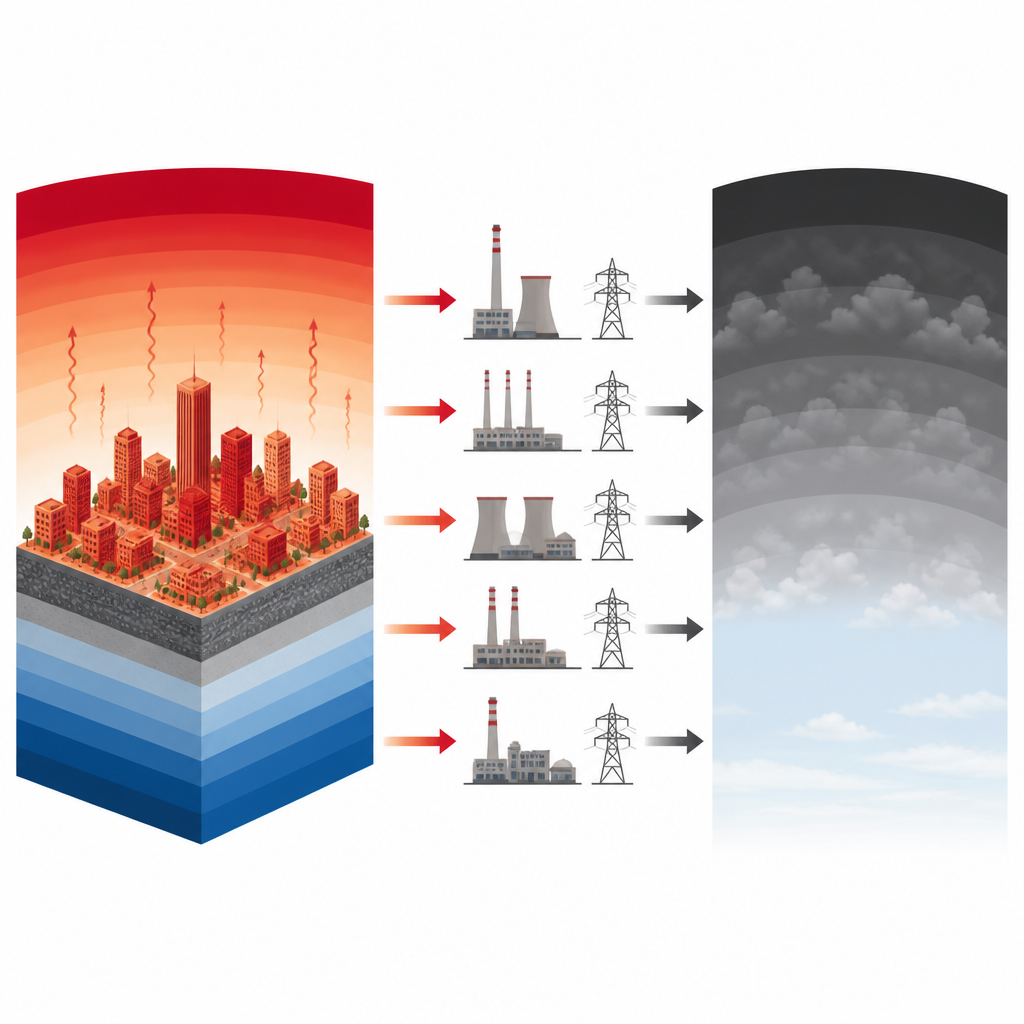
When growing cities cross critical lines
The link between heat, energy, and carbon is not the same everywhere. The team shows that economic development acts like a set of thresholds that change how strongly warming cities affect emissions. In poorer areas with simpler economies and fewer appliances, hotter surfaces have a weaker impact on carbon output. Once a city’s economy passes certain income levels, however, households buy more cooling devices, businesses and factories expand, and electricity demand becomes much more sensitive to heat. The study identifies two such economic thresholds, beyond which the carbon impact of a given increase in surface warmth grows noticeably stronger. A similar pattern appears when they look at shifts in industrial structure: as regions move toward more advanced but energy-hungry industries, heat-driven emissions responses become larger.
How city design can ease the burden
Landscapes inside and around cities also play a role. By examining indicators of how urban land is divided and connected, the researchers find that better-connected green and open spaces are linked with lower emissions overall. These landscape features can cool local areas, reduce the need for mechanical cooling, and help store carbon in vegetation. In contrast, highly fragmented surfaces of hard materials trap more heat. Together, the economic and landscape results suggest that both what cities do and how they are built determine how severely heat waves translate into carbon-intensive energy use.
What this means for city residents and planners
For a layperson, the message is straightforward: when city surfaces get hotter, people turn up the cooling, power plants work harder, and more carbon enters the atmosphere. This cycle is especially strong in wealthy, densely built regions where many people rely on energy-hungry cooling systems. The study suggests that breaking this loop will require a mix of cleaner energy, more efficient buildings and appliances, and smarter urban design that weaves in green corridors and parks. By tailoring strategies to each city’s stage of development, policymakers can cut emissions while still protecting residents from dangerous heat, helping to keep both neighborhoods and the climate more livable.
Citation: Tang, Z., Huang, S. The mediating role of energy consumption in the impact of thermal environment change on carbon emissions: evidence from the Yangtze River Economic Belt, China. Humanit Soc Sci Commun 13, 676 (2026). https://doi.org/10.1057/s41599-026-06982-x
Keywords: urban heat, energy consumption, carbon emissions, Yangtze River Economic Belt, city planning