Clear Sky Science · en
Coupling of inter-provincial water competition and economic development in China: a multi-method water–food–energy–economic nexus analysis
Why water use between farms and power plants matters
Across China, the same rivers and aquifers are asked to do double duty: grow food for more than a billion people and cool the power plants that keep its cities and factories running. This study looks at how that tug-of-war over water plays out between provinces, and how it shapes local economies. By tracing where and how water is used for crops and energy, and linking this to growth and jobs, the authors offer a window into the hidden connections behind everyday staples such as rice, electricity and fuel.
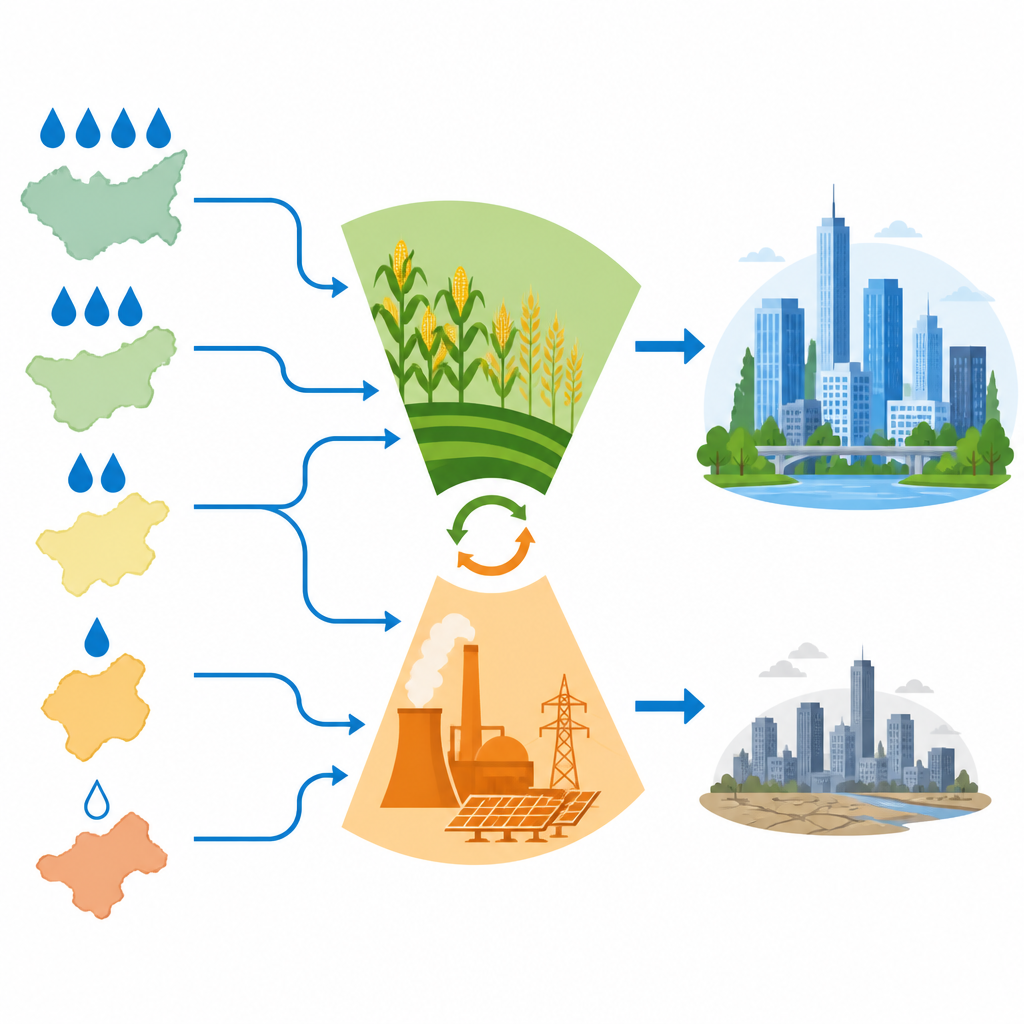
Following every drop from field and mine
The researchers start by calculating the “water footprints” of China’s food and energy production from 2006 to 2022. For food, they track not just irrigation from rivers and groundwater, but also rainfall taken up by crops and the extra clean water needed to dilute farm pollution. For energy, they follow water through coal, oil and gas extraction, power plant cooling, and newer sources like wind, solar and hydropower. This life cycle approach reveals how much water each sector really uses, province by province, instead of only counting what leaves a tap or canal.
Where competition for water is fiercest
When food and energy demand grow together, they can collide over the same limited supplies. To capture this, the team builds a simple competition index that rises when both sectors claim large shares of a province’s total water use. They find that many inland regions, especially along the middle Yellow River and in the northeast, have spent years in an “antagonism” stage, where water is heavily contested. Coastal provinces such as Guangdong, Jiangsu and Shanghai tend to be better off: they have improved coordination between sectors, even as their economies have expanded.
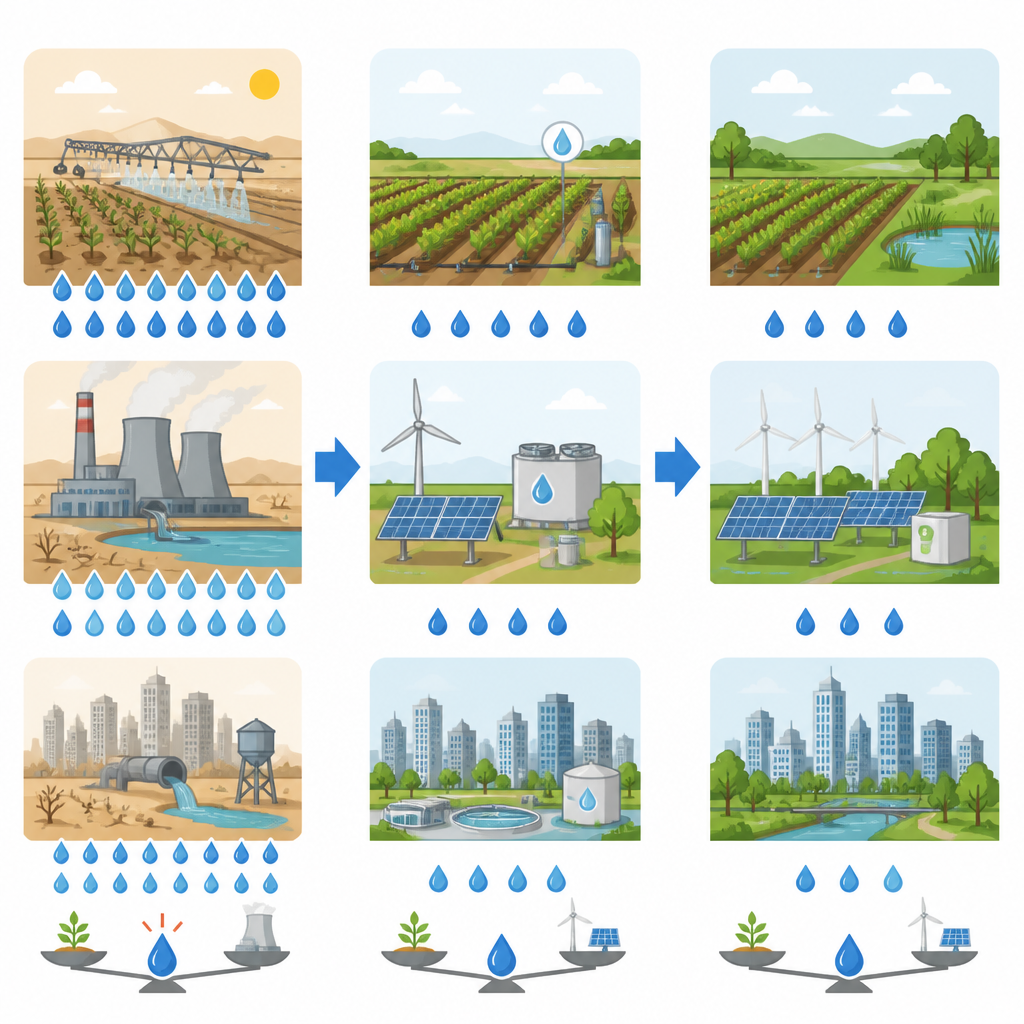
Linking water struggles to regional growth
Water conflicts do not happen in a vacuum, so the authors connect their competition index to a broader picture of development. They build an economic score for each province that includes output, living standards, growth rates and greener practices such as using less water and energy per unit of GDP. A coupling model then shows how tightly water competition and economic progress move together. In places with intense competition, such as Shanxi and Shaanxi, water-hungry coal and grain bases can slow efforts to upgrade the economy. In better balanced regions, investment in efficiency and cleaner energy helps ease pressure on rivers while supporting high-value industries.
What shapes the balance between water and wealth
To understand why some provinces manage this balancing act better than others, the study tests a range of influences, from climate and education to industry mix and innovation. Ample rainfall stands out as a powerful buffer, since it supports both crops and hydropower and reduces the need to overdraw rivers. A heavy reliance on traditional agriculture tends to worsen competition, while higher patent activity, research spending and stronger trade ties are linked to more coordinated use of water. The authors then feed past data into an improved machine learning model to estimate how competition and coordination are likely to evolve in the next few years.
Looking ahead to smarter sharing of scarce water
The forecasts suggest that, with well-targeted policies and technology, several provinces now in a “break-in” stage, including Fujian, Guangxi and Hubei, could move toward healthier coordination between food, energy and growth. Others, notably Shanxi and Shaanxi, may remain under high stress unless they change how and where they farm and produce power. For readers, the takeaway is straightforward: managing water wisely is not just an environmental goal, but a foundation for stable jobs, food on the table and reliable electricity. By seeing how these pieces fit together at the provincial level, decision makers can tailor subsidies, infrastructure and innovation support so that China’s limited water can feed both people and the economy without running dry.
Citation: Zhao, Q., Tian, G., Xia, Q. et al. Coupling of inter-provincial water competition and economic development in China: a multi-method water–food–energy–economic nexus analysis. Humanit Soc Sci Commun 13, 680 (2026). https://doi.org/10.1057/s41599-026-06978-7
Keywords: water footprint, China provinces, food energy water nexus, economic development, water competition