Clear Sky Science · en
How does remote work shape work–family balance? The interaction of work stress and leadership support
Why your home office matters for your home life
As remote and hybrid work become a normal part of life, many people wonder whether working from home truly helps them juggle their jobs and families, or simply stretches work into every corner of the day. This study looks closely at how remote work changes the tug-of-war between work and family, focusing on two powerful forces: how stressed people feel, and how their bosses support them. Using data from hundreds of employees across different industries in China, the authors show that remote work can indeed improve balance at home—but the story is more complicated than a simple "remote is good, office is bad" slogan.
What the study set out to understand
The researchers started from a puzzle in earlier studies: some found that remote work frees up time and energy, while others showed it blurs boundaries and fuels burnout. To untangle this, the authors combined three ideas from the social sciences. One explains how people draw lines between their work and home roles. Another looks at how heavy demands and helpful resources shape stress. The third focuses on how much care and practical help leaders offer. Together, these perspectives guided three key questions: Does remote work affect balance mainly by changing stress levels? How does leadership support shape that link? And do these patterns look different in China, where cultural expectations around family and authority are distinctive?

How the research was carried out
The team surveyed 312 employees who used remote work to varying degrees, drawn from industries such as IT, finance, education, manufacturing, and services. Participants answered standard questionnaires about how often and how flexibly they worked remotely, how stressed they felt about their jobs, how well they thought they were balancing work and family, and how supportive their immediate leaders seemed. All questions used simple rating scales. The researchers then used statistical techniques to test how these elements fit together: whether remote work predicted better balance, whether it lowered stress, whether stress in turn hurt balance, and whether leadership support changed the strength of these links.
What remote work and stress do to family life
The results paint a mostly encouraging picture for remote work. Employees who worked remotely more often and with greater flexibility reported better work–family balance overall. They also tended to feel less work-related stress. Lower stress, in turn, was strongly tied to better balance: when people were drained or overwhelmed, they had less time, patience, and emotional energy left for family roles. When the authors ran a more detailed analysis, they found that about one-third of the benefit of remote work on balance flowed through reduced stress. In other words, remote work helps both directly—by freeing up time and control—and indirectly, by easing the strain that otherwise spills over into home life.
When support from the boss helps—and when it backfires
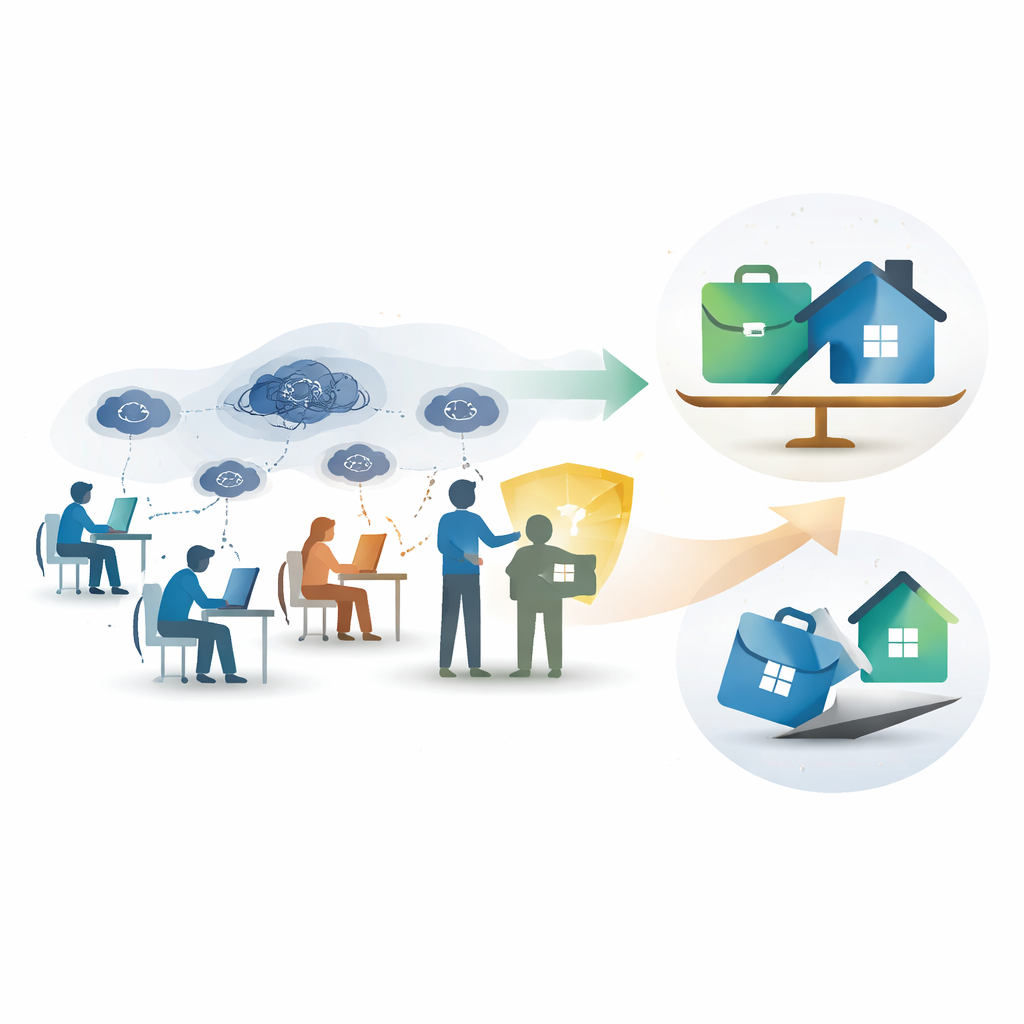
Leadership support added an unexpected twist. On its own, having a caring, helpful supervisor clearly improved people’s sense of balance. But when the researchers looked at how leadership support interacted with remote work, they found a surprise: the more support employees perceived, the weaker the positive effect of remote work on balance became. In statistical terms, strong support from the boss partly “substituted” for what remote work would otherwise provide. Interviews suggested an additional nuance: if leaders became too involved—checking in constantly, monitoring work closely, or crowding decisions—they could actually add pressure and chip away at the freedom that makes remote work attractive in the first place.
What this means for workers and organizations
Taken together, the study suggests that remote work can be a powerful tool for improving the fit between job and family life, especially when it genuinely reduces stress. But it also shows that leadership support is a double-edged sword. Thoughtful encouragement, help with tasks, and understanding around family needs clearly help people thrive. Heavy-handed oversight, however, can cancel out the benefits of flexible work and even contribute to burnout. The authors argue for a balanced management approach they describe as "flexible arrangements–stress mitigation–moderate leadership": give people real freedom in where and when they work, actively monitor and reduce sources of stress, and encourage leaders to support without smothering. For everyday workers and managers alike, the message is clear: how we design remote work, and how leaders behave within it, can make the difference between a home office that supports family life and one that quietly erodes it.
Citation: Li, T., Yang, W. How does remote work shape work–family balance? The interaction of work stress and leadership support. Humanit Soc Sci Commun 13, 467 (2026). https://doi.org/10.1057/s41599-026-06957-y
Keywords: remote work, work–family balance, work stress, leadership support, employee well-being