Clear Sky Science · en
TRGCN: a hybrid framework for social network rumor detection
Why online rumors matter to everyone
From vaccine scares to financial panics, a single false post can ripple across social media and shape what millions of people think and do. Human fact-checkers work hard to keep up, but the sheer volume and speed of online chatter make it impossible to review everything by hand. This study introduces a new computational approach that automatically spots suspicious stories by looking not only at what people say, but also at how that information spreads through a network of users.

How rumors flow through social networks
The authors begin by examining rumors as a social process. On platforms like Twitter, one person posts a claim, others reply, share, support, or challenge it, and these interactions form a branching web of messages. Some users act as hubs that keep the rumor alive many steps away from the original source. The pattern of who replies to whom, and when, carries clues about whether the claim is likely true, false, verified, or still unconfirmed. Traditional computer models either focused on the text alone or on the network shape alone, missing the full picture of how content and connections interact.
Limits of earlier detection methods
Earlier approaches relied on hand-crafted features such as how often a post was reposted, the length of messages, or basic statistics about users. While these methods captured simple patterns, they struggled with the complex, high-dimensional signals found in large social networks. Later, deep learning models such as recurrent and convolutional neural networks learned richer text patterns and short-term time patterns, but they did not fully capture the branching structure of rumor spread. Graph-based methods improved matters by treating conversations as networks of posts and users, yet common graph models had trouble following long chains of influence across many steps.
A hybrid model that looks at shape and story
To overcome these gaps, the researchers propose a hybrid framework called TRGCN. It blends two powerful types of neural networks: Graph Convolutional Networks, which are well suited for analyzing networks, and Transformer networks, which excel at tracking long-range relationships in sequences. First, the model turns each post into a numerical representation based on how important each word is in the overall collection of tweets. At the same time, it encodes the pattern of replies and reposts as a graph. These two views are merged so that every node in the propagation network carries both its text meaning and its position in the conversation.
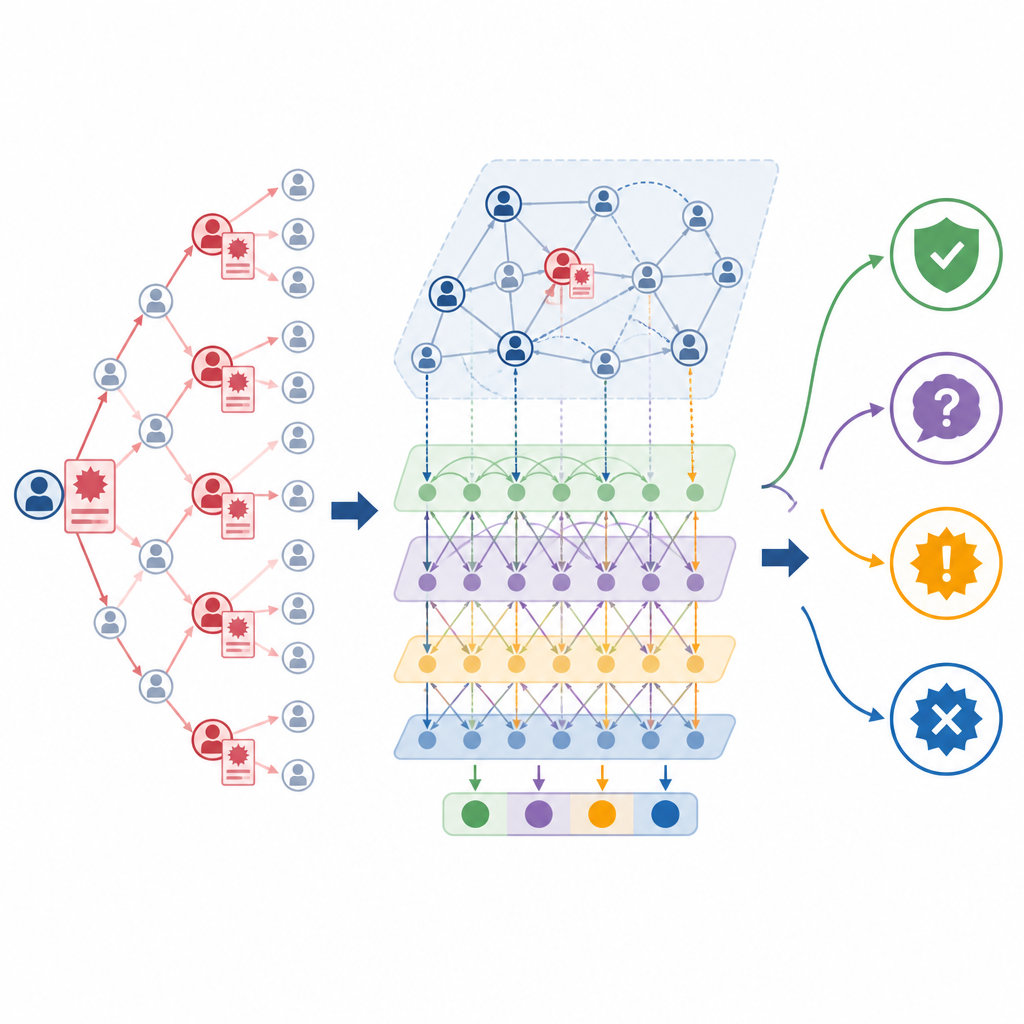
Following the path of a rumor step by step
TRGCN then enriches these node representations in several stages. A graph module looks at each post and its neighbors to capture local interaction patterns, such as clusters of users who either repeat or refute a claim. A positional scheme marks how far each post sits from the original source, helping the model understand the depth of the conversation. The data are then passed through a Transformer module, whose attention mechanism scans across the entire structure to pick up on long-range and subtle relationships that might link distant parts of the rumor cascade. Finally, another graph layer refines these combined signals, and a classification stage estimates whether the event is a non-rumor, a confirmed rumor, a false rumor, or still unverified.
How well the method works in practice
The authors test TRGCN on two widely used Twitter datasets that include thousands of rumor events labeled by expert fact-checkers. They compare their framework to a broad set of existing methods, from classic machine learning models to advanced graph-based systems. Across both datasets, the new model achieves the highest accuracy, correctly distinguishing between true, false, and uncertain stories more often than the alternatives. Additional experiments remove key components such as attention, positional information, or residual links and show that performance drops in each case. This suggests that the model’s strength comes from carefully combining network structure, text content, and long-range context.
What this means for safer online conversations
For everyday users and platform moderators, the main takeaway is that how a story travels online can be as revealing as the words it contains. By jointly learning from message content and the branching conversation patterns around it, TRGCN offers a more precise way to flag misleading claims for closer review. While it does not replace human judgment, such tools can help fact-checkers and platforms react more quickly to harmful rumors and support a healthier information environment.
Citation: Yan, Y., Zhang, S., Yu, D. et al. TRGCN: a hybrid framework for social network rumor detection. Humanit Soc Sci Commun 13, 692 (2026). https://doi.org/10.1057/s41599-026-06946-1
Keywords: social media rumors, rumor detection, graph neural networks, Transformer models, misinformation