Clear Sky Science · en
Enhancing expectations of well-being in old age in rural China through polycentric spontaneous order: mixed-methods research from the perspective of family culture and filial piety
Why this matters for growing old
As people live longer, a key question emerges: what really makes for a good old age? This study looks beyond money and health clinics to explore how everyday family values and traditions shape how older adults in rural China expect their later years to unfold. By following one large extended family over five generations, the authors show that the stories families tell about land, schooling, work, and children’s duties can quietly lock in very different futures for parents and grandparents.
Life in the countryside is changing fast
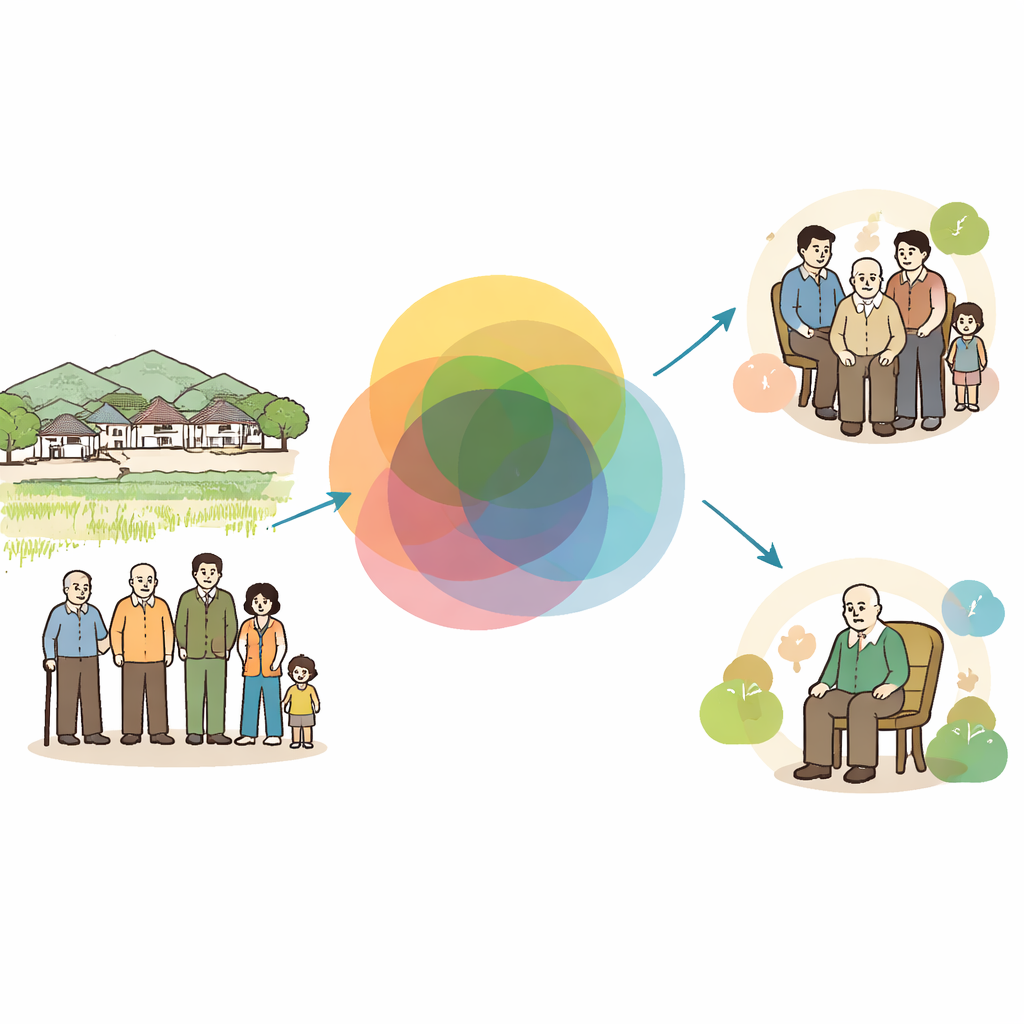
Rural China has been transformed over the past century, from small farms and food shortages to migrant work, mass schooling, and smartphones. Many studies blame poor roads, low pensions, and thin public services for the gap in well-being between older people in cities and those in the countryside. But the authors argue that this material view misses something crucial: long before someone grows old, family beliefs about what counts as a good life steer choices about education, migration, and savings. These choices, in turn, shape how secure and respected people feel in their later years, regardless of how much the local economy grows.
Four family mindsets that shape the future
By mapping ties inside a 119-person clan in Shandong province, the researchers identified four main family outlooks. One treats land as the anchor of life, putting farming and staying in the village first. A second, which they call “cultivation and reading,” urges parents to farm or work hard so their children can study and get ahead through education. A third outlook dismisses schooling as a bad bet and favors sending children to cities early to earn cash and build houses quickly. A fourth, newer mindset celebrates entrepreneurship and risk-taking as the path to wealth. Each outlook spreads through kin networks over time, often started by younger adults but later adopted by parents and grandparents who see which strategies appear to work.
Children’s duty: from obedience to mutual care
The study also tracks changing ideas about what adult children owe their parents. Older generations tend to favor a stricter, obedience-based model in which sons are expected to sacrifice for parents. Younger people lean toward a more mutual approach based on affection and fairness between siblings. These two styles overlap in some individuals and do not automatically guarantee better old-age experiences. Instead, they form part of a wider mix of values that families juggle as they weigh near-term gains against long-term support, often under pressure from migration, exam competition, and job markets.

Following the pathways to later-life contentment
To see which combinations of beliefs actually matter, the authors use a blend of social network mapping, a natural experiment, and a configurational method that looks for patterns across cases. Comparing older adults who grew up under different family outlooks, they find that those from “cultivation and reading” families report higher expectations of well-being in old age than those from land-first, early-work, or high-risk business families. The education-focused mindset seems best at balancing basic care needs, steady income, and a fulfilling inner life, while also tempering envy when comparing oneself with neighbors. Interestingly, no single style of children’s duty is essential: in some successful patterns filial piety plays a supporting role, and in others, strong family cultures that stress self-development can offset weaker filial norms.
A new way to boost aging well, without breaking the bank
Rather than relying only on larger pensions or more facilities, the authors propose nurturing a “polycentric” system of many small decision centers—families, communities, local officials, and online platforms—that together foster supportive cultures. Encouraging education-valuing family stories, celebrating modest, sustainable success, and building community-based mutual help for elders could quietly raise expectations of a good old age without heavy spending. In simple terms, the study suggests that how families think and talk today about land, learning, work, and care can be just as important for tomorrow’s older adults as how much money is in the village budget.
Citation: Dong, X., Zhang, F. & Cai, R. Enhancing expectations of well-being in old age in rural China through polycentric spontaneous order: mixed-methods research from the perspective of family culture and filial piety. Humanit Soc Sci Commun 13, 613 (2026). https://doi.org/10.1057/s41599-026-06898-6
Keywords: rural aging, family culture, filial piety, China, well-being