Clear Sky Science · en
Visualizing the Chinese cyberspace: a spatial-temporal analysis (2012–2019)
Why Online Searches Can Redraw the Map
When you search for a city online—perhaps to plan a trip, look for a job, or check the news—you leave a digital trace of your curiosity. Multiply that behavior by hundreds of millions of people, and those traces turn into powerful patterns. This study asks a simple but striking question: if we map who is searching for which Chinese cities, what does that reveal about the country’s hidden digital landscape, and how might it differ from the familiar map of roads, flights, and economic powerhouses?
A New Way to See City Connections
Instead of counting planes, trains, or company offices, the researchers turned to web search data from Baidu, China’s dominant search engine. They examined how often people in one city searched for information about another city between 2012 and 2019, covering 296 major cities across the country. Each search that combined a city name with a topic such as travel, business, or housing was treated as a tiny signal of interest. When added up across a year, these signals formed a directed network: arrows of attention flowing from the city doing the searching to the city being searched. This approach captures not where people go, but what they want to know—revealing the digital reputation and pull of different places.
A Diamond of Digital Attention
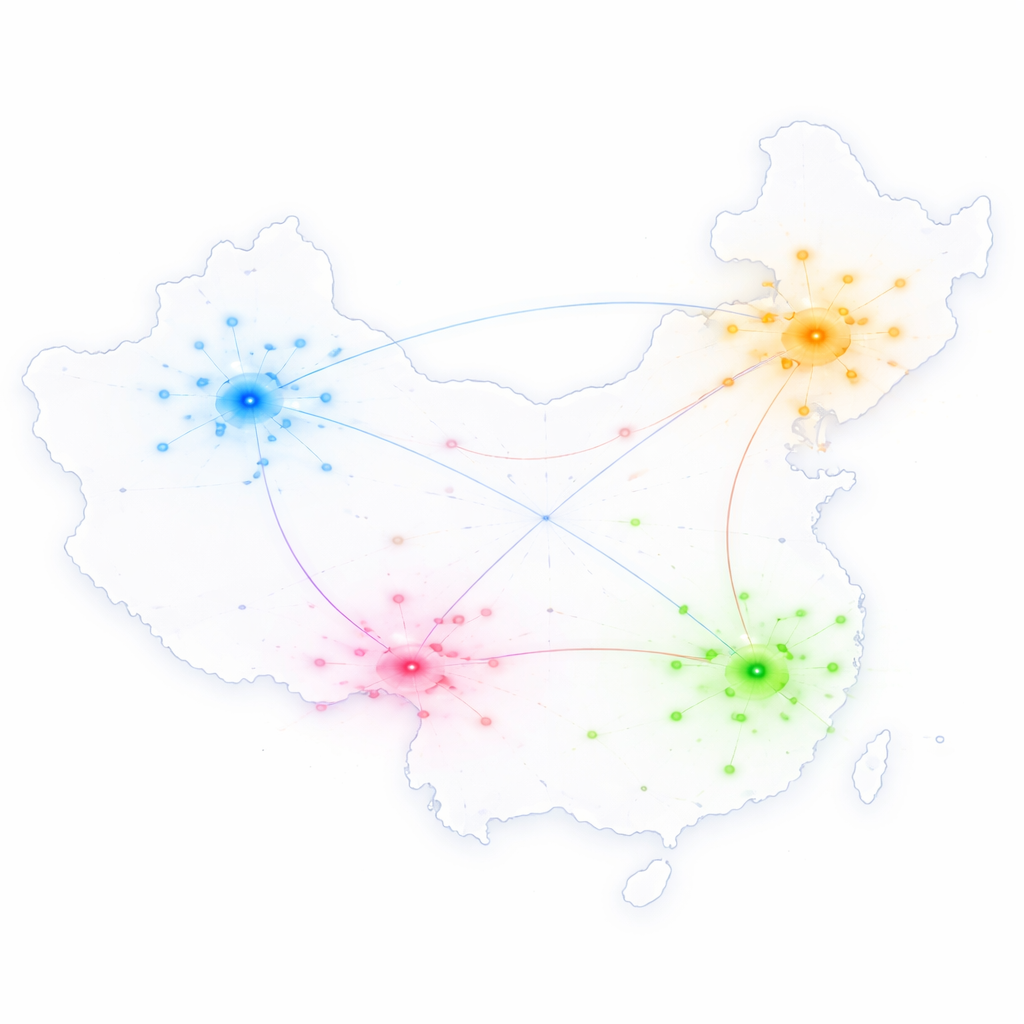
The national picture that emerges is far from random. Over time, the map of web searches settled into a clear diamond shape. At its four corners sit the Beijing–Tianjin–Hebei region in the north, the Yangtze River Delta around Shanghai in the east, the Pearl River Delta including Shenzhen and Guangzhou in the south, and the Chengdu–Chongqing area in the west. These regions, already known as China’s economic and population engines, also dominate online curiosity. People in many other cities search heavily for them, and residents there search widely outward as well. In short, the familiar concentration of factories, offices, and migrants is mirrored by a concentration of clicks.
Rising Stars and Shifting Ranks
Yet the study also shows that digital standing is not fixed. While Beijing and Shanghai remained the top two cities in search volume throughout the period, several others rose or fell noticeably in the online hierarchy. Cities such as Chengdu, Hangzhou, Wuhan, and Qingdao climbed the rankings, helped by tourism appeal, cultural branding, and favorable national policies that drew attention. Meanwhile, places like Chongqing, Xi’an, Wenzhou, and Baoding slipped, either crowded out by newcomers or lacking fresh hooks to attract interest. Overall, eastern China still hosts most of the most-searched cities, but the gap between online “haves” and “have-nots” narrowed slightly as more interior cities strengthened their presence.
How Distance and Borders Still Matter Online
Cyberspace is often described as borderless, but the patterns in this study say otherwise. Most search activity happens between cities that are a few hundred to about a thousand kilometers apart; interest drops off sharply at greater distances. Provincial boundaries also loom large: the strongest ties tend to link a provincial capital with other cities in the same province, creating semi-closed clusters of attention. This means that even when information flows frictionlessly across fiber‑optic cables, people’s curiosity still leans toward nearby and administratively related places. Over the years, the national network evolved from a simple pattern radiating out of Beijing and Shanghai to a multi‑centered diamond in which several large regions, rather than one or two megacities, anchor the digital system.

New Openings for Out‑of‑the‑Way Cities
At the same time, the analysis highlights an important twist: some less-developed or inland cities can punch above their economic weight online. Places like Chengdu and Urumqi have drawn growing inbound attention by leaning on distinctive culture, scenery, and media exposure. The authors argue that in an “attention economy,” cities compete not just for factories and highways, but for stories, images, and trends that travel quickly across screens. Viral content, short videos, and smart promotion can temporarily or even permanently boost a city’s digital profile, partially reshaping regional networks in ways that traditional infrastructure alone cannot achieve.
What This Means for City Planning
For non-specialists, the takeaway is that maps of search behavior reveal a second, invisible geography layered on top of roads and rail lines. In China, that digital geography largely reinforces existing inequalities: big, rich, coastal regions dominate both the economy and the national imagination. But it also offers strategic openings. By investing in their online image and making use of media events and cultural assets, less-developed cities can redirect a slice of public attention, attracting tourists, investors, and talent. The authors suggest that planners and policymakers treat flows of online attention as seriously as they treat physical flows of people and goods, using them to design more balanced, opportunity-rich regions in the digital age.
Citation: Zhang, L., Qian, X., Yang, Y. et al. Visualizing the Chinese cyberspace: a spatial-temporal analysis (2012–2019). Humanit Soc Sci Commun 13, 561 (2026). https://doi.org/10.1057/s41599-026-06883-z
Keywords: urban cyberspace, web search data, Chinese cities, digital attention, urban networks