Clear Sky Science · en
How do physical characteristic indicators of urban green spaces affect residents’ place attachment: an analysis based on a spatially explicit measure approach
Why some parks feel like home
Many of us have a favorite corner of a park: a shady bench, a lakeside path, or a playground that just feels special. This study asks a simple but powerful question: what exactly makes those spots in urban green spaces feel so meaningful that people grow emotionally attached to them? By pinpointing the physical features that nurture this sense of “belonging,” city planners can design parks that better support everyday happiness, social life, and community ties.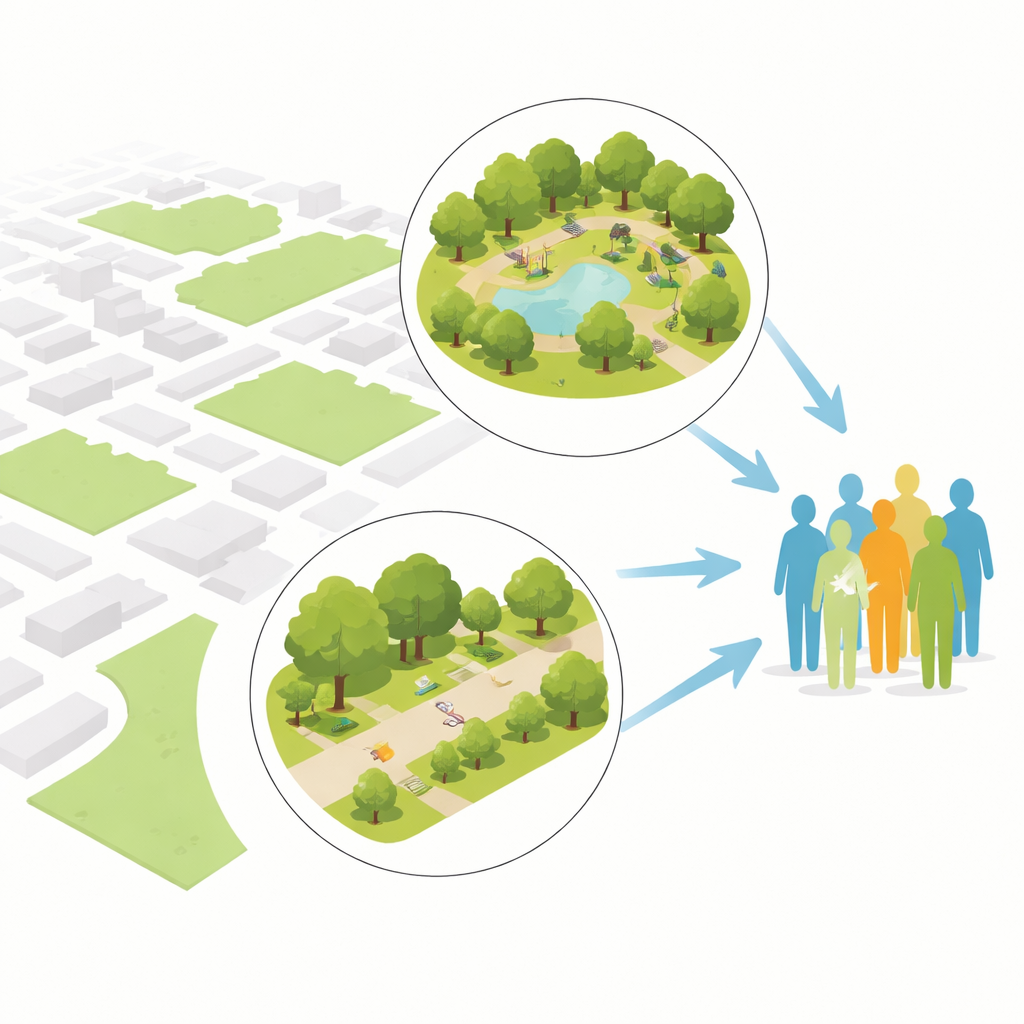
Looking closely at where feelings gather
Instead of treating each park as a single blob on a map, the researchers zoomed in to examine small pieces within five popular urban green spaces in Changchun, a garden city in northeast China. They divided these parks into two basic types of places: compact areas such as playgrounds, plazas, and waterfront zones, and linear stretches such as paths and walkways. Visitors first pointed out the specific spots that meant something to them, then filled out a well-tested questionnaire that measures how strongly they feel a place is part of who they are and how much they depend on it for their activities. Participants also reported how far away they can still sense or notice that spot, allowing the researchers to model how emotional intensity fades with distance.
Turning feelings into detailed maps
Using these answers, the team built computer-generated “heat maps” that show how strongly people feel attached to every part of each park. These maps revealed that emotional ties are not spread evenly. Instead, they cluster: some zones glow with high attachment, while other areas—often dense groves with little to do—remain relatively cold. Lakeshores, exercise areas, and children’s playgrounds frequently emerged as hot spots. By blending survey-based scores with public‑participation mapping and geographic information systems, the study moves beyond simple opinion polls to a precise, spatial view of how people experience green spaces.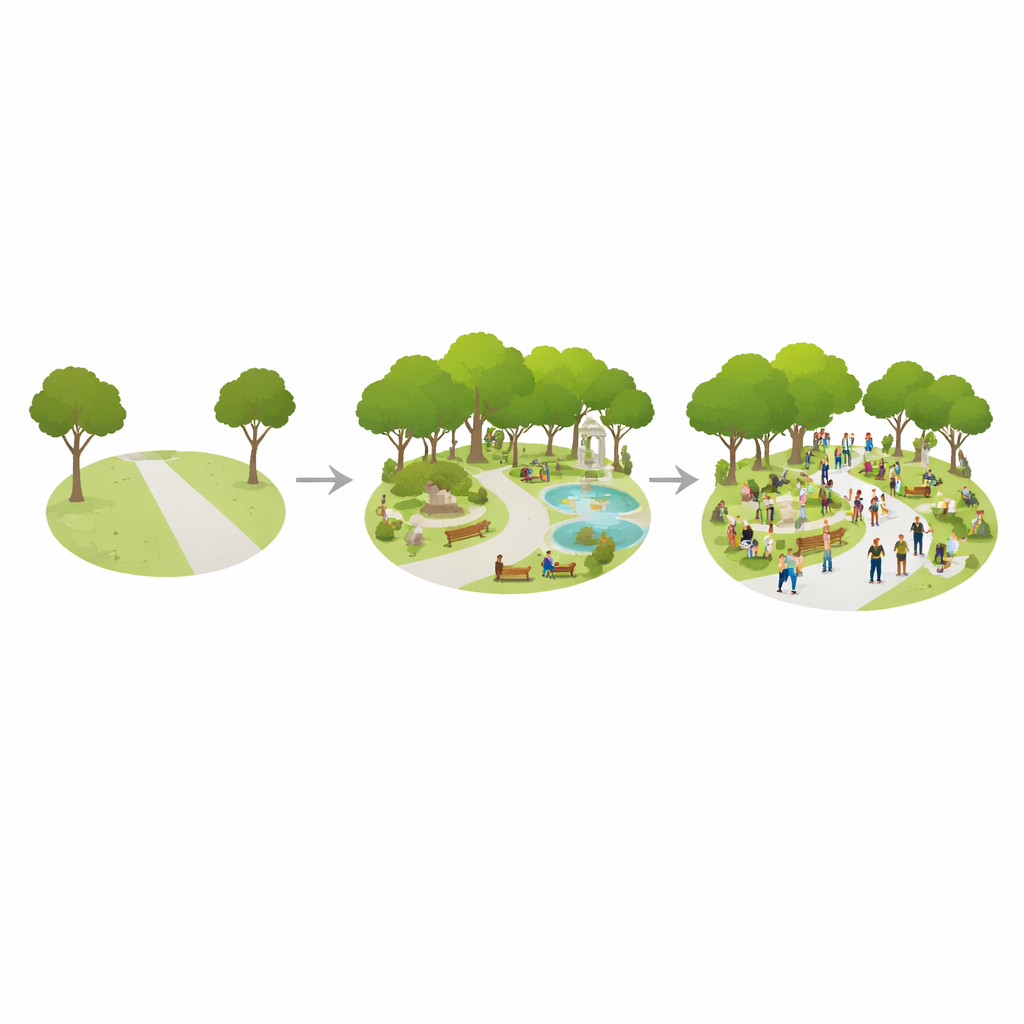
What makes activity areas feel special
With 139 carefully measured sites, the researchers then asked which concrete design elements best predict strong attachment. For compact activity areas, size mattered: larger zones supported a richer mix of things to do and were linked to stronger bonds. Shade was crucial too—areas where tree canopies covered much of the active space tended to attract deeper attachment, likely because they offer comfort and invite lingering. Places with more recreational facilities and plenty of formal seating, such as benches, also fostered stronger ties, as they encourage people to stay, play, and interact. Finally, views of water and historic features—such as old buildings or ancient trees—boosted attachment, suggesting that both sensory pleasure and a sense of continuity with the past help people feel rooted.
Why paths can be powerful
Linear spaces, like paths, followed a slightly different recipe. Here, the width of the path and the presence of tree cover were important: wider, shaded walkways made strolling more pleasant and promoted stronger attachment. Seating again played a starring role. Both formal benches and informal places to perch, such as low walls, increased the chance that people would pause, watch others, or chat. Visible public art along the path—sculptures and other installations—also mattered. These features act as visual anchors and social magnets, providing memorable landmarks and natural conversation starters that turn a simple route into a place where people like to spend time, not just pass through.
Designing parks that people truly love
Altogether, the study shows that emotional bonds to parks depend on specific, tangible design choices, not just on having green space nearby. When parks offer comfortable shade, room to move, inviting places to sit, engaging activities, views of water, touches of history, and well‑placed art, people are more likely to adopt them as “their” places. By mapping where attachment is strong or weak and linking those patterns to physical features, the authors provide a practical toolkit for cities that want to strengthen everyday well‑being and community life through smarter park design and management.
Citation: Jiang, H., Xie, W., Dong, W. et al. How do physical characteristic indicators of urban green spaces affect residents’ place attachment: an analysis based on a spatially explicit measure approach. Humanit Soc Sci Commun 13, 492 (2026). https://doi.org/10.1057/s41599-026-06850-8
Keywords: urban green spaces, place attachment, park design, public participation GIS, urban well-being