Clear Sky Science · en
Linking life satisfaction and employability to student learning outcomes: moderating effect of collaborative learning
Why feeling good at college matters
College is not just about grades and getting a diploma; it is also about how students feel about their lives and how ready they are for work. This study looks at how students’ happiness with life and their sense of being employable together shape what they actually learn at university. By focusing on upper-year business students in China, the authors explore how well-being, confidence, friendships, and group work combine to influence both classroom success and future career development. 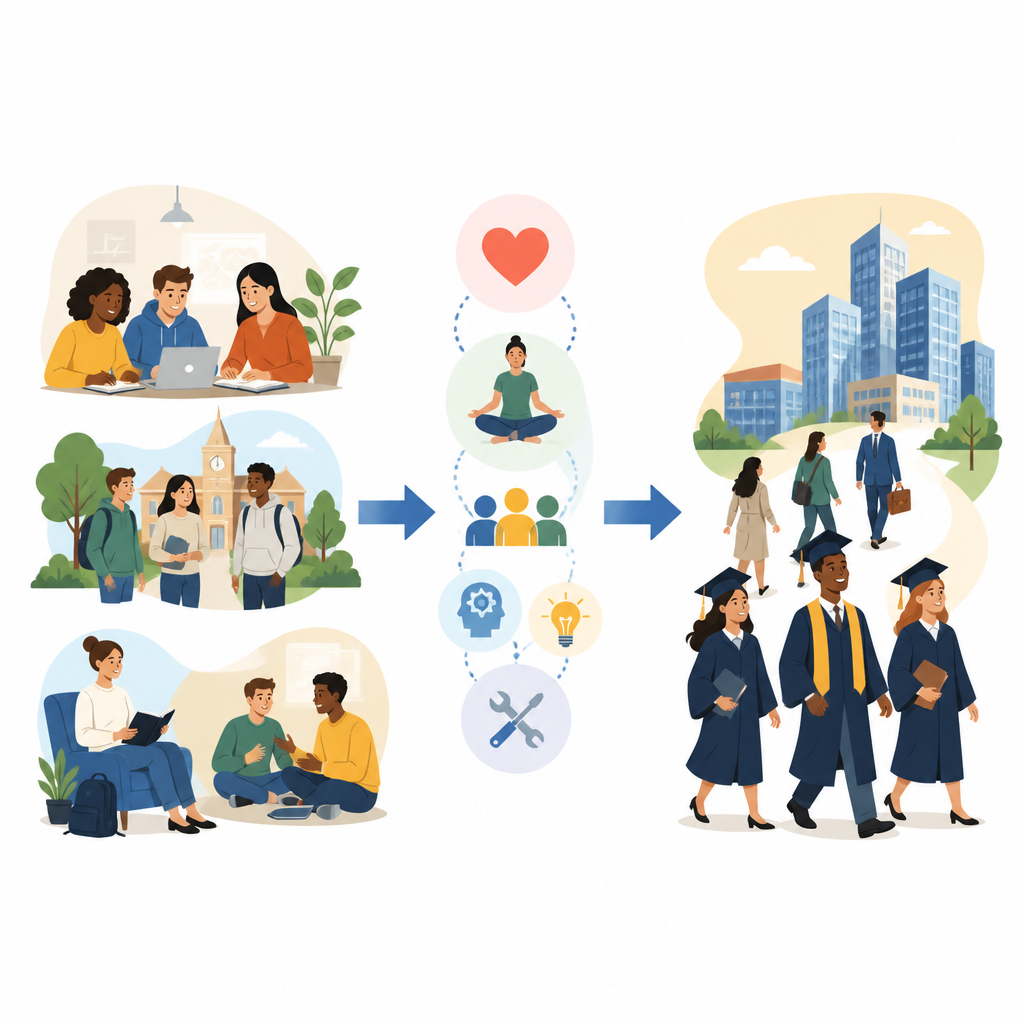
Connecting mood, skills, and success
The researchers start from a simple idea: when students feel good about their lives and believe they have useful skills for future jobs, they are more likely to learn well. Life satisfaction here means being broadly content with one’s situation, relationships, and prospects. Employability refers to having the mix of knowledge, abilities, attitudes, and career planning needed to find and keep work. The study argues that these two forces do not work in isolation. Instead, they feed into students’ inner drive to learn, their belief in their own abilities, and the quality of their relationships with teachers and classmates, all of which are closely tied to academic performance.
How confidence and connections help learning
Two key ingredients sit between life satisfaction, employability, and learning: self-belief and social ties. Self-belief, or self-efficacy, is students’ sense that they can handle study tasks and overcome setbacks. Social ties, or social capital, capture the trust, support, and shared norms that grow from interactions with peers and teachers. The study finds that students who are happier with their lives tend to feel more capable and are better able to form supportive networks. Likewise, students who see themselves as employable report stronger confidence and richer social links. These inner and outer resources, in turn, are closely associated with better learning outcomes, both in terms of knowledge gained and personal growth.
The power of learning with others
Beyond individual traits, the study highlights the importance of collaborative learning, where students work together on projects, share ideas, and solve problems as a group. Such settings can boost confidence, strengthen social bonds, and make study more engaging. The authors show that collaboration slightly intensifies the positive impact of both self-belief and social ties on learning results. In other words, when students already feel capable and connected, learning with others gives these advantages a further, though modest, push. This suggests that group-based tasks and peer interaction can help turn personal strengths into concrete academic gains. 
What the data reveal
To test their ideas, the authors surveyed 875 junior and senior students from management schools in eight coastal Chinese cities. Using detailed questionnaires, they measured life satisfaction, employability, confidence, social ties, experiences with collaborative learning, and different kinds of learning gains. Statistical modeling showed that social ties and self-belief significantly predict learning outcomes, and that both are strongly shaped by life satisfaction and employability. The model also confirmed that collaboration in class and group work slightly strengthens how much confidence and social ties translate into better learning. Together, these results point to a web of influences rather than a single simple cause.
What this means for students and universities
For a lay reader, the message is clear: doing well at university depends on more than hard work and talent. Feeling satisfied with life, building skills that seem useful for future work, believing in one’s own abilities, and forming strong relationships all contribute to better learning. Group projects and cooperative activities can help amplify these benefits, even if their added effect is not huge. The authors suggest that universities should design programs that nurture student well-being, career readiness, confidence, and social connections at the same time, creating campuses where students can thrive academically while also preparing for satisfying careers and lives.
Citation: Peng, M.YP., Yue, X. & Zhang, M. Linking life satisfaction and employability to student learning outcomes: moderating effect of collaborative learning. Humanit Soc Sci Commun 13, 648 (2026). https://doi.org/10.1057/s41599-026-06825-9
Keywords: life satisfaction, student employability, self-efficacy, social capital, collaborative learning