Clear Sky Science · en
Balance and security: policing strategies for counties with population loss
Why this matters for everyday communities
Across the world, many small towns and counties are shrinking as younger people move to big cities, leaving behind older residents and children. This quiet population shift creates a hidden puzzle: how can local police keep people safe when there are fewer taxpayers, fewer officers, but still serious responsibilities—and sometimes crowds of visiting tourists? This article looks closely at one such county in southern China to understand how local policing actually works on the ground and what lessons it offers for communities facing similar change.

A town with fewer people but new safety pressures
The study begins by describing a pattern familiar in many countries: as jobs and opportunities concentrate in major cities, smaller counties lose residents, empty homes multiply, and local services must do more with less. In the Chinese county examined here, fewer residents mean fewer serious crimes overall, and daily life is mostly calm and orderly. Yet this calm surface hides deeper strains. Tax income falls, budgets tighten, and local police must stretch limited staff, vehicles, and equipment to cover large rural areas. On top of this, scenic spots draw waves of tourists during holidays, briefly turning a quiet place into a crowded destination that needs fast, flexible safety responses.
Listening to the people on the front line
To understand these realities, the researchers carried out in-depth interviews with police officers of different ranks who handle budgets, staffing, and front-line work. Instead of testing a single theory with numbers, they let themes emerge from the officers’ own words. Using a step-by-step coding method, they sorted dozens of comments into related topics. This process revealed two big, intertwined sides of county policing: real strengths that give these places an advantage, and stubborn weak points that threaten to undermine those strengths if they are not addressed.
Hidden strengths: calm streets and helpful technology
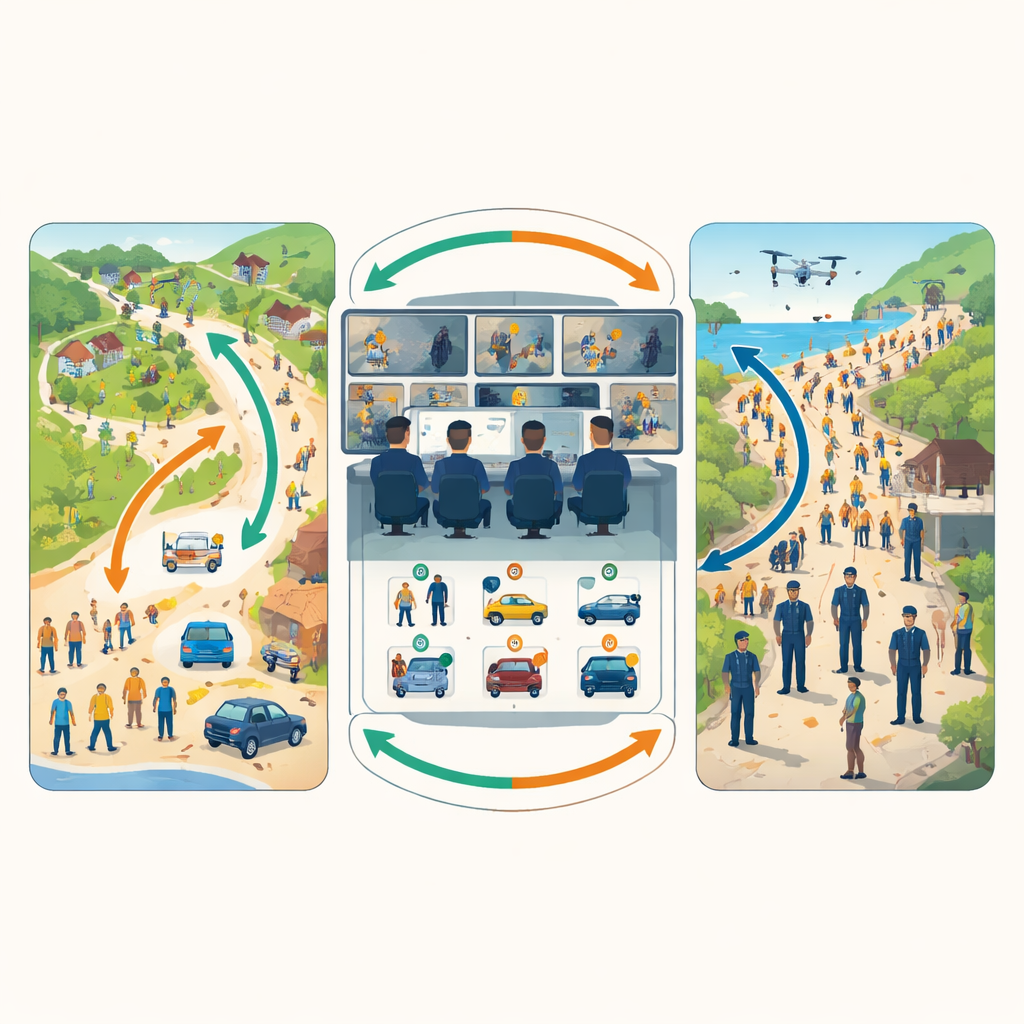
On the positive side, officers stressed that serious violent crime is rare, most disputes are minor, and people generally know and trust each other. Fewer emergencies mean that officers are less overloaded by constant calls and can invest more time in prevention and community contact. Many also described how new tools—such as camera networks and mobile devices—have made it quicker to gather evidence and respond to incidents. Regular training and clear legal rules help ensure that cases are handled carefully and by the book. Together, these features create a basic safety net that works surprisingly well despite tight resources.
Stubborn weak spots: thin staffing and rigid systems
At the same time, the interviews revealed sharp pain points. Stations often operate with very small teams; it is not unusual for only a couple of officers to be on duty, covering large territories. Vehicles and equipment can be outdated, and budgets for investigating cases are limited, forcing creative workarounds. The promise of digital policing is also uneven: younger staff may be comfortable with complex systems, while older officers struggle with new software and devices. Administrative rules bring heavy inspection and paperwork burdens, while some specialized units exist mostly on paper and add little real capacity. When large numbers of tourists arrive, this fragile system is stretched even further, as the temporary crowds bring more minor incidents and demands for rapid, visible policing.
Toward a better balance between safety and resources
Drawing on ideas from decision-making theory and cooperative governance, the authors argue that the key challenge is balancing three things at once: limited money, limited manpower, and the community’s expectation of safety. In simple terms, local authorities must spend every unit of effort where it matters most, while building partnerships with other agencies and using technology in ways that match staff skills. The article suggests flexible staffing, smarter budget planning, shared use of advanced tools across nearby areas, and training programs that help both younger and older officers adapt. Although the research focuses on one Chinese county, its main message is broad: even in places with shrinking populations and tight wallets, careful planning and cooperation can keep streets safe—so long as leaders confront weaknesses honestly instead of being lulled by low crime numbers alone.
Citation: Wu, F., Liu, Y. & Zhang, J. Balance and security: policing strategies for counties with population loss. Humanit Soc Sci Commun 13, 474 (2026). https://doi.org/10.1057/s41599-026-06766-3
Keywords: population decline, rural policing, public safety, tourist towns, local governance