Clear Sky Science · en
One of the oldest Syriac monasteries: Mor Ahron
Ancient stones on a lonely mountain
High above the Euphrates River in eastern Turkey, the ruins of Mor Ahron Monastery cling to the summit of a steep mountain. To reach them, visitors must hike for hours with no road in sight. Yet this crumbling complex once anchored the spiritual and everyday life of a Syriac Christian community and may be among the oldest monasteries of its kind in the world. The article behind this summary combines fieldwork, old maps, religious stories and state archives to reconstruct the monastery’s past, explain how it was built, and argue that its true age has long been underestimated.

A forgotten Christian world
The study begins by introducing the Syriacs, one of the earliest Christian peoples of the Middle East. Originating in Mesopotamia, they spread into what is now southeastern Turkey, including the province of Elazığ where Mor Ahron stands. Over centuries they developed their own branch of Christianity, church traditions and building styles, amid fierce debates in the wider Christian world about the nature of Christ. Written records about Syriacs in this particular region are thin, which makes every surviving site crucial for understanding how these communities lived, worshipped and coped with shifting empires and frontiers.
A monastery between earth and sky
Mor Ahron Monastery crowns Mount Abdulvahab, a rocky peak more than a thousand meters high. From this aerie, one can see the bend of the Euphrates and historic towns and castles that once guarded key crossings. Around the church lie cisterns carved into the rock, a burial ground and traces of other buildings, hinting at a sizable resident community. Legends describe the monastery’s patron saint, Mor Ahron, as a hermit and healer whose miracles drew pilgrims, and later tales claim that even an emperor sent skilled builders to create a complex worthy of his fame. The authors treat such stories cautiously but show how they preserve memories of the site’s importance and isolation.
Reading architecture as a time machine
The heart of the article is a close reading of the monastery’s stones. The surviving church is a two‑story rectangular hall with a single rounded sanctuary at its eastern end and four stout towers attached to its sides. Inside, pairs of arches line the long walls, narrow window slits pierce the masonry, and traces of wall paintings survive in the sanctuary. Two barrel‑vaulted underground cisterns, carefully measured by the team, once stored enough water to sustain dozens of residents through dry months. By comparing the plan, building techniques and proportions with other Syriac churches in the Tur Abdin region and beyond, the authors classify Mor Ahron as a “hall‑church” — a simple, elongated worship space typical of late antique rural monasteries.
New clues and a revised timeline
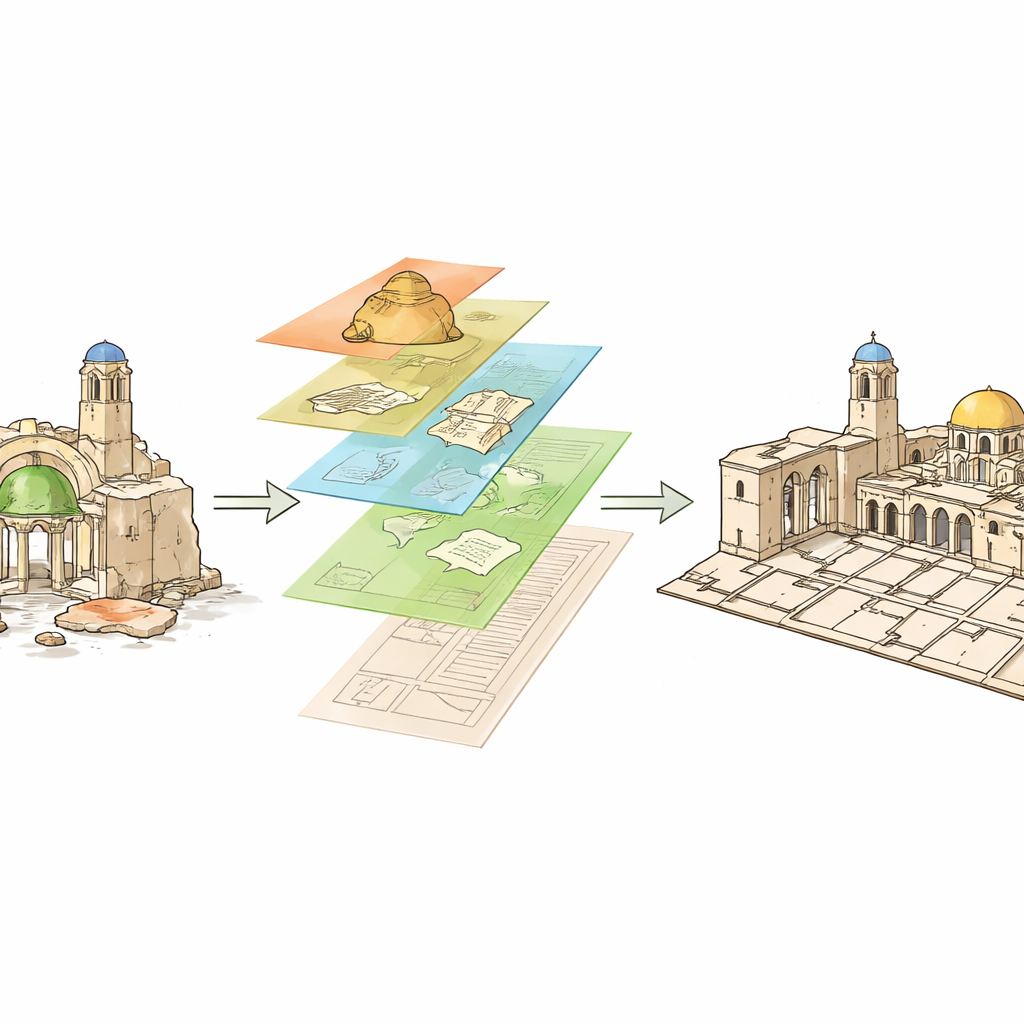
Earlier scholars had dated the monastery to as late as the tenth century, largely based on political history and scattered written references. The new study challenges this view. The layout of the church, the style of its vaults, and the way its towers knit into the main walls all point to a much earlier origin, close to the fifth or sixth century. The researchers bolster this by noting similarities with nearby Roman‑Byzantine cisterns, by analyzing ceramic sherds and small glass vessels found around the site, and by applying a geometric “lozenge” model that reveals a sophisticated, highly symmetrical design. They argue that only some upper parts of the walls and a pair of western corner towers were added later, likely as defensive measures during times of unrest when neighboring monasteries also fortified themselves.
Why this mountain matters today
Beyond correcting a date in the scholarly record, the article shows how one remote ruin can illuminate the wider story of early Christianity in Anatolia. Mor Ahron links ancient pagan worship sites, frontier politics between empires, and the long presence of Syriac Christians who left few written traces in this region. The building’s careful proportions and the scale of its water system suggest trained builders and a substantial monastic community, not a makeshift outpost. Today, earthquakes, weathering and looting threaten what remains. The authors conclude that Mor Ahron should be recognized, protected and restored as a key piece of shared cultural heritage and as one of the oldest known Syriac monasteries surviving anywhere.
Citation: Şen, K., Yılmaz, S. One of the oldest Syriac monasteries: Mor Ahron. Humanit Soc Sci Commun 13, 389 (2026). https://doi.org/10.1057/s41599-026-06757-4
Keywords: Syriac Christianity, monastery archaeology, Mor Ahron, religious architecture, Anatolian history