Clear Sky Science · en
Multidimensional ergonomic latent modeling of prefabricated adaptive decoration by robotic 3D printing
Greener hotel rooms for modern travelers
Imagine checking into a budget hotel room that feels calm, bright, and fresh—and knowing it was built with far less waste and carbon emissions than a typical room. This study looks at how robotic 3D printing and prefabricated room elements can reshape hotel interiors so they are not only cheaper and faster to build, but also quieter, healthier, and kinder to the planet. By combining ideas from architecture, engineering, and psychology, the researchers ask a simple question: when we redesign hotel rooms with both comfort and the environment in mind, do guests actually feel the difference—and does it make them happier?
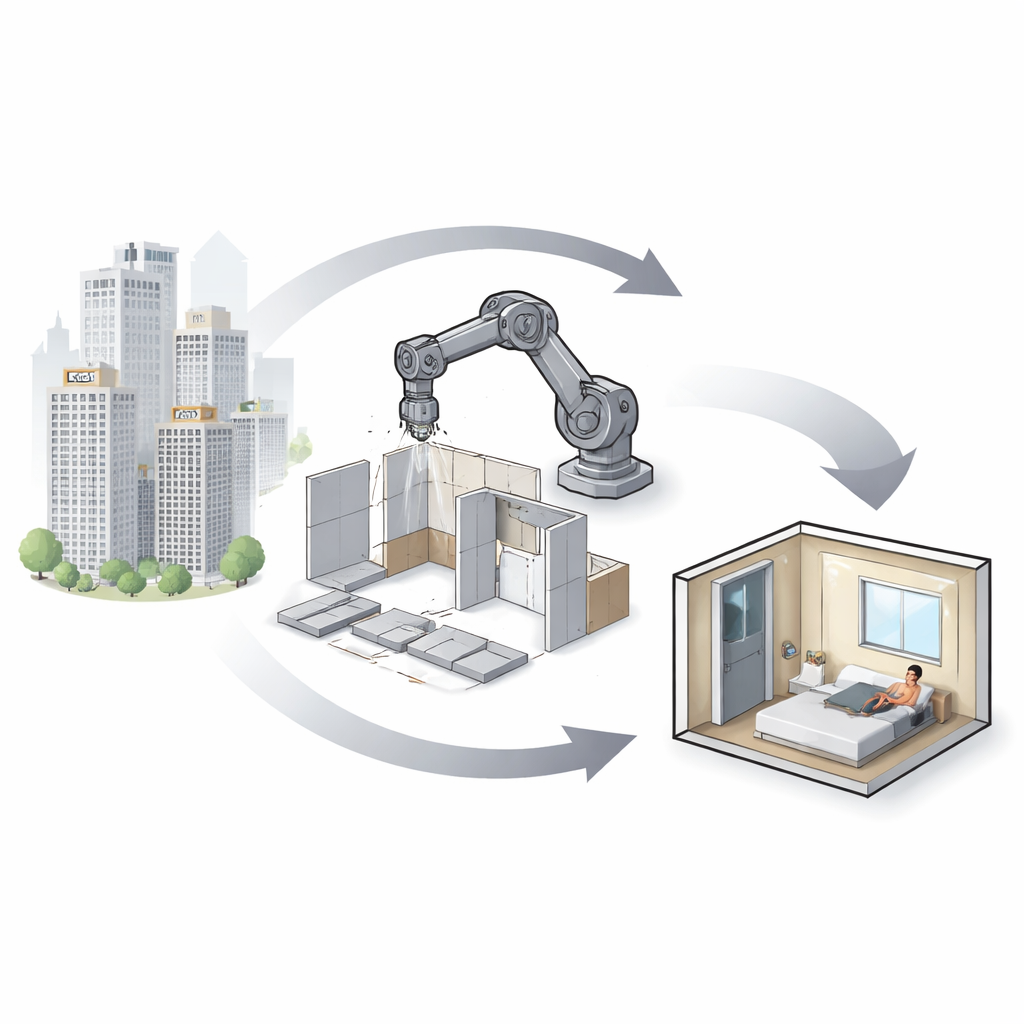
Why hotel interiors need a rethink
Hotel rooms are refurbished surprisingly often, with many chain hotels replacing their interior decorations every two to five years. Each cycle generates large amounts of waste and uses significant energy and materials. At the same time, travelers and governments are demanding greener buildings, yet most research has focused on glamorous luxury properties rather than the budget chains where many people actually stay. The authors argue that rethinking how rooms are built and finished—using prefabricated parts assembled off-site and robotic 3D printing—could cut waste, improve energy use, and raise comfort, especially in these overlooked budget hotels.
Robots, room modules, and what guests notice
Robotic 3D printing allows walls, ceilings, and decorative elements to be produced as precise modules in a factory-like setting, then quickly assembled on site. This approach can improve insulation, daylight use, and air circulation by baking those qualities into the room’s basic parts. To see what matters most to guests, the researchers focused on several everyday features: how well the room blocks noise, how easy it is to control light and enjoy a view, how stable the temperature feels, how fresh the air is, how flexible the furniture and layout are, and whether the space feels safe, clean, and environmentally responsible. They then treated these as hidden “dimensions” of the stay that could be shaped by smart prefabricated design.
Turning guest opinions into a hidden map of comfort
To build this hidden map, the team surveyed hotel guests using a detailed questionnaire about their experiences in rooms using robotic 3D printed and prefabricated elements. Guests rated things like quietness, glare, ventilation, adaptability of the space, and perceived greenness on a simple scale. The researchers used advanced statistical tools to connect these ratings into a network of cause-and-effect relationships. In this model, sound quality, lighting and view, and thermal comfort and air quality form one cluster of environmental conditions; flexible layout, safety, and green services form another cluster of service and safety features. Tourist satisfaction sits at the end of these pathways as the overall outcome that both clusters feed into.
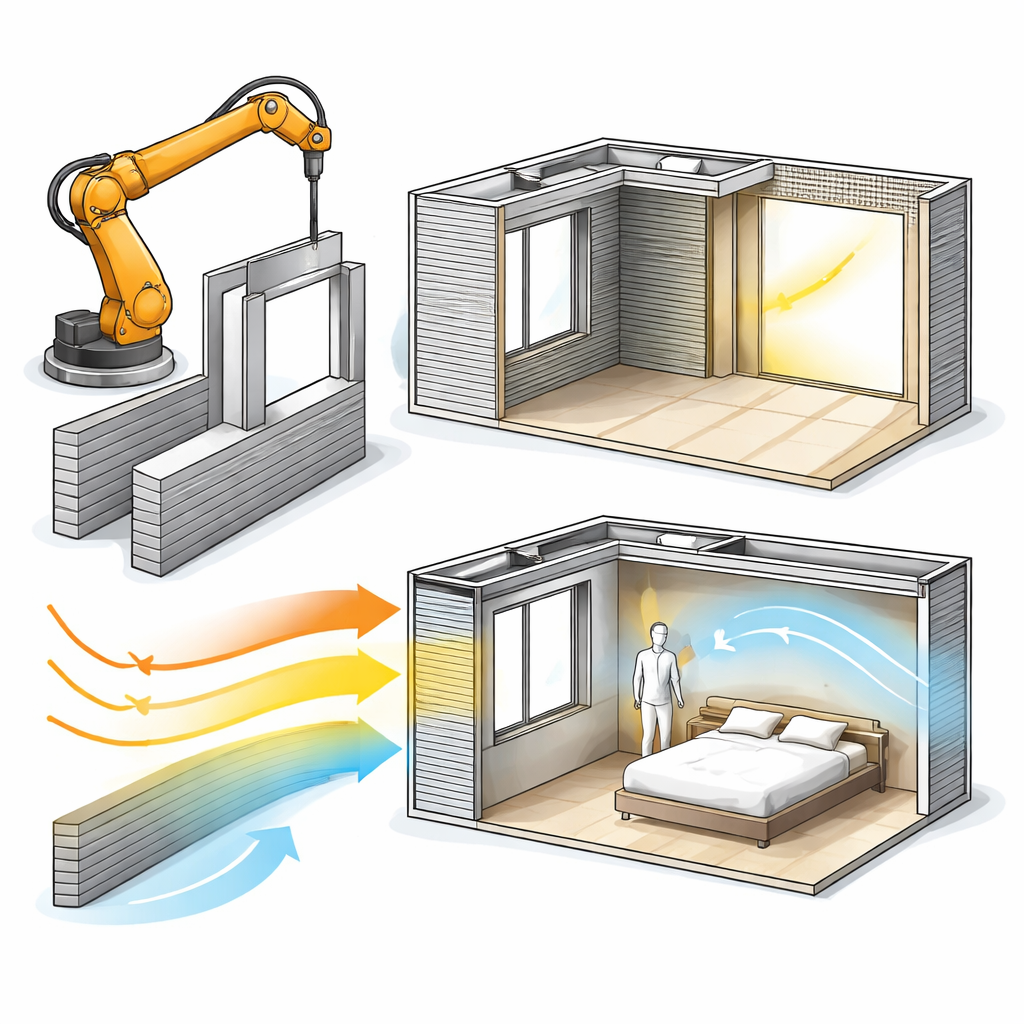
What really drives a satisfying stay
The analysis shows that not all room features are equal. Among all the paths in the model, thermal comfort and air quality have the strongest effect on how flexibly the room can be used, while a quiet sound environment has the single biggest direct impact on how satisfied guests feel. Good lighting and pleasant views also matter, contributing meaningfully to both satisfaction and perceptions of green service. Safety measures and eco-friendly touches—like recyclable consumables and water- or energy-saving fittings—do improve how guests feel, but their influence is smaller and often works through the background of a comfortable, well-designed room. Overall, the study finds that robotic 3D printing and prefabrication are most powerful when they first secure calm, well-lit, and healthy indoor conditions, then layer green services and flexible layouts on top.
From hotel rooms to habitats beyond Earth
For non-specialists, the takeaway is clear: guests care deeply about how a room feels, and new building technologies can quietly shape that experience while cutting environmental damage. By using robotic 3D printing to craft prefabricated hotel interiors, designers can systematically improve noise control, light, air, safety, and flexibility in ways that raise satisfaction and reduce waste. The authors also suggest that the same human-centered, low-carbon design principles could guide construction in extreme settings—from remote islands to future bases on the Moon or Mars—where comfort, safety, and efficiency are even more critical. In short, smarter, greener room modules built by robots may help hotels, and perhaps future space habitats, feel better to stay in while doing less harm to the world around them.
Citation: Cai, G., Xu, B., Hu, Z. et al. Multidimensional ergonomic latent modeling of prefabricated adaptive decoration by robotic 3D printing. Humanit Soc Sci Commun 13, 470 (2026). https://doi.org/10.1057/s41599-026-06688-0
Keywords: green hotels, robotic 3D printing, prefabricated construction, indoor comfort, sustainable tourism