Clear Sky Science · en
Navigating through green policies: how green technology innovation affects the financial cycle
Why green inventions matter for your money
When we think about green technology—cleaner fuels, smarter pipelines, or low‑emission engines—we usually picture smokestacks and tailpipes, not stock markets. Yet this study shows that new green ideas in the oil industry can change how bumpy the global financial ride becomes. By tracking tens of thousands of green energy patents along the oil supply chain and pairing them with a famous "fear gauge" from Wall Street, the authors reveal when and where green innovation calms markets—or makes them more jittery. 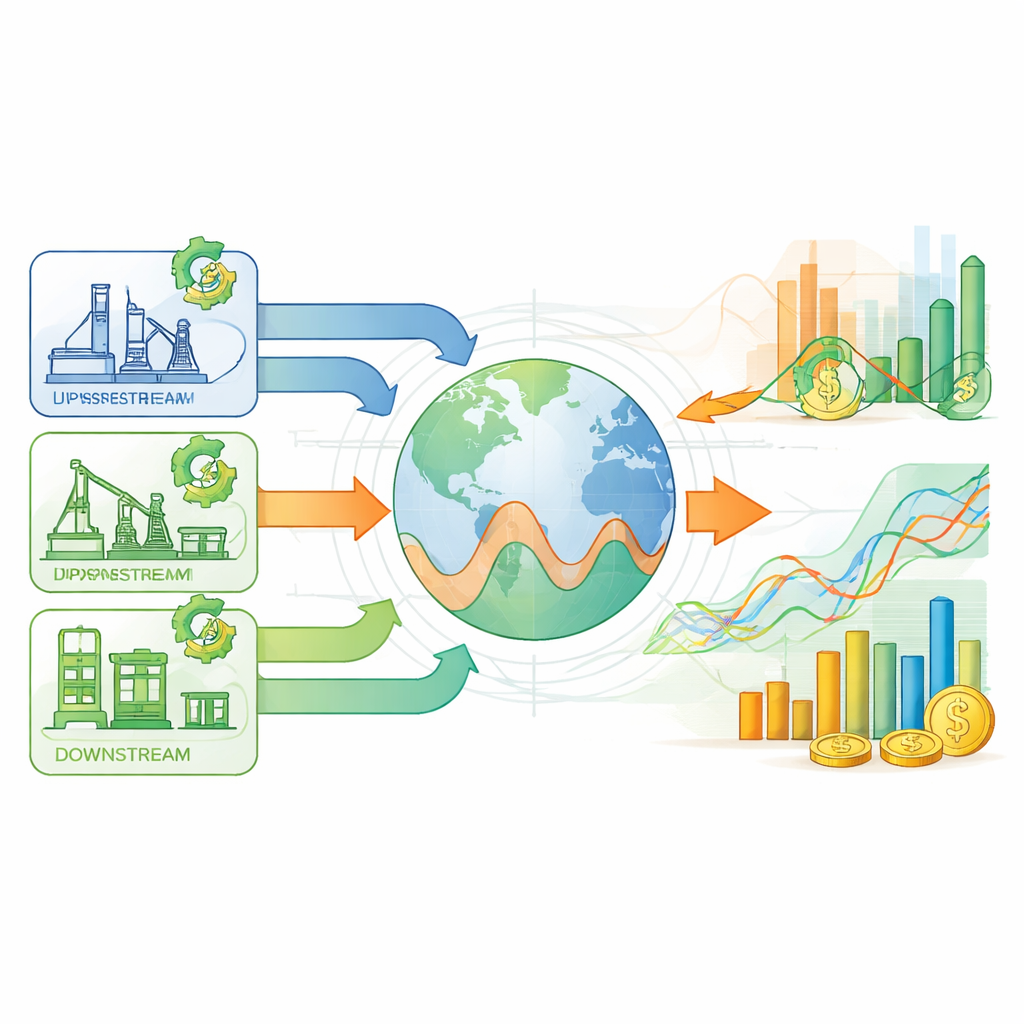
Following the trail from oil wells to investors
The researchers focus on three everyday fuels that power modern life: crude oil, diesel, and liquefied petroleum gas (LPG). Each sits in a different part of the oil value chain—upstream extraction, midstream transport and storage, and downstream refining and sales. The team counts more than 95,000 green technology patents across these stages, using them as a concrete measure of how intensely companies are trying to clean up their operations. They then compare this patent activity to the Chicago Board Options Exchange Volatility Index, or VIX, a widely watched indicator of how turbulent investors expect stock markets to be in the near future.
Time lags in turning ideas into stability
A key lesson from the study is that markets do not react to green inventions overnight. The authors show that bursts of green patenting tend to increase the sensitivity of energy markets to financial ups and downs in the short and medium term, but reduce that sensitivity in the long run. This pattern fits what economists call "time‑compression diseconomies": rushing innovation can be costly and messy at first, but as new technologies spread and mature, they start to pay off. In the early stages, investors face more uncertainty about which technologies will succeed, and this anxiety feeds into volatility. Over several years, however, cleaner and more efficient energy systems help smooth price swings and dampen financial shocks.
Different links along the energy chain
The study also finds that the impact of green innovation depends strongly on where it happens in the oil chain. New technologies in upstream crude oil operations, such as cleaner drilling and extraction, affect market volatility differently from green advances in diesel refining or LPG transport. For example, midstream diesel and LPG innovations—closer to the fuels used by trucks, factories, and homes—prove especially powerful for predicting medium‑term movements in the VIX. This suggests that improvements in the parts of the system that directly touch end users can ripple quickly through both energy prices and financial expectations. 
Policies, headlines, and global risks
Government policies and public debate shape these effects. The authors track worldwide news about green policies, along with measures of climate concern, economic policy uncertainty, and geopolitical risk. They find that strong bursts of policy attention can improve short‑term forecasts of financial volatility, likely because they send clear signals that investors react to immediately. At the same time, high levels of climate or geopolitical risk tend to weaken the link between green innovation and the financial cycle, especially in the short run, as nervous investors pull back from markets in general. Over longer horizons, these external shocks matter less, and the underlying benefits of cleaner technology become more visible.
What this means for savers and decision‑makers
For non‑specialists, the takeaway is straightforward: green technology in the energy sector is not just about emissions, it is also about financial stability. New patents in cleaner oil, diesel, and LPG systems may make markets feel choppier at first, as investors sort winners from losers and grapple with shifting rules. But as these technologies filter through the entire oil chain—from wells to pipelines to fuel pumps—they help make the financial cycle more predictable and less extreme. The study’s forecasting model, which treats volatility as a range rather than a single point, shows that including green innovation and policy signals leads to more accurate predictions of future market swings. That insight can help policymakers design smarter climate and industrial strategies, and it can help investors understand why today’s green bets may be key to a steadier financial future.
Citation: Yan, Z., Wang, Z., Zhang, J. et al. Navigating through green policies: how green technology innovation affects the financial cycle. Humanit Soc Sci Commun 13, 346 (2026). https://doi.org/10.1057/s41599-026-06620-6
Keywords: green technology innovation, energy finance, oil value chain, market volatility, sustainable policy