Clear Sky Science · en
Precision implementation guided by simulation derived clusters of regional immunity
Why local immunity patterns matter
During COVID-19, many places received the same rules and advice, yet their experiences were very different. This study asks why some communities within one rural region of southwest Virginia weathered the pandemic with fewer severe outcomes than others, and whether a more tailored playbook could guide future responses.
A valley of contrasting communities
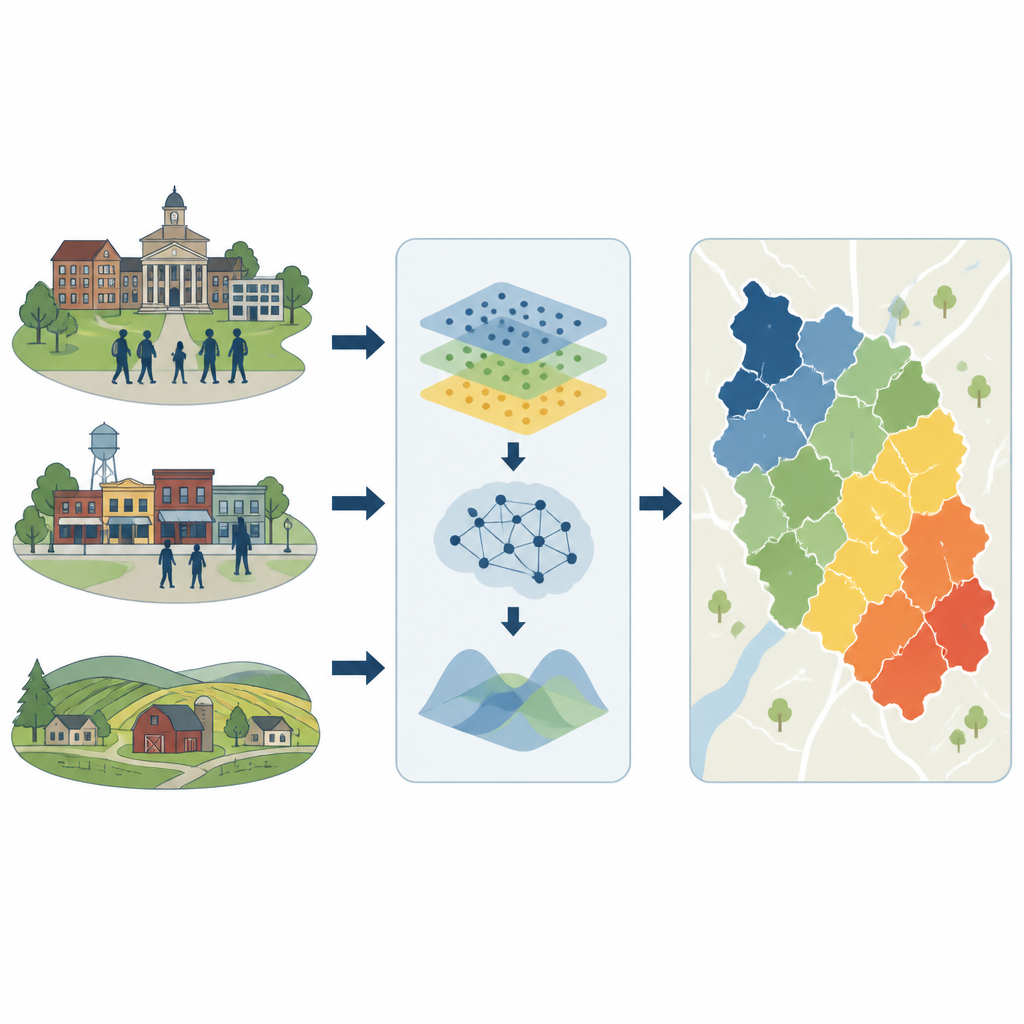
The researchers focus on the New River Valley, a mostly rural area with older residents, high rates of chronic illness, and limited health care access, but also two large universities with younger, more mobile populations and strict campus rules. This mix of small towns, farm country, and college hubs created a natural test bed to explore how age, health, income, politics, and policy combined to shape COVID-19 risks and protection.
Following the changing virus and vaccines
Using detailed testing and genetic data, the team traced how different variants moved through the region, from early strains to Alpha, Delta, and Omicron. At the same time, they tracked vaccinations by brand, dose, age group, and ZIP code. They found that campus areas with early vaccine mandates reached high levels of protection quickly and saw relatively low case and hospitalization rates, while surrounding rural zones depended more on infection to build immunity and experienced more severe illness, especially among older adults.
A person by person regional simulator
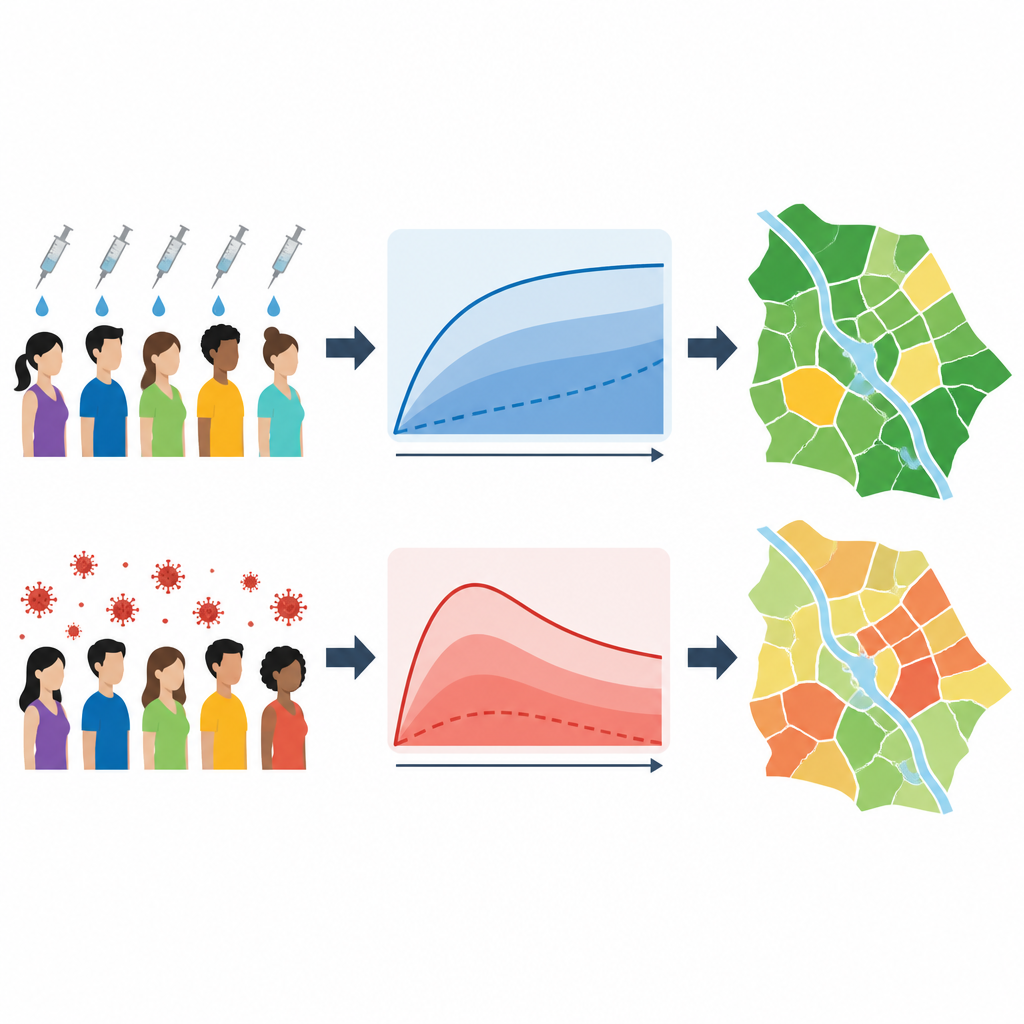
To make sense of these patterns, the authors built an individual-based computer model that represents every resident in 27 ZIP codes and follows them week by week for infections, recovery, vaccination, and waning protection. The simulator uses real case counts, vaccine uptake, and published estimates of how long immunity lasts after shots or illness. By running the model over 103 weeks, they generated curves showing how total immunity rose and fell in each age group and location, and separated the contributions of vaccination and infection.
Uneven immunity across age, health, and place
The model reveals that immunity did not build up evenly. Young adults in college towns gained strong vaccine-based protection early, while children and many older adults lagged. Rural ZIP codes with high burdens of conditions such as diabetes, high blood pressure, and kidney disease often saw more infection-driven immunity and later benefits from vaccines. By comparing immunity curves with local traits like income, education, rurality, and political leaning, the team found that these factors shifted in importance over time: health problems dominated early exposure, then education, income, and politics became key markers of who was getting vaccinated and when.
Clustering communities for smarter responses
Next, the researchers grouped ZIP codes by the shape of their immunity curves rather than by county lines. Using a pattern-matching technique, they identified clusters of places that shared similar timing and levels of protection. One college ZIP code stood out on its own, with a sharp rise in vaccine-based immunity and relatively little infection, reflecting strong mandates and monitoring. Other clusters gathered rural areas that lagged in vaccination or experienced delayed waves of infection. These clusters suggest that neighboring communities can follow very different paths, so blanket policies can miss pockets of vulnerability.
From one-size-fits-all to precision public health
Overall, the study shows that even within a single rural region, immunity against COVID-19 formed in highly uneven ways, shaped by age, chronic disease, behavior, and local rules. The authors argue that future pandemic planning should treat immunity patterns as signals for action, using cluster-based maps to spot places where protection is thin and then tailoring outreach, vaccination clinics, and surveillance accordingly. In other words, instead of assuming the same strategy works everywhere, public health agencies can use this type of modeling to guide “precision implementation” that closes local immunity gaps before the next wave hits.
Citation: Seref, O., Ceci, A., Helmick, M. et al. Precision implementation guided by simulation derived clusters of regional immunity. npj Digit. Public Health 1, 14 (2026). https://doi.org/10.1038/s44482-026-00019-5
Keywords: COVID-19 immunity, rural public health, vaccination patterns, simulation modeling, precision intervention